Ancient Martian Meteorite’s Earthly Journey Traced to Red Planet Highlands
Scientists have identified 13 potential landing sites on Mars that could be the origin of Teghaza 001, a remarkably ancient meteorite discovered on Earth. This significant find offers a glimpse into the early history of the Red Planet, with mineralogical and chemical analysis pointing towards the southern hemisphere’s highlands as the most likely source.
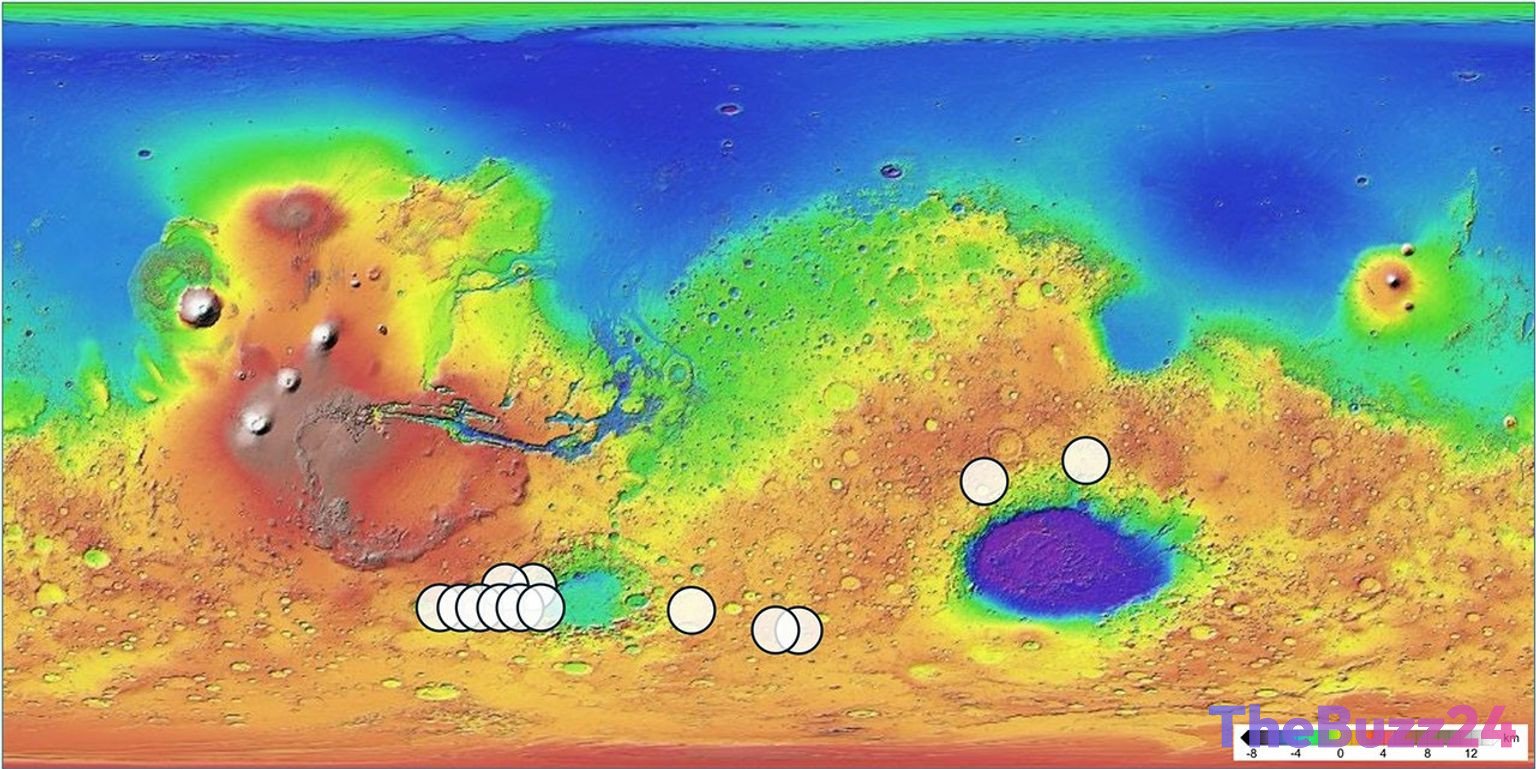
The meteorite, Teghaza 001, is considered one of the oldest Martian samples ever recovered. While pinpointing the exact location of its ejection from Mars is impossible, researchers have utilized sophisticated data from NASA missions to narrow down the possibilities. The base map used for this investigation was generated using data from the Mars Orbiter Laser Altimeter, part of the Mars Global Surveyor mission.
Further analysis involved data from NASA’s Mars Reconnaissance Orbiter. This allowed scientists to identify specific regions on the Martian surface, marked by white circles on the accompanying map, that exhibit mineral compositions and chemical signatures consistent with those found in Teghaza 001. These identified areas are predominantly located in the planet’s southern highlands, suggesting a dramatic geological event in that region may have launched this ancient rock into space millions of years ago.
Key Takeaways
- 13 potential origin sites on Mars identified for the ancient meteorite Teghaza 001.
- Analysis of Teghaza 001's mineralogy and chemistry suggests a link to Mars' southern hemisphere highlands.
- Data from NASA's Mars Global Surveyor and Mars Reconnaissance Orbiter missions were crucial for the study.
Editor’s Analysis & Impact
The identification of potential origins for the Teghaza 001 meteorite is a significant step in understanding Mars’ geological past. By correlating terrestrial meteorite samples with specific Martian surface features, scientists can refine models of planetary evolution and impact events. This research not only deepens our knowledge of Mars but also enhances our ability to interpret other extraterrestrial samples, potentially aiding future sample-return missions. The focus on ancient meteorites like Teghaza 001 provides invaluable insights into the conditions of early Mars, a period of great interest for astrobiology and the search for past life.
Frequently Asked Questions
Q: What is Teghaza 001?
A: Teghaza 001 is a Martian meteorite discovered on Earth, notable for being one of the most ancient samples of Martian rock ever found.
Q: How did scientists determine potential origins on Mars?
A: Scientists analyzed the mineralogy and chemistry of Teghaza 001 and compared it to data collected by NASA's Mars Global Surveyor and Mars Reconnaissance Orbiter missions, identifying areas on Mars with similar characteristics.
Q: Can scientists be certain of the meteorite's origin?
A: No, scientists can never know the exact origin of a Martian meteorite with absolute certainty, but the analysis provides strong evidence pointing to specific regions on Mars.
AI Disclosure: This article is based on verified data and official reports. Our Team and AI have cross-referenced every financial detail with primary sources to ensure total accuracy.
More from this Category