Sombrero Galaxy’s Hidden History: Deep Images Reveal Evidence of Ancient Collisions
The iconic Sombrero Galaxy, officially designated M104, has long captivated astronomers with its distinctive hat-like appearance, characterized by a prominent dark dust lane encircling its bright central bulge. However, recent deep-field imaging has unveiled previously unseen structures, offering a profound new perspective on this majestic celestial object and hinting at a tumultuous past.
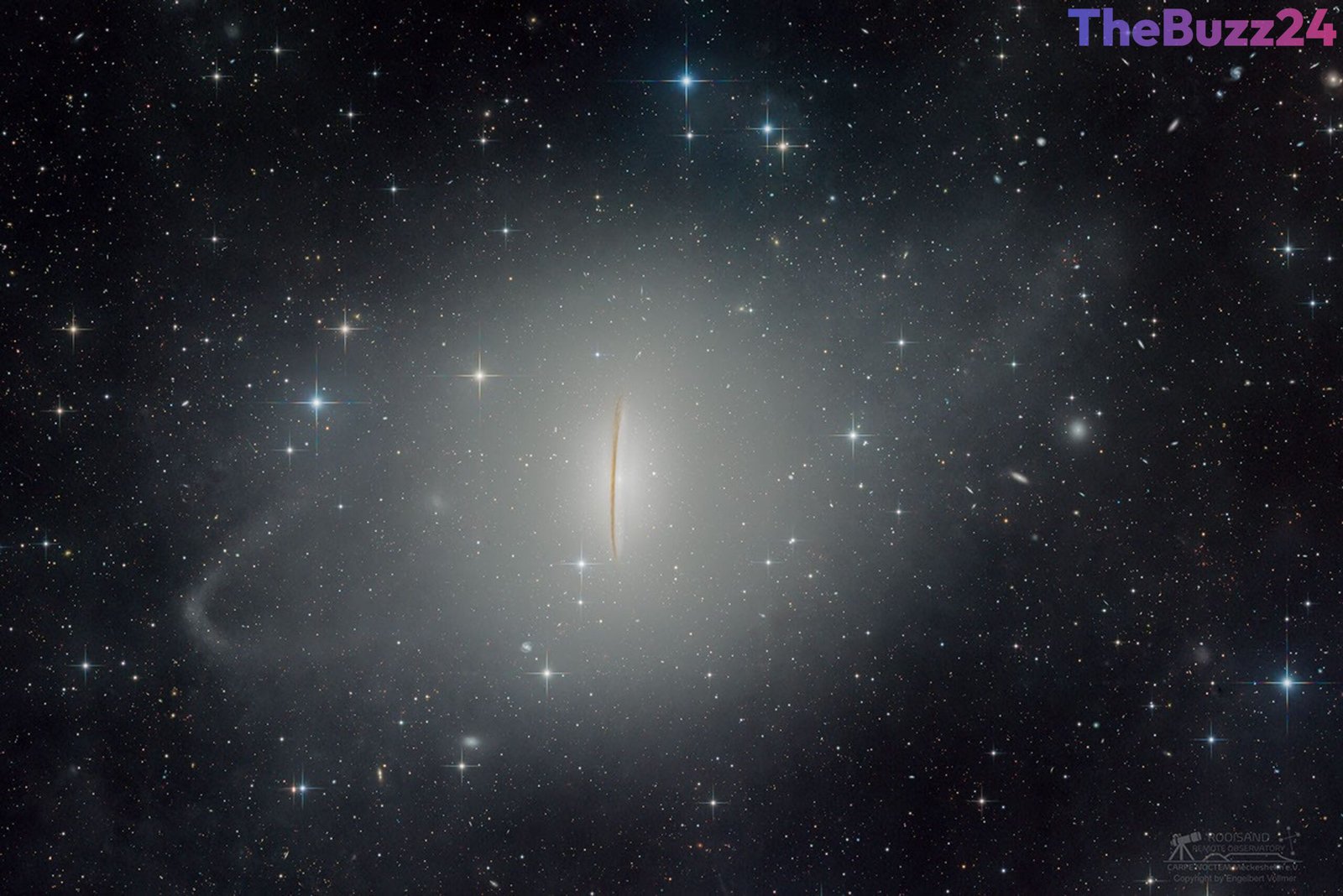
These extended exposures reveal a vast, luminous halo stretching far beyond the galaxy’s familiar disk. This ethereal glow is composed of countless unresolved stars, and within this stellar haze, astronomers have identified intricate features, including a striking diagonal ring and numerous delicate tidal streams. These newly observed structures are not merely aesthetic additions but serve as crucial evidence of the galaxy’s dynamic history.
The presence of these tidal streams and the unusual ring strongly suggests that M104 is the product of ancient, violent cosmic encounters. Such features are typically formed when smaller galaxies are gravitationally torn apart and absorbed by a larger galaxy, leaving behind trails of stars and gas. This discovery provides compelling insights into the processes of galactic evolution, illustrating how massive galaxies like the Sombrero are built up over billions of years through mergers and collisions. Located approximately 30 million light-years from Earth, the Sombrero Galaxy spans an impressive 150,000 light-years across, making these newly observed features truly colossal in scale. The detailed image capturing these phenomena was meticulously compiled over seven days in mid-2026 from a remote observatory in Namibia.
Key Takeaways
- Deep imaging of the Sombrero Galaxy (M104) has revealed extensive stellar halos and intricate tidal streams.
- These newly discovered structures, including a diagonal ring, indicate a violent past involving collisions and mergers with smaller galaxies.
- The findings provide crucial evidence for understanding galactic evolution and how large galaxies are formed.
Editor’s Analysis & Impact
This discovery significantly advances our understanding of galaxy formation and evolution. The identification of tidal streams and a diagonal ring within the Sombrero Galaxy’s halo provides direct observational evidence for the hierarchical model of galaxy growth, where larger galaxies are assembled through the accretion and merger of smaller ones. This insight is vital for refining cosmological simulations and theoretical models of the universe’s development. Future research will likely focus on analyzing the kinematics and composition of these streams to reconstruct the precise history of M104’s mergers, potentially revealing the types and sizes of the galaxies it consumed. This also underscores the power of long-exposure imaging in uncovering hidden details of the cosmos, pushing the boundaries of observational astronomy.
Frequently Asked Questions
Q: What are tidal streams in galaxies?
A: Tidal streams are long, thin trails of stars and gas that are pulled away from a smaller galaxy as it is gravitationally disrupted by a larger galaxy during a close encounter or merger. They are essentially the cosmic debris left behind from galactic cannibalism.
Q: Why is M104 called the Sombrero Galaxy?
A: M104 earned its nickname, the Sombrero Galaxy, due to its distinctive appearance in optical telescopes. It features a bright, prominent central bulge and a thick, dark lane of dust that encircles its disk, resembling the brim of a wide-brimmed hat.
Q: How far away is the Sombrero Galaxy?
A: The Sombrero Galaxy (M104) is located approximately 30 million light-years from Earth. Its immense size spans about 150,000 light-years across.
AI Disclosure: This article is based on verified data and official reports. Our Team and AI have cross-referenced every financial detail with primary sources to ensure total accuracy.
More from this Category