Unlocking Structural Dynamics: How Complex Modes Emerge in Lightly Damped Systems
In traditional structural engineering and modal analysis, lightly damped linear systems have long been treated under the assumption that they exhibit purely real mode shapes. When complex mode shapes appear during physical testing, engineers often attribute them to nonlinear behavior, significant damping mechanisms, or faulty experimental data. However, breakthrough insights into structural dynamics reveal that complex modes can naturally arise even when a structure features exceptionally low damping levels, challenging standard testing interpretations.
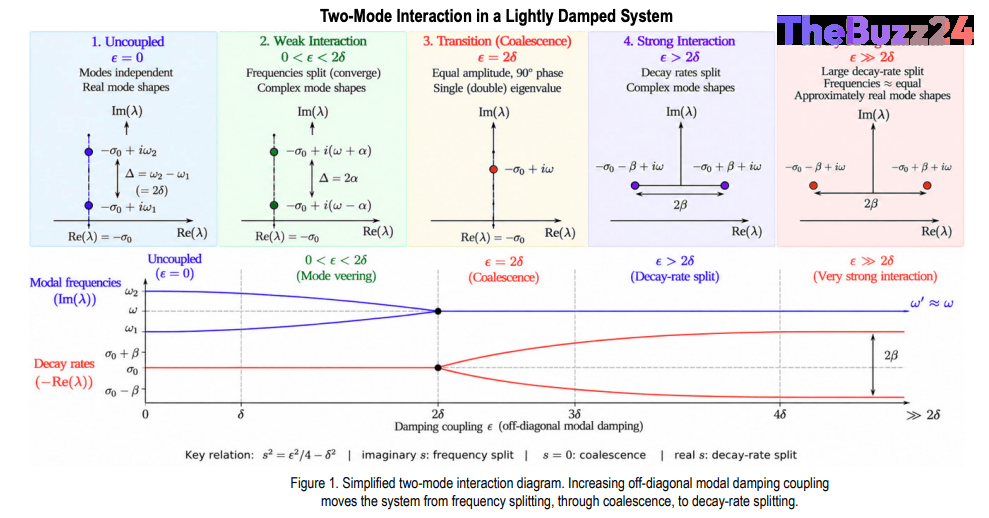
The phenomenon occurs primarily when two structural modes are situated closely in frequency and experience coupling through nonproportional damping. In modal coordinate systems, this interaction introduces off-diagonal coupling terms. When this coupling becomes significant relative to the baseline frequency separation between the two modes, the modal frequencies begin to converge toward one another, causing the corresponding mode shapes to gain substantial imaginary components and complex phase characteristics.
As the strength of this interaction reaches a critical threshold, the two distinct modal frequencies completely coalesce. Beyond this critical transition point, the frequencies remain virtually identical, but their decay rates abruptly split apart. At significantly higher interaction levels, the mode shapes transition back toward becoming approximately real, though representing entirely new linear combinations of the initial uncoupled modes. This behavior provides a coherent physical explanation for classical phenomena such as mode veering, eigenvalue coalescence, and decay-rate bifurcations.
Developed through research connected to the Langley Research Center, a reduced perturbation framework now offers practical guidance for interpreting dynamic test data. By analyzing identified complex poles and mode-shape phase relationships, engineers can quantify the interaction parameter and determine proximity to transition boundaries. Rather than re-running tests or assuming measurement failures, structural analysts in aerospace, automotive, and civil engineering can now accurately account for modal interaction, drastically enhancing the fidelity of predictive vibration models.
Key Takeaways
- Complex mode shapes can manifest naturally in lightly damped linear structures without requiring high damping or nonlinear behavior.
- The convergence of closely spaced modal frequencies causes frequency coalescence followed by a distinct horizontal separation in modal decay rates.
- A reduced perturbation framework allows structural engineers to bridge analytical predictions and physical vibration testing to identify true modal coupling.
Editor’s Analysis & Impact
The realization that complex mode shapes can naturally develop in low-damping environments fundamentally reshapes how aerospace and structural engineers diagnose vibration test data. For decades, discrepancies between real-mode analytical models and complex-mode test outputs have driven costly diagnostic investigations, often wrongly attributed to sensor defects, loose boundary fixtures, or unmodeled nonlinearities. By formalizing the mathematics behind closely spaced mode interactions, this analytical framework saves critical development time during hardware qualification for spaceflight systems and lightweight commercial structures. Looking ahead, integrating these perturbation formulations into automated modal identification software will streamline certification protocols and prevent over-engineering of dynamic damping systems.
Frequently Asked Questions
Q: What causes complex mode shapes to appear in structures with minimal damping?
A: Complex modes occur when two natural frequencies are closely spaced and become coupled via nonproportional damping. The ratio of this coupling to the half-frequency separation dictates the emergence of complex modal phase characteristics.
Q: Does seeing a complex mode shape mean modal testing data is flawed?
A: No. While complex modes were historically suspected of being caused by measurement noise or experimental errors, research demonstrates they are often a legitimate physical outcome of coupled modes in linear systems.
Q: What happens after modal frequencies coalesce?
A: Once the frequencies converge at a critical interaction level, they remain nearly identical while their modal decay rates diverge horizontally in the complex plane, eventually realigning the mode shapes into new linear combinations.
AI Disclosure: This article is based on verified data and official reports. Our Team and AI have cross-referenced every financial detail with primary sources to ensure total accuracy.
More from this Category