Rare ‘Reverse Rainbow’ Illusion Captivates Observer in Italian Sunset
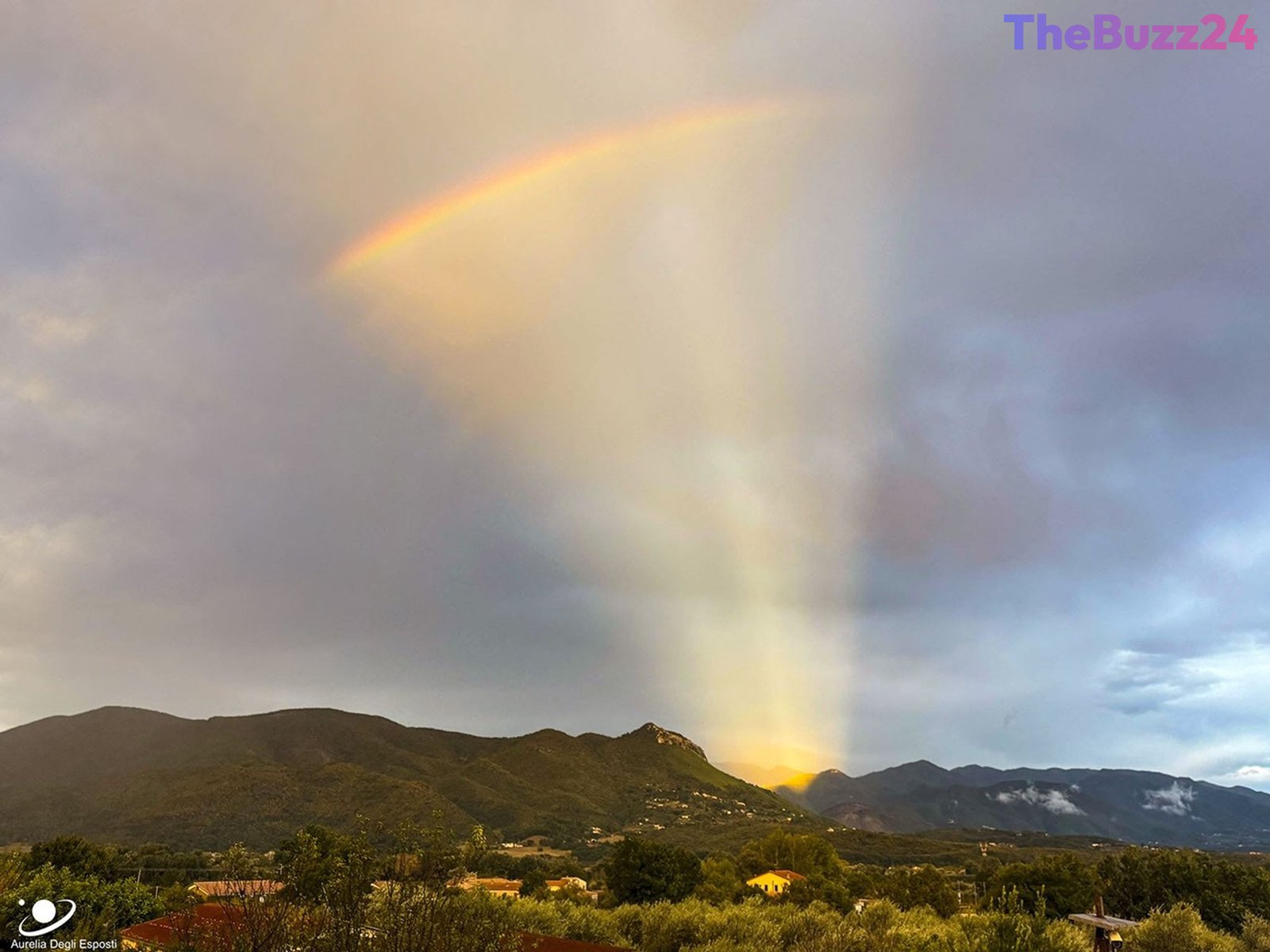
A breathtaking and scientifically intriguing atmospheric phenomenon, dubbed an “anticrepuscular rainbow fan,” recently captivated an observer in Presenzano, Italy. Captured last week during sunset, the spectacle presented a partial rainbow that appeared to defy conventional understanding by seemingly originating from the same direction as the setting sun.
Typically, rainbows form when sunlight is refracted and reflected by water droplets in the atmosphere, always appearing opposite the sun’s position relative to the observer. However, this particular display, photographed by Aurelia Degli Esposti while she was hanging laundry, showed a vibrant arc seemingly in front of the sun, creating a striking optical illusion.
Experts explain this rare occurrence as a manifestation of anticrepuscular rays. These rays are essentially crepuscular rays (sunbeams) that travel across the entire sky from the sun’s position, appearing to converge at the antisolar point – the point directly opposite the sun. In this instance, gaps in the clouds near the setting sun allowed these rays to traverse the sky, creating the illusion that the light source for the rainbow was ahead, rather than behind, the viewer. The combination of these rays with the conditions necessary for a partial rainbow resulted in the stunning “reverse rainbow” effect.
Key Takeaways
- An unusual "anticrepuscular rainbow fan" was recently observed in Presenzano, Italy, creating a rare optical illusion.
- This phenomenon makes a partial rainbow appear to be in the same direction as the setting sun, contrary to how rainbows typically form.
- The effect is caused by anticrepuscular rays, where sunbeams appear to converge at the antisolar point, combined with specific atmospheric conditions.
Editor’s Analysis & Impact
Minimal direct market impact, but this event highlights the growing role of citizen science and accessible technology, like smartphone cameras, in documenting rare natural phenomena. While not directly influencing specific markets, it could indirectly boost interest in atmospheric optics, photography, and even local tourism for unique natural sights. The future outlook suggests that as more people carry high-quality cameras, the chances of capturing and sharing such fleeting atmospheric wonders will increase, enriching our collective understanding of Earth’s complex atmosphere. Broader implications include reinforcing the idea that even seemingly common natural occurrences can present surprising variations, underscoring the beauty and intricate physics of light interaction within our environment.
Frequently Asked Questions
Q: What is an anticrepuscular rainbow fan?
A: It's a rare atmospheric optical phenomenon where a partial rainbow appears to be in the same direction as the sun, an illusion created by anticrepuscular rays converging at the antisolar point.
Q: How do anticrepuscular rays differ from regular crepuscular rays?
A: Crepuscular rays are sunbeams that appear to diverge from the sun's position, often seen through gaps in clouds. Anticrepuscular rays are the same sunbeams viewed from the opposite side of the sky, appearing to converge at the antisolar point.
Q: Why is this considered a 'reverse rainbow'?
A: Rainbows typically form when the sun is behind the observer. This phenomenon creates the illusion that the sun is in front, making the rainbow appear to be in the 'wrong' direction relative to the sun's apparent position.
AI Disclosure: This article is based on verified data and official reports. Our Team and AI have cross-referenced every financial detail with primary sources to ensure total accuracy.
More from this Category