Mars Autumn Unveils High-Altitude Clouds as Curiosity Rover Continues Scientific Drills
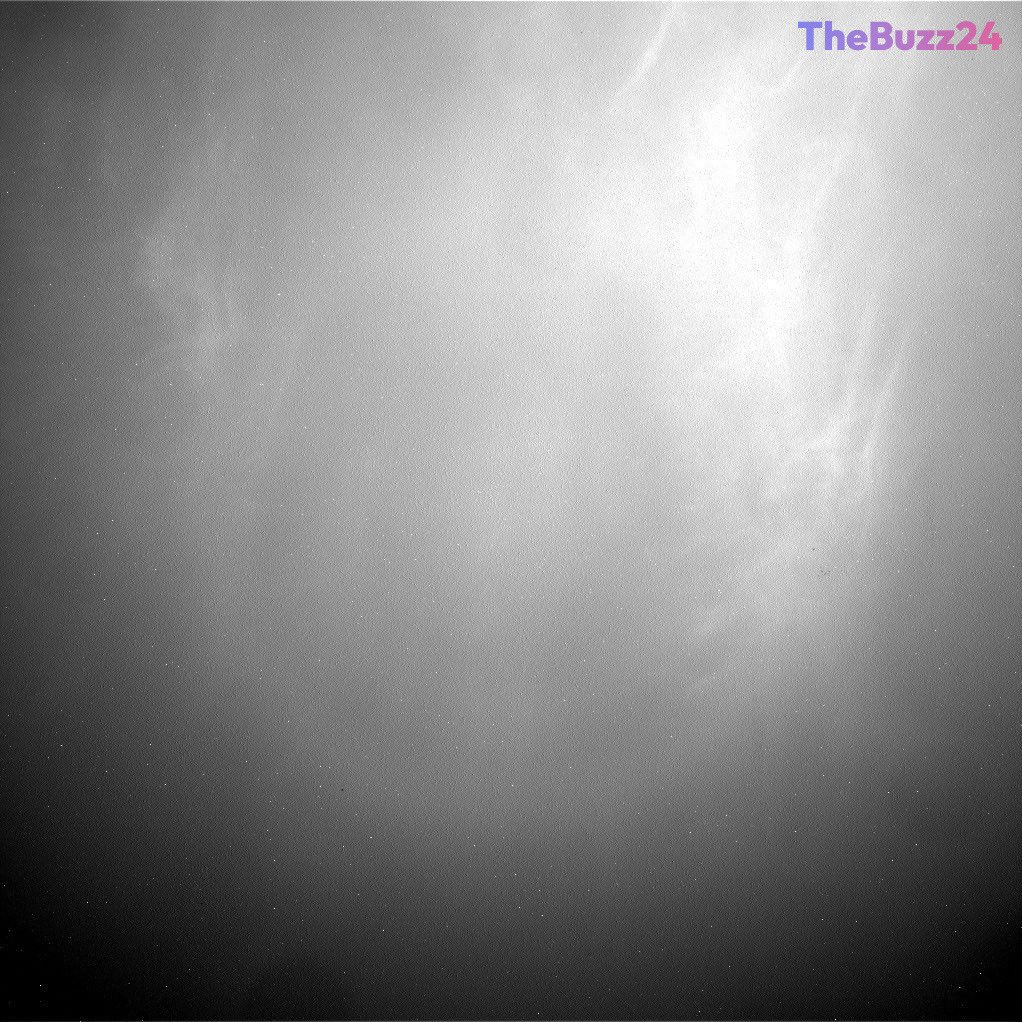
NASA’s Curiosity rover recently captured striking images of high-altitude, wispy clouds drifting across the Martian sky above Gale Crater. These observations, part of a “zenith movie” taken directly overhead shortly before sunset on October 7, 2026 (Martian day 5037 of the mission), mark the onset of autumn in the southern equatorial region of Mars. The new Martian year, the 39th since tracking began, commenced in late September on Earth, ushering in a period of distinct atmospheric changes.
Amidst these celestial displays, Curiosity has been diligently concluding its drilling operations at a site dubbed “Basque Lakes.” Following successful initial lab analyses, the Sample Analysis at Mars (SAM) instrument team opted for an additional Gas Chromatograph/Mass Spectrometry (GCMS) experiment, a power-intensive but crucial investigation. The mission plan for the week also incorporated extensive remote-sensing activities using the Mastcam and ChemCam instruments, alongside close-up contact science on the drill tailings—the residual rock and mineral fragments from the sampling process.
With the drilling campaign at Basque Lakes nearing completion, the rover is preparing for a drive towards the “Chiu Chiu” region, an area previously noted for its intriguing crystal formations. Concurrently, the Martian atmosphere continues its seasonal transformation. Autumn in Gale Crater is characterized by the return of high-altitude twilight clouds, which become beautifully illuminated by the low angle of the setting sun. While many Martian clouds are too faint to be seen by the rover’s cameras or human eyes, these twilight clouds are sufficiently bright to be captured by Curiosity’s Navigation Cameras, offering valuable insights into the planet’s atmospheric dynamics.
Key Takeaways
- NASA's Curiosity rover observed high-altitude twilight clouds over Gale Crater, signaling the start of autumn in the region.
- The rover concluded drilling operations at "Basque Lakes," conducting advanced chemical analysis and remote sensing.
- Curiosity is preparing to relocate to the "Chiu Chiu" region, known for its unique crystal formations, while continuing to monitor seasonal atmospheric changes.
Editor’s Analysis & Impact
The ongoing observations by NASA’s Curiosity rover, particularly the detailed atmospheric studies and geological sampling, underscore the critical role of long-duration planetary missions. The data gathered from Gale Crater, including the seasonal cloud patterns and subsurface material composition, are invaluable for understanding Mars’ past climate, potential for habitability, and geological evolution. This continuous stream of information not only advances our scientific knowledge but also informs future human and robotic exploration strategies. The ability to conduct complex experiments like GCMS and target specific geological features demonstrates the rover’s enduring capability and the ingenuity of the mission teams, paving the way for more ambitious missions to the Red Planet.
Frequently Asked Questions
Q: What is a "Martian year" and why is it significant for Curiosity's mission?
A: A Martian year is the time it takes Mars to orbit the Sun, which is approximately 687 Earth days. The start of a new Martian year (Mars year 39) and the change of seasons are significant because they influence atmospheric conditions, cloud formations, and the types of scientific observations Curiosity can make, providing crucial data on Mars' climate cycles.
Q: What is the significance of the "Basque Lakes" and "Chiu Chiu" regions?
A: "Basque Lakes" is a recent drilling site where Curiosity collected samples for detailed chemical analysis, helping scientists understand the geological composition of the area. The "Chiu Chiu" region is a future destination known for its "neat crystal forms," which likely hold clues about past water activity and mineral formation on Mars.
Q: How does Curiosity observe clouds on Mars?
A: Curiosity uses its Navigation Cameras (Navcam) to capture images of the Martian sky, including "zenith movies" that look directly overhead. While many Martian clouds are "suboptical" (too thin to be seen), high-altitude twilight clouds, illuminated by the low sun angle during autumn, are bright enough for the rover's cameras to detect and study.
AI Disclosure: This article is based on verified data and official reports. Our Team and AI have cross-referenced every financial detail with primary sources to ensure total accuracy.
More from this Category