NASA Study Reveals Human Footprint Dramatically Altering Earth’s Water Cycle
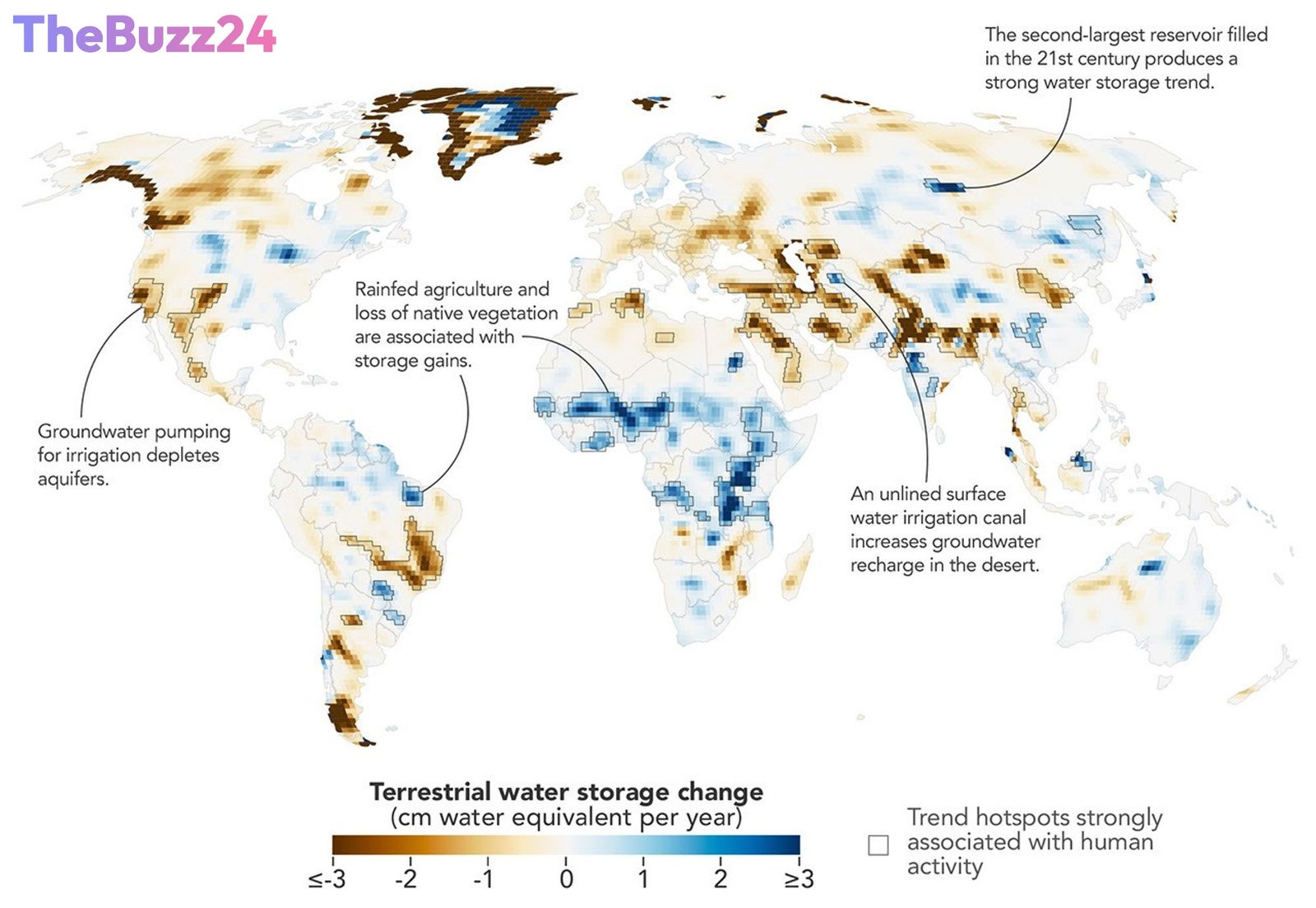
A groundbreaking NASA study, utilizing over two decades of satellite data, has unveiled the profound and widespread impact of human activities on Earth’s terrestrial water storage. Researchers analyzed subtle gravitational shifts detected by the GRACE and GRACE-FO missions, revealing distinct patterns of change in lakes, rivers, soil, and groundwater across the globe. The findings highlight 40 specific regions where human interventions, such as extensive irrigation, reservoir construction, and land-use modifications, have significantly influenced water availability, often overshadowing the effects of natural climate variability.
The study’s advanced spatial resolution, achieved by combining years of satellite passes, allowed scientists to pinpoint human signatures with unprecedented detail. In several critical areas, including California’s Central Valley and northern India, the depletion of groundwater due to agricultural demands has led to substantial declines in water storage. This analysis indicates that groundwater pumping in northern India is occurring at a faster rate than previously estimated, with retreating Himalayan glaciers contributing only a minor fraction to the overall water loss.
Conversely, the research also identified regions where human activities have led to increased water storage. In parts of sub-Saharan Africa and northern Brazil, the expansion of certain types of agriculture, such as rainfed cropland and soybean fields, has been linked to rising water tables. This phenomenon is attributed to factors like efficient water use by specific crops and traditional farming methods that aid in replenishing shallow aquifers. Furthermore, the study successfully mapped the impact of large-scale water management projects, such as Russia’s Boguchany Reservoir and Turkmenistan’s Karakum Canal, demonstrating the capacity of satellite gravimetry to monitor even remote hydrologic engineering efforts.
Lead author Mary Michael O’Neill emphasized the study’s ability to disentangle the complex interplay between human actions and climate in shaping water resources. The enhanced detail provided by this research offers crucial insights for water management strategies and a clearer understanding of how human interventions are reshaping the planet’s vital water systems. Future research aims to further refine these observations, focusing on downstream effects and the temporal evolution of these trends in response to events like droughts and policy changes.
Key Takeaways
- Human activities, including irrigation and reservoir construction, are significantly altering terrestrial water storage globally, with 40 regions showing strong correlations.
- Groundwater depletion due to intensive agriculture is a major driver of water storage decline in areas like California's Central Valley and northern India.
- Satellite gravimetry data from NASA's GRACE missions provides unprecedented detail in mapping these human-induced hydrological changes.
Editor’s Analysis & Impact
This NASA study underscores a critical, yet often underappreciated, aspect of climate change and resource management: the direct and significant human impact on the global water cycle. The ability to precisely map these alterations using satellite gravimetry offers a powerful tool for policymakers and environmental scientists. It highlights the urgent need for sustainable water management practices, particularly in regions heavily reliant on groundwater. The findings also suggest that while climate change poses a threat, human interventions can exacerbate or, in some cases, mitigate water storage trends. This research provides a vital baseline for future monitoring and intervention strategies, emphasizing the interconnectedness of human actions and planetary systems.
Frequently Asked Questions
Q: What are terrestrial water storage trends?
A: Terrestrial water storage trends refer to the long-term changes in the total amount of water held on land, encompassing surface water (lakes, rivers), soil moisture, groundwater, and ice. NASA's GRACE and GRACE-FO missions measure these changes by detecting subtle variations in Earth's gravity field caused by shifts in water mass.
Q: How does NASA use gravity to measure water?
A: NASA's GRACE and GRACE-FO satellites fly in tandem, measuring the distance between them. As they pass over areas with greater mass (like large bodies of water or underground aquifers), the gravitational pull slightly alters their distance. By precisely tracking these minute changes, scientists can infer where water has been gained or lost over time.
Q: Are human impacts on water storage uniform across the globe?
A: No, the study identified specific regions where human impacts are particularly strong. While some areas experience significant water depletion due to groundwater pumping for irrigation, others show increases in water storage due to different agricultural practices or water diversion projects. The impact varies greatly depending on local activities and geography.
AI Disclosure: This article is based on verified data and official reports. Our Team and AI have cross-referenced every financial detail with primary sources to ensure total accuracy.
More from this Category