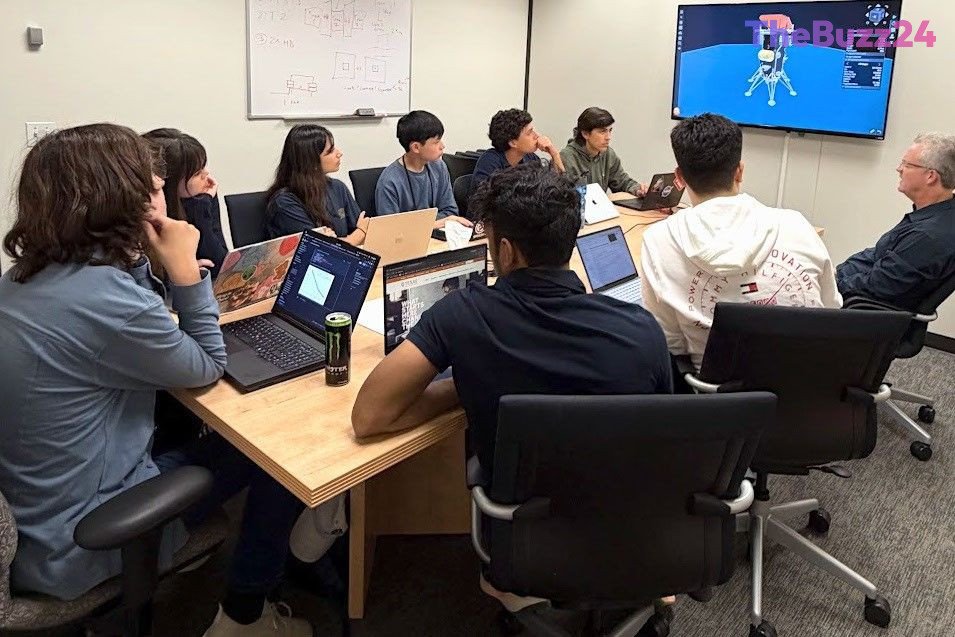
High School Interns Advance Lunar Exploration Tech Through Real-World Mission Analysis
A group of high school students participating in the NASA STEM Enhancement in Earth Science (SEES) internship program has achieved a significant milestone in aerospace research. Working as the Mission Architecture Tool for Research, Integration, and eXploration (MATRIX) team, these students developed sophisticated computational models to address one of the most persistent challenges in space travel: measuring propellant mass in microgravity. By utilizing Modal Propellant Gauging (MPG)—a technique that uses acoustic responses to estimate fuel levels—the team provided actionable insights for the upcoming Intuitive Machines IM-3 lunar mission.
Operating under the mentorship of Dr. Kevin Crosby, the team reconstructed complex flight trajectories using publicly available data from previous missions. By applying computational fluid dynamics and Monte Carlo simulations, the interns successfully identified optimal windows for propellant measurement during critical mission phases, such as Lunar Orbit Insertion and Powered Descent. Their work was so precise that it was presented directly to the Intuitive Machines propulsion engineering team, demonstrating that high-level analytical research can be effectively conducted using open-source mission data.
The project highlights the growing importance of practical, mission-focused education for the next generation of aerospace professionals. By tackling the same technical hurdles faced by industry experts, the MATRIX team contributed to the broader understanding of propellant management, a vital capability for future in-space refueling and long-term lunar exploration. The students’ research has since been showcased at major scientific symposiums, earning praise for its professional-grade sophistication and technical rigor.
Key Takeaways
- High school interns successfully modeled propellant gauging techniques for the upcoming Intuitive Machines IM-3 lunar mission.
- The team utilized public mission data and advanced computational simulations to identify reliable fuel measurement windows in microgravity.
- The research provides critical data for future lunar surface operations and in-space refueling technologies.
Editor’s Analysis & Impact
The success of the MATRIX team underscores a pivotal shift in aerospace education and development: the democratization of mission-critical data. By enabling students to perform high-level analysis on active lunar missions, programs like SEES are effectively bridging the gap between theoretical classroom learning and the practical demands of the space industry. From a market perspective, the ability to accurately gauge propellant in microgravity is a ‘holy grail’ for the burgeoning commercial space economy. As companies move toward sustained lunar presence and orbital refueling, the cost-efficiency and reliability of these gauging methods will be essential for mission success. This project demonstrates that the next generation of engineers is already prepared to contribute to the complex logistics of the lunar economy, signaling a robust future for private-public space partnerships.
Frequently Asked Questions
Q: What is Modal Propellant Gauging (MPG)?
A: MPG is a technology that uses the acoustic response of propellant tanks to estimate the amount of fuel remaining inside, which is particularly useful in microgravity where liquid fuel does not settle at the bottom of a tank.
Q: How did the students conduct their research without access to private mission data?
A: The team relied on publicly available data, including mission trajectories from previous Intuitive Machines flights and published flight records, to build their own reconstruction algorithms and simulation models.
AI Disclosure: This article is based on verified data and official reports. Our Team and AI have cross-referenced every financial detail with primary sources to ensure total accuracy.
More from this Category