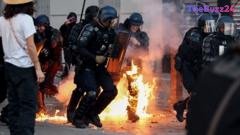
France Launches Attempted Murder Probe Amid Escalating Protest Violence
French authorities have initiated an attempted murder investigation following a violent incident where a police officer was struck by a petrol bomb during recent street demonstrations. The officer sustained burns to his ankle and minor hand injuries in Paris, an event that has sparked widespread outrage and intensified concerns over the escalating nature of public unrest.
The attack occurred amidst weeks of protests across France, primarily driven by youth demanding action on the rising cost of living and deficiencies in public services, particularly schools. Interior Minister Laurent Nuñez condemned the act, labeling the throwing of a Molotov cocktail at law enforcement as an “attempted murder” and affirming efforts to apprehend those responsible.
While hundreds of thousands participated in largely peaceful demonstrations nationwide, clashes have also been reported, leading to significant police deployments and the use of tear gas in some cities. Over 770 arrests were made on a recent Saturday, though officials noted no arrests had yet been made specifically for the petrol bomb attack. The injured officer, a member of the National Gendarmerie, described the incendiary device as “particularly sophisticated” with a “far greater burning capacity than a standard Molotov cocktail,” distinguishing the perpetrators from typical protesters.
The unrest has also seen numerous protesters injured, with organizers like the Gilets Jaunes reporting serious wounds, some attributed to “grenades.” While France temporarily suspended one type of stun grenade after a teenager’s injury, reports indicate a different model continues to be used. This wave of demonstrations, focused on socio-economic grievances, mirrors similar youth-led protests observed in other European nations like Germany and Italy.
Key Takeaways
- French prosecutors have launched an attempted murder investigation after a police officer was injured by a petrol bomb during protests in Paris.
- The incident occurred amid weeks of youth-led demonstrations across France, driven by concerns over the cost of living and public services.
- Both police and protesters have reported injuries, with authorities condemning the violence and deploying significant law enforcement resources.
Editor’s Analysis & Impact
The attempted murder investigation following the petrol bomb attack on a police officer underscores a worrying escalation in France’s ongoing social unrest. While not directly impacting specific markets, sustained instability and violence can deter tourism and foreign investment, creating a climate of uncertainty for local businesses. The future outlook suggests continued challenges for the French government, which must navigate public demands for improved living conditions and public services while maintaining order. The distinction drawn by authorities between legitimate protesters and ‘hostile individuals’ could pave the way for more stringent policing tactics, potentially exacerbating tensions. This situation reflects a broader European trend of youth-led protests driven by socio-economic grievances, signaling a critical period for governments to address systemic issues and reconsider their approaches to public dissent and law enforcement.
Frequently Asked Questions
Q: What prompted the recent protests in France?
A: The protests are primarily youth-led and have been ongoing for weeks, driven by demands for action on the high cost of living and concerns over poor public services, particularly in schools.
Q: What was the specific incident that led to the attempted murder investigation?
A: French prosecutors launched the investigation after a police officer in Paris was struck by a petrol bomb during demonstrations, sustaining burns to his ankle and minor hand injuries.
Q: Are similar protests occurring elsewhere in Europe?
A: Yes, the article notes that similar youth-led protests, often linked to cost-of-living issues and public services, have also taken place in other European countries like Germany and Italy.
AI Disclosure: This article is based on verified data and official reports. Our Team and AI have cross-referenced every financial detail with primary sources to ensure total accuracy.
More from this Category