The Invisible Force Shaping Ethereum: Decoding the MEV Economy
The Ethereum network operates on a sophisticated and often opaque economic layer known as Maximum Extractable Value (MEV). Before transactions are finalized on the blockchain, they reside in a public staging area called the mempool. This transparency allows specialized actors to analyze pending transactions and strategically reorder, include, or exclude them to capture profit, a practice that mirrors the high-frequency trading strategies seen in traditional financial markets.
This ecosystem is driven by a hierarchy of participants, primarily ‘searchers’ and ‘block builders.’ Searchers scan decentralized finance protocols for profitable opportunities like arbitrage, which can contribute to market efficiency. However, this same mechanism facilitates predatory tactics such as ‘sandwich attacks,’ where automated bots manipulate asset prices to the detriment of everyday users. These searchers bundle their transaction instructions and forward them to block builders, who are responsible for constructing the final blocks submitted to the network.
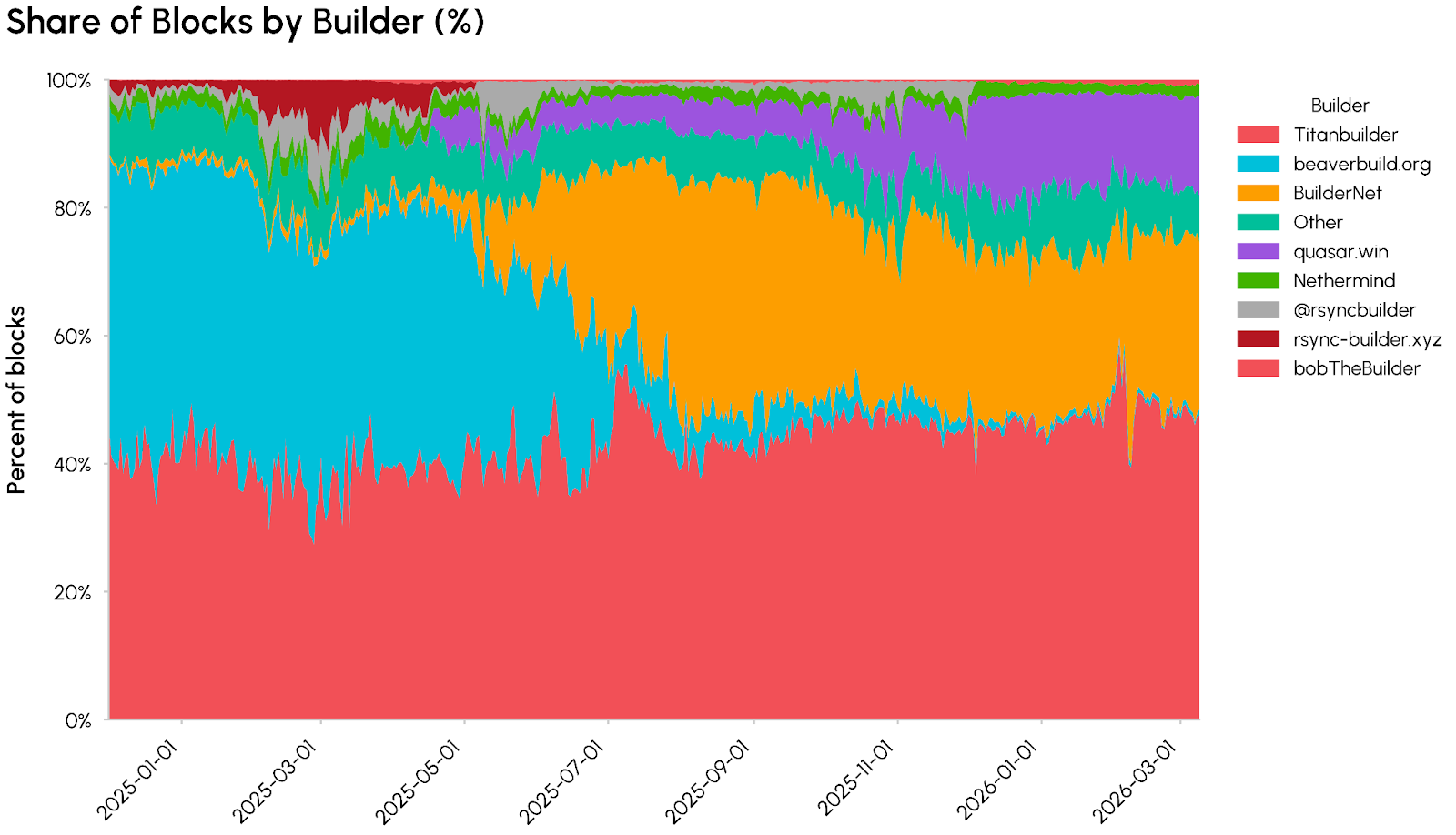
Under the current Proposer-Builder Separation (PBS) framework, validators prioritize blocks that offer the highest financial return. This competitive structure has inadvertently led to significant market concentration, as a small number of dominant builders now control a substantial portion of block production. This consolidation creates a self-reinforcing cycle where successful builders attract more transaction flow, making it increasingly difficult for new competitors to enter the space.
This centralization of power has raised alarms regarding the potential for transaction censorship and the long-term integrity of the network. While developers are actively researching solutions to decentralize the block-building process and shield users from malicious MEV, the current economic incentives remain a deeply embedded and controversial aspect of Ethereum’s infrastructure.
Key Takeaways
- Maximum Extractable Value (MEV) allows participants to profit from the strategic ordering of transactions within Ethereum blocks.
- The current block-building process has become highly centralized, with a few dominant entities controlling the majority of transaction flow.
- While some MEV activities improve market efficiency, others like sandwich attacks can negatively impact individual users.
Editor’s Analysis & Impact
The MEV ecosystem represents a double-edged sword for Ethereum. On one hand, it facilitates efficient market operations and provides necessary liquidity for decentralized finance. On the other, the resulting centralization of block building poses a structural risk to the network’s ethos of decentralization. The ‘flywheel effect’—where dominant builders gain more influence through higher bids—suggests that without significant protocol-level interventions, the barrier to entry for block building will continue to rise. Future developments, such as encrypted mempools or decentralized builder networks, will be critical in determining whether Ethereum can mitigate these risks while maintaining its economic efficiency. Investors and developers should monitor these shifts closely, as they will dictate the future landscape of transaction fairness and network censorship resistance.
Frequently Asked Questions
Q: What is a sandwich attack in the context of Ethereum?
A: A sandwich attack occurs when a bot detects a pending transaction on a decentralized exchange and places its own trades immediately before and after the user's transaction to manipulate the price and profit from the user's trade.
Q: Why is the centralization of block builders a concern?
A: Centralization is a concern because it creates a single point of failure or control, potentially allowing a small group of builders to censor specific transactions or manipulate the network in ways that favor their own profits over the interests of the broader user base.
AI Disclosure: This article is based on verified data and official reports. Our Team and AI have cross-referenced every financial detail with primary sources to ensure total accuracy.
More from this Category