DeFi Liquidity Crisis: $50 Million Trade Vanishes in Automated Trading Blunder
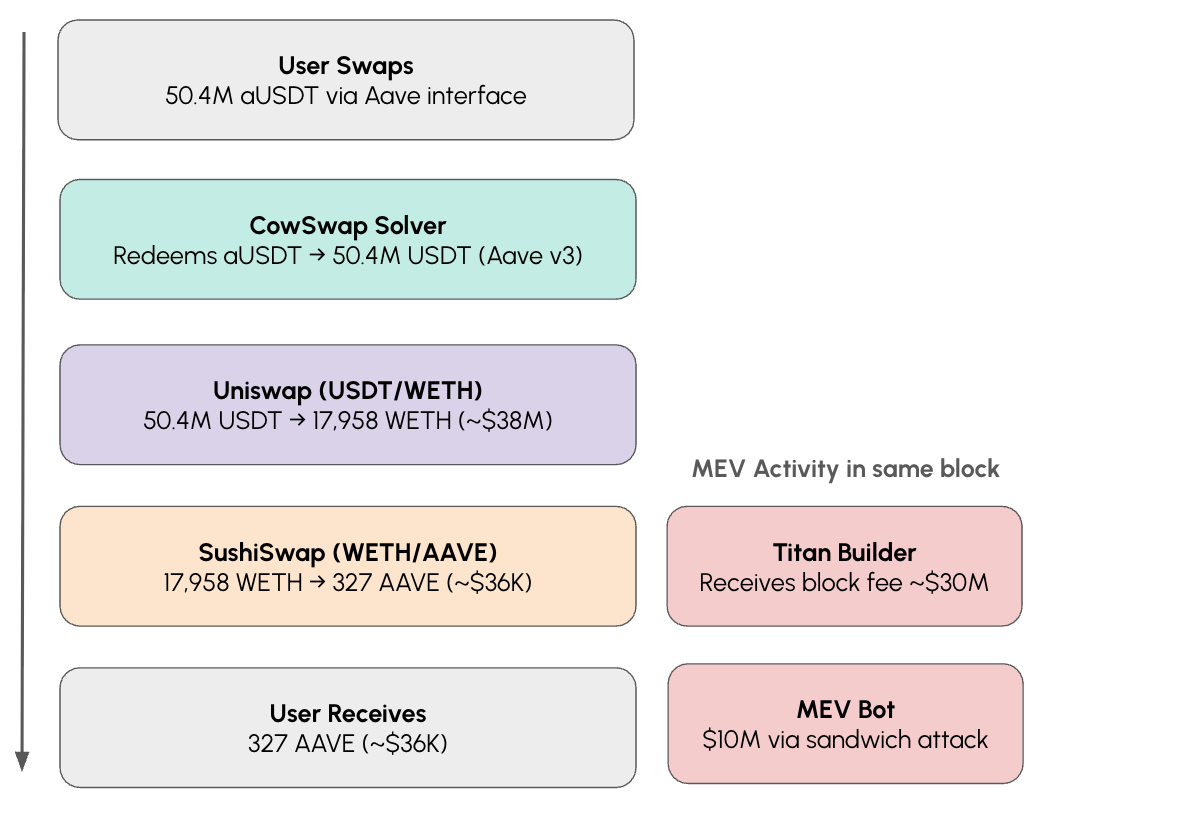
A significant decentralized finance (DeFi) transaction on the Ethereum network has resulted in a staggering $50 million loss, underscoring the extreme volatility and risks associated with large-scale automated trading. The user, attempting to swap a substantial position of interest-bearing Tether (aEthUSDT), saw their capital dwindle to a mere $36,000 in AAVE tokens following a series of execution failures and predatory market activity.
The trade, initiated through the Aave interface and routed via the CoW Protocol, was intended to optimize execution across decentralized exchanges. However, the automated routing system directed the massive order into a SushiSwap WETH/AAVE pool that held only $75,000 in liquidity. Because the trade size dwarfed the available pool depth, the transaction triggered extreme price slippage, effectively wiping out the majority of the user’s assets in a single execution.
Compounding the disaster, the transaction fell victim to a sophisticated Maximal Extractable Value (MEV) sandwich attack. An automated bot identified the impending trade and manipulated the price of AAVE before the user’s order was processed. This predatory maneuver allowed the bot to extract roughly $10 million in profit, while approximately $27 million was diverted to the block builder as a fee. This incident highlights a critical vulnerability in current DeFi infrastructure, where automated routing systems often fail to account for shallow liquidity pools when handling high-value transactions.
Key Takeaways
- A $50 million DeFi trade was decimated due to extreme slippage caused by routing a large order into a low-liquidity pool.
- The transaction was targeted by an MEV sandwich attack, resulting in $10 million in bot profits and $27 million in block-builder fees.
- Industry experts are calling for better guardrails, such as automated liquidity checks and the use of TWAP strategies for large orders.
Editor’s Analysis & Impact
This incident serves as a stark reminder of the ‘wild west’ nature of decentralized finance. While DeFi protocols offer unprecedented access to financial instruments, the lack of institutional-grade execution safeguards remains a significant barrier to entry for large-scale capital. The event demonstrates that even when using reputable aggregators, the underlying mechanics of automated market makers (AMMs) can be weaponized against users through MEV bots. Moving forward, the industry must prioritize the development of ‘smart’ execution layers that can detect liquidity depth in real-time and prevent orders from executing in pools that cannot support them. Without these guardrails, high-net-worth participants will likely remain hesitant to engage with on-chain liquidity, potentially stifling the growth of the broader DeFi ecosystem.
Frequently Asked Questions
Q: What is an MEV sandwich attack?
A: An MEV sandwich attack occurs when a bot detects a pending transaction, places its own trades before and after the user's transaction to manipulate the price, and profits from the resulting price difference.
Q: How can users prevent such massive losses in DeFi?
A: Users should avoid executing large trades in a single transaction. Utilizing algorithmic strategies like Time-Weighted Average Price (TWAP) allows for breaking down large orders into smaller chunks over time, which reduces market impact and minimizes exposure to slippage and MEV bots.
AI Disclosure: This article is based on verified data and official reports. Our Team and AI have cross-referenced every financial detail with primary sources to ensure total accuracy.
More from this Category