Blockchain Markets Demonstrate Resilience During Weekend Geopolitical Volatility
When geopolitical tensions flared in late February, traditional financial markets were shuttered for the weekend, leaving institutional and retail investors unable to adjust their positions. While equity and commodity exchanges remained closed, blockchain-based financial platforms provided a critical, 24/7 venue for price discovery and risk management. This event highlighted the growing utility of decentralized infrastructure as a continuous, always-on alternative to legacy financial systems.
As news of the conflict broke, Bitcoin initially faced a sharp decline, mirroring a typical ‘risk-off’ sentiment. However, the asset quickly demonstrated resilience, rebounding roughly 7% from its local low. Simultaneously, investors sought refuge in tokenized gold products, such as Paxos Gold (PAXG) and Tether Gold (XAUT). By utilizing ERC-20 tokens backed by physical gold, market participants were able to secure safe-haven exposure outside of standard banking hours, driving trading volumes for these assets to over $1 billion during the period of heightened uncertainty.
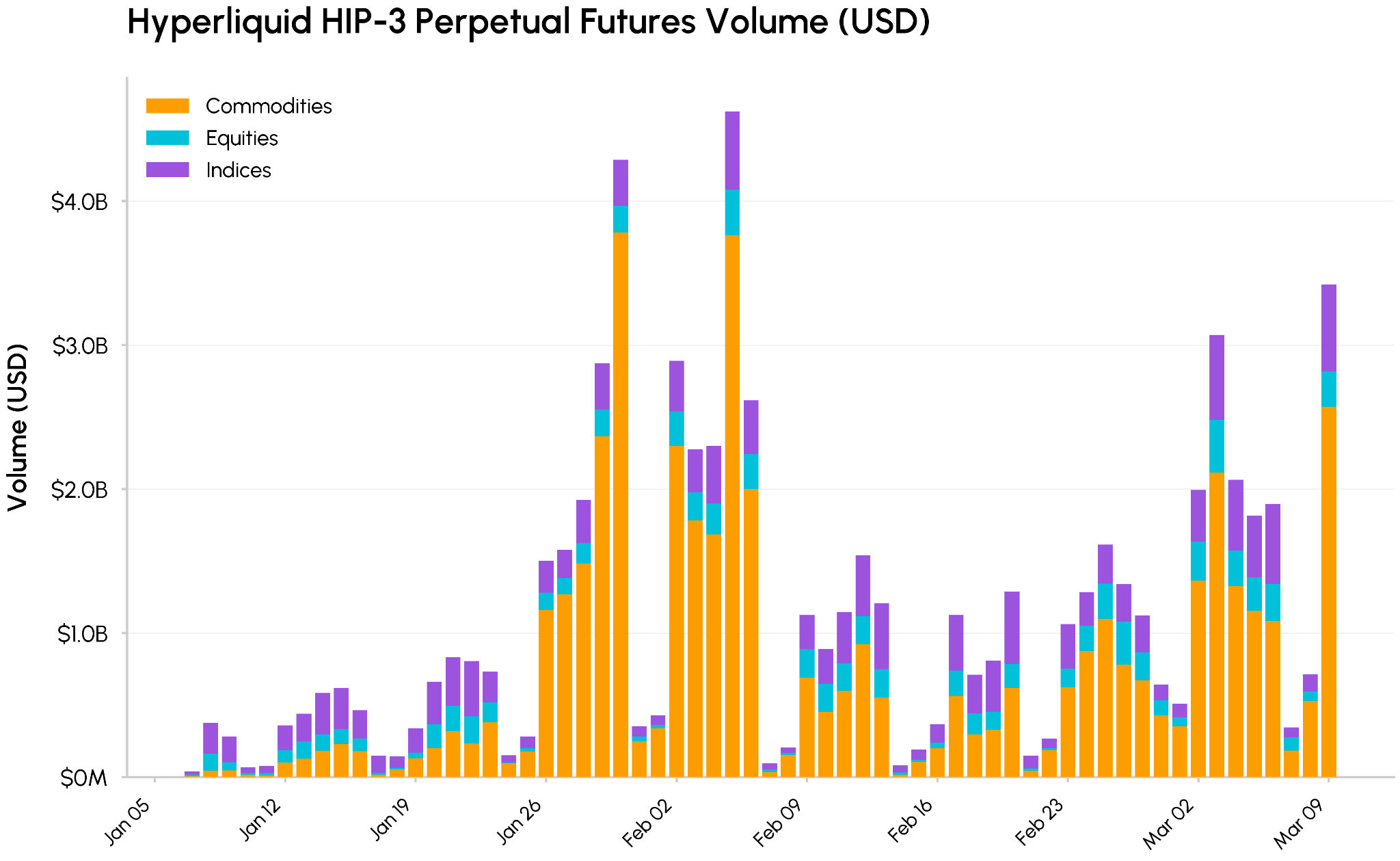
Beyond precious metals, decentralized protocols like Hyperliquid proved their worth as a barometer for broader macro risk. Through the use of perpetual futures contracts, the platform allowed for the real-time repricing of assets such as crude oil and equity indices. With total volume on these non-crypto markets exceeding $95 billion, the incident underscored a shift toward a financial landscape where on-chain rails act as a permanent extension of traditional markets, ensuring that global economic activity does not pause simply because traditional exchanges are closed.
Key Takeaways
- Blockchain platforms provided the only venue for price discovery and trading during a weekend geopolitical crisis when traditional markets were closed.
- Tokenized gold assets saw a surge in volume exceeding $1 billion as investors sought safe-haven exposure in real-time.
- Decentralized perpetual futures protocols are increasingly being used to trade traditional macro assets like oil and equity indices around the clock.
Editor’s Analysis & Impact
The events of late February serve as a proof-of-concept for the integration of decentralized finance (DeFi) into the broader global economy. By providing 24/7 liquidity for both crypto and traditional assets, blockchain infrastructure is effectively solving the ‘weekend gap’ problem that has long plagued traditional finance. The rapid repricing of oil and gold on-chain suggests that these platforms are no longer just speculative venues for digital assets, but are becoming essential tools for macro-hedging. As regulatory frameworks evolve and liquidity deepens, we expect to see a continued migration of traditional financial activity toward these always-on, permissionless rails. This shift poses a long-term challenge to the relevance of traditional market hours and highlights the growing necessity for institutional-grade, continuous financial infrastructure.
Frequently Asked Questions
Q: Why were traditional markets unable to react to the geopolitical news?
A: Traditional equity and commodity markets operate on set schedules and are typically closed on weekends, preventing immediate trading in response to events that occur outside of business hours.
Q: What are tokenized gold assets?
A: Tokenized gold assets, such as PAXG or XAUT, are digital tokens on a blockchain where each unit represents ownership of a specific amount of physical gold held in a vault, allowing for the trading of gold 24/7.
AI Disclosure: This article is based on verified data and official reports. Our Team and AI have cross-referenced every financial detail with primary sources to ensure total accuracy.
More from this Category