Base Network Sees Record $8 Trillion in Stablecoin Volume Driven by DeFi Activity
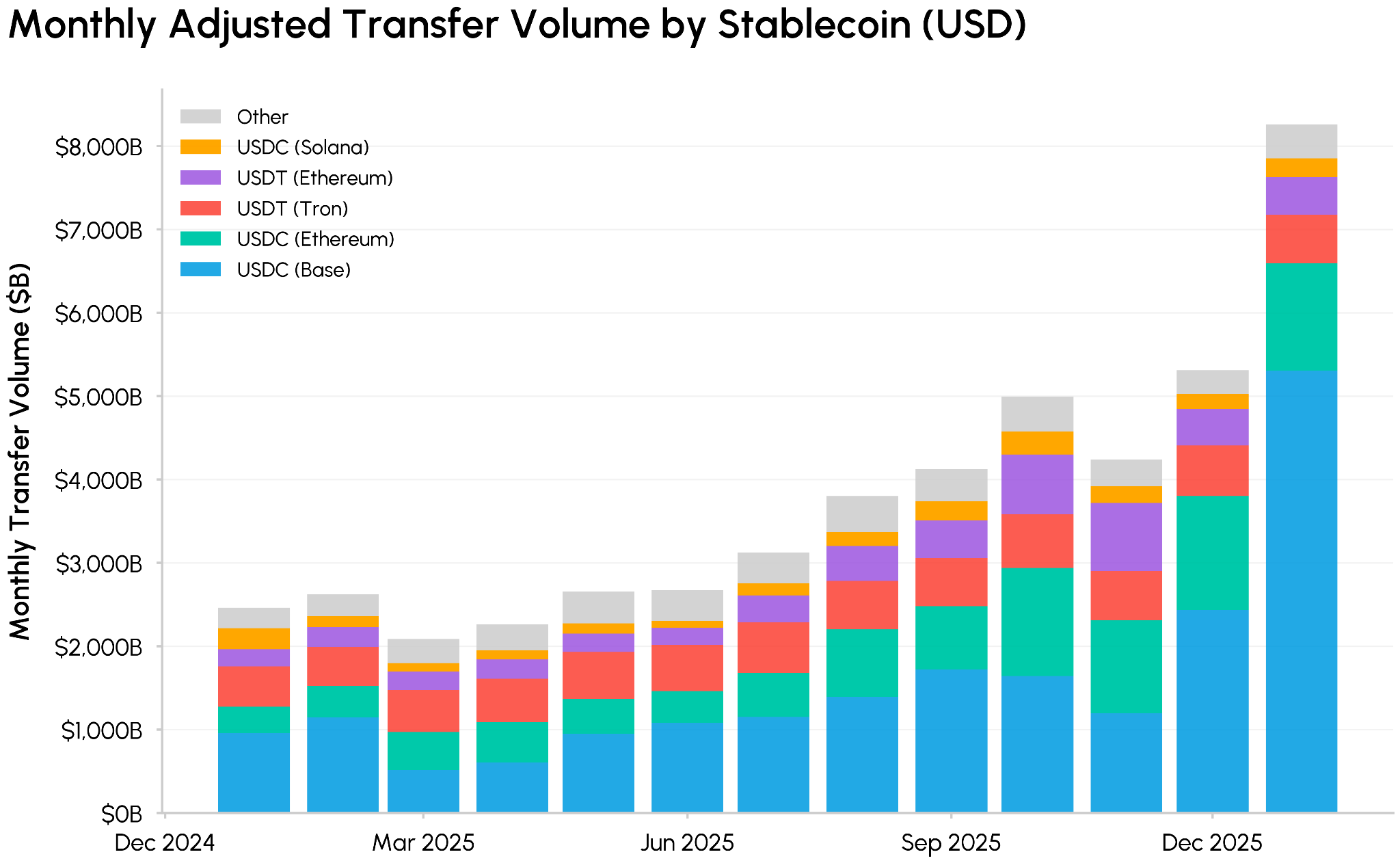
The Base blockchain experienced a historic surge in stablecoin activity in January 2026, with adjusted transfer volumes climbing to an unprecedented $8 trillion. This massive influx was primarily fueled by the performance of USDC, which saw $5.3 trillion in transaction volume on the Base network alone, despite a circulating supply of roughly $4.1 billion. This high velocity of capital highlights a significant shift in how stablecoins are utilized within the blockchain ecosystem, particularly as daily large-value transfers exceeding $100,000 jumped from under 50,000 to more than 450,000 in a single month.
Much of this record-breaking volume is attributed to the complex mechanics of decentralized finance (DeFi) rather than traditional retail payments. Platforms such as the automated market maker Aerodrome and the lending protocol Morpho have become primary drivers of this activity. These protocols rely on operational designs that necessitate frequent, high-value movements of assets, which are recorded as transfer volume even when the net economic change remains relatively low.
Aerodrome, the leading decentralized exchange on Base, utilizes concentrated liquidity models that encourage liquidity providers to frequently rebalance their positions to maximize capital efficiency. Similarly, Morpho’s flash loan infrastructure allows for massive, instantaneous movements of USDC for arbitrage and liquidation purposes. Because these transactions are atomic—meaning the funds are borrowed and repaid within the same block—they generate billions in volume without representing long-term capital shifts, underscoring the need for nuanced analysis when evaluating on-chain financial data.
Key Takeaways
- Base network recorded $8 trillion in stablecoin transfer volume in January 2026, largely driven by USDC.
- DeFi protocols like Aerodrome and Morpho are the primary engines behind this volume, rather than standard consumer payments.
- High transaction figures are often the result of automated rebalancing and flash loans, which do not necessarily reflect net economic growth.
Editor’s Analysis & Impact
The record-breaking volume on the Base network serves as a critical case study in the evolution of DeFi infrastructure. While an $8 trillion figure might suggest massive retail adoption, the reality is more nuanced; it reflects the hyper-efficiency of automated market makers and lending protocols. This trend indicates that blockchain networks are increasingly becoming back-end engines for sophisticated financial engineering rather than just simple value-transfer rails. For investors and analysts, this means that ‘transaction volume’ is becoming a less reliable metric for gauging actual user growth or economic utility. Future market health will likely depend on the ability of these protocols to maintain liquidity while transitioning from high-frequency, automated activity to sustainable, long-term capital deployment. As these systems mature, we expect to see more granular reporting standards to distinguish between ‘noise’ from flash loans and genuine economic activity.
Frequently Asked Questions
Q: Why is the USDC volume on Base so much higher than its total supply?
A: The volume is high because the same units of USDC are being moved repeatedly within a short timeframe due to automated DeFi processes like liquidity rebalancing and flash loans, rather than representing a static pool of capital.
Q: What are flash loans and how do they affect volume?
A: Flash loans are atomic transactions that allow users to borrow large amounts of capital and repay it within the same block. Because the entire transaction is recorded on-chain, it creates massive transfer volume even though the capital is only held for a few seconds.
AI Disclosure: This article is based on verified data and official reports. Our Team and AI have cross-referenced every financial detail with primary sources to ensure total accuracy.
More from this Category