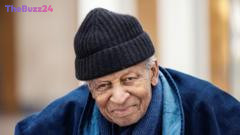
Abdullah Ibrahim, South African Jazz Icon and Anti-Apartheid Voice, Dies at 91
South African music legend Abdullah Ibrahim, celebrated globally for his profound jazz compositions and unwavering commitment to social justice, has passed away at the age of 91. His family confirmed he died peacefully in Germany, surrounded by loved ones, following a brief illness.
Born Adolph Johannes Brand in Cape Town in 1934, Ibrahim began his musical journey at the piano at just seven years old. His illustrious career, spanning over eight decades, produced dozens of acclaimed recordings. Among his most iconic works is the 1974 track “Mannenberg,” a piece that became deeply intertwined with the struggle against South Africa’s brutal apartheid regime. Ibrahim, who adopted the name Abdullah Ibrahim after converting to Islam in the late 1960s, was initially known as Dollar Brand.
Ibrahim’s early musical endeavors included playing in swing bands and forming the Jazz Epistles, a seminal sextet that featured fellow South African jazz giant Hugh Masekela. As apartheid’s oppressive grip tightened, jazz, with its inherent spirit of cross-cultural collaboration, was often viewed with suspicion by the authorities. The challenging political climate eventually led to the disbandment of the Jazz Epistles and Ibrahim’s move to Switzerland.
His distinctive musical voice truly began to take shape after being discovered by American jazz legend Duke Ellington, who facilitated his move to the United States. Ibrahim’s music became renowned for its unique fusion of South African musical traditions—its vocal nuances and harmonic richness—with the improvisational spirit and rhythmic complexity of jazz. Despite living abroad for many years, he remained deeply connected to his homeland, frequently returning to perform and record, captivating audiences with his artistry, grace, and profound musical vision. His final public performance took place at the Cape Town International Jazz Festival less than three months prior to his death.
Key Takeaways
- Abdullah Ibrahim, a globally recognized South African jazz musician and composer, has died at the age of 91.
- His music, including the famous "Mannenberg," became an anthem for the anti-apartheid movement.
- Ibrahim was known for his unique style blending South African musical traditions with jazz improvisation, and maintained a strong connection to his homeland throughout his career.
Editor’s Analysis & Impact
The passing of Abdullah Ibrahim marks the end of an era in jazz and a significant loss for South African culture. His music transcended mere entertainment, serving as a powerful voice against oppression and a symbol of hope during the apartheid years. Ibrahim’s ability to weave the distinct sounds of his homeland into the global language of jazz cemented his legacy as a truly original artist. His influence will undoubtedly continue to inspire musicians and activists alike, highlighting the potent role of art in social and political change. The enduring power of his compositions ensures his music will resonate for generations to come, a testament to his enduring spirit and artistic brilliance.
Frequently Asked Questions
Q: When and where was Abdullah Ibrahim born?
A: Abdullah Ibrahim was born Adolph Johannes Brand in Cape Town, South Africa, in 1934.
Q: What is Abdullah Ibrahim most famous for?
A: He is most famous for his influential jazz compositions, particularly the track 'Mannenberg,' which became associated with the anti-apartheid struggle, and for his unique musical style that blended South African musical traditions with jazz.
Q: Did Abdullah Ibrahim live in South Africa his entire life?
A: No, while deeply connected to his homeland, Ibrahim lived abroad for many years, notably in Switzerland and the United States, before frequently returning to South Africa to perform and record.
AI Disclosure: This article is based on verified data and official reports. Our Team and AI have cross-referenced every financial detail with primary sources to ensure total accuracy.
More from this Category