Ancient Secrets of the Desert: How a UAE Ridge Rewrites Human and Geological History
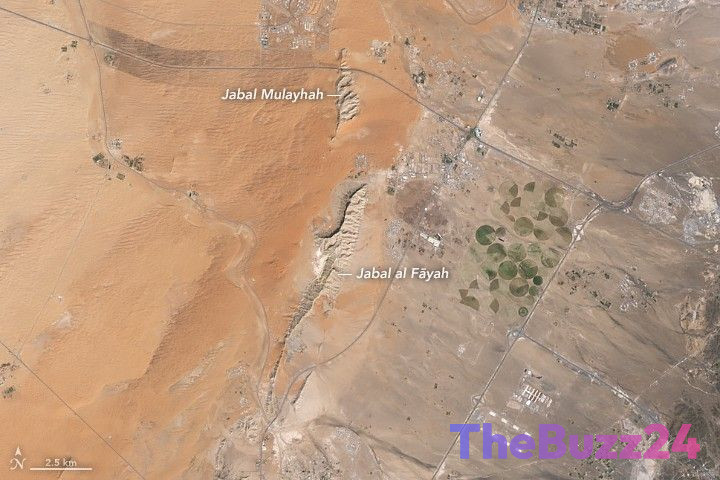
Just an hour’s drive east of Dubai’s ultra-modern skyline lies a starkly different landscape where deep history is etched into the earth. Rising 412 meters above the desert plains of Sharjah, the pale limestone ridge of Jabal al Fāyah stands as a geological sentinel at the edge of the Rub’ al Khali desert. While today it is surrounded by saffron-colored sand dunes and the rugged Al-Hajar Mountains, satellite observations reveal a complex terrain that once lay deep beneath ancient oceans.
Geologists view these striking ridges as a window into a watery past dating back tens of millions of years. The marine limestone forming Jabal al Fāyah was deposited during the late Cretaceous through the early to mid-Paleocene epochs, when the region was covered by the warm, shallow waters of the Tethys Sea. This process left behind a treasure trove of marine fossils, including ancient coral, sea urchins, and mollusks, which are particularly visible at the nearby Fossil Rock. Furthermore, the presence of the Samail Ophiolite—a rare exposure of ancient oceanic crust thrust onto the continental plate—makes the area a premier site for studying tectonic history.
Beyond its geological marvels, Jabal al Fāyah holds profound archaeological significance, having been designated a UNESCO World Heritage site. The ridge and its surrounding landscape preserve evidence of human occupation dating back between 120,000 and 210,000 years. During the Middle Paleolithic era, early Homo sapiens migrating out of Africa utilized this landscape as a crucial refuge. Archaeologists have unearthed a wealth of ancient stone tools, including hand axes, scrapers, and blades, which offer vital clues about how early humans adapted to and survived in this environment.
The survival of these early pioneers was made possible by dramatic environmental shifts. Geological data indicates that freshwater lakes periodically formed on the eastern side of the ridge, offering reliable water and food resources in an otherwise harsh climate. Additionally, the natural rocky overhangs of Jabal al Fāyah provided essential shelter from the extreme desert heat and winds. These findings challenge previous assumptions about early human migration routes and highlight the Arabian Peninsula’s critical role as a gateway for global human expansion.
Key Takeaways
- Jabal al Fāyah in the UAE's Sharjah emirate serves as a vital geological and archaeological site, showcasing marine limestone ridges that formed tens of millions of years ago under the ancient Tethys Sea.
- The site was designated a UNESCO World Heritage site due to its rich archaeological deposits, which trace modern human (Homo sapiens) presence on the Arabian Peninsula back to between 210,000 and 120,000 years ago.
- Discoveries of ancient stone tools and evidence of periodic freshwater lakes suggest the ridge was a crucial oasis and shelter for early humans migrating out of Africa.
Editor’s Analysis & Impact
The recognition of Jabal al Fāyah as a UNESCO World Heritage site underscores a growing global appreciation for the Arabian Peninsula’s pivotal role in human prehistory. Historically viewed as a barren barrier, the region is now understood to have been a dynamic corridor of migration and adaptation. For the United Arab Emirates, these scientific revelations provide a powerful cultural asset, diversifying its global appeal beyond luxury tourism and modern architecture into eco-tourism and archaeological heritage. This shift not only boosts scientific funding and international research collaborations in the Middle East but also reshapes the narrative of early human migration. By proving that Homo sapiens successfully navigated and inhabited these landscapes much earlier than previously thought, the discoveries at Jabal al Fāyah force anthropologists to revise established timelines of the ‘Out of Africa’ migration theory.
Frequently Asked Questions
Q: What makes Jabal al Fāyah geologically unique?
A: Jabal al Fāyah is composed of marine limestone layers deposited tens of millions of years ago when the region was submerged under the Tethys Sea. It also sits near the Samail Ophiolite, one of the world's best-preserved exposures of ancient oceanic crust that was pushed onto land by tectonic forces.
Q: Why is this site important for understanding human history?
A: The site contains some of the earliest evidence of modern humans (Homo sapiens) outside of Africa, dating back up to 210,000 years. The discovery of stone tools and evidence of ancient lakes shows how early humans survived and adapted to changing climates on the Arabian Peninsula.
Q: What is Fossil Rock?
A: Located just north of Jabal al Fāyah, Fossil Rock is a famous geological formation rich in marine fossils, including ancient snails, clams, and sea urchins, offering clear evidence of the area's prehistoric marine environment.
AI Disclosure: This article is based on verified data and official reports. Our Team and AI have cross-referenced every financial detail with primary sources to ensure total accuracy.
More from this Category