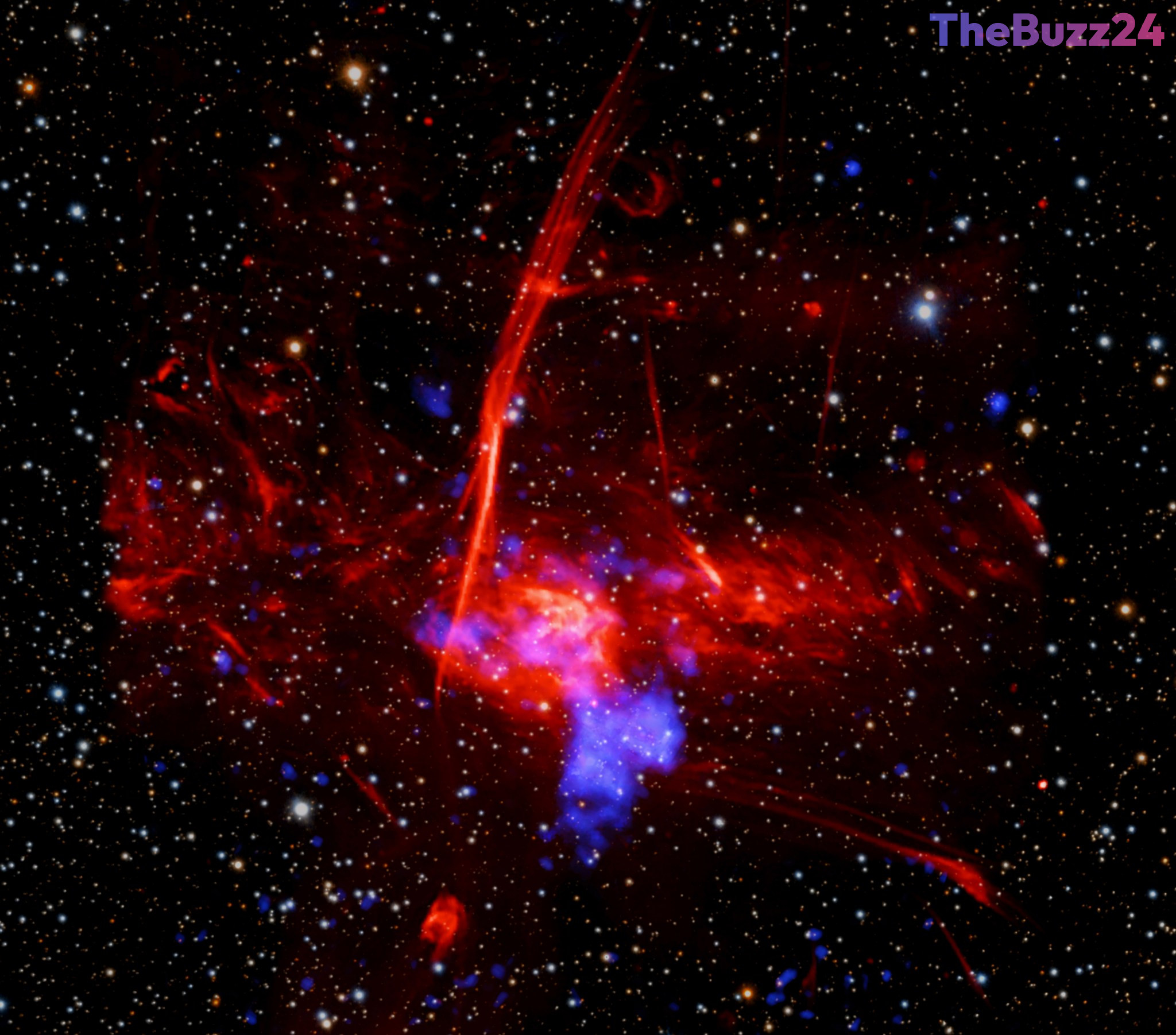
Astronomers Identify Potential Supernova Remnant Near Galactic Center
Astronomers utilizing data from the Chandra X-ray Observatory have identified a potential supernova remnant situated in a highly unusual location within the Milky Way. The discovery, which highlights the expanding debris of an exploded star, offers a rare glimpse into the volatile environment surrounding the center of our galaxy.
Supernova remnants are essential to cosmic evolution, as they disperse heavy elements such as iron, oxygen, and silicon throughout space. These elements serve as the fundamental building blocks for the formation of planets and the development of biological life. By studying these remnants, researchers can better understand the chemical enrichment processes that shape the universe.
If the identification is confirmed, this remnant would rank among the closest ever observed to the supermassive black hole residing at the Galactic Center. This region is characterized by extreme conditions, including dense gas clouds, intense magnetic fields, and a high concentration of massive stars, making the detection of such a structure a significant milestone in galactic mapping.
Key Takeaways
- Researchers have identified a potential supernova remnant located near the center of the Milky Way galaxy.
- Supernova remnants are vital for distributing elements like iron and oxygen, which are necessary for planetary formation.
- The discovery is notable for its proximity to the supermassive black hole at the heart of the galaxy, an area known for its extreme physical conditions.
Editor’s Analysis & Impact
The discovery of a supernova remnant in the immediate vicinity of the Galactic Center provides a unique laboratory for studying high-energy astrophysics. The Galactic Center is a region of extreme gravitational and magnetic complexity, and finding evidence of a stellar explosion here allows scientists to test models of how stars evolve and die in dense, high-radiation environments. From a broader perspective, this finding underscores the ongoing importance of multi-wavelength astronomy, as it requires the integration of X-ray, radio, and infrared data to confirm such elusive structures. As observational technology improves, we can expect a more detailed census of the Milky Way’s history, which will ultimately refine our understanding of how galaxies recycle matter and sustain the conditions necessary for the formation of solar systems.
Frequently Asked Questions
Q: Why are supernova remnants important to study?
A: Supernova remnants are crucial because they spread heavy elements like iron and oxygen across the galaxy, which are the essential ingredients for creating planets and supporting life.
Q: What makes this specific discovery unique?
A: This remnant is significant because of its location; if confirmed, it would be one of the closest remnants ever found to the supermassive black hole at the center of the Milky Way.
AI Disclosure: This article is based on verified data and official reports. Our Team and AI have cross-referenced every financial detail with primary sources to ensure total accuracy.
More from this Category