Meet Clawdmeter: The Retro-Style Desktop Gadget That Tracks Your Claude AI Token Usage
A creative new open-source hardware project is changing how power users monitor their artificial intelligence usage. Dubbed the “Clawdmeter,” this compact desktop dashboard offers developers and AI enthusiasts a tactile, visually engaging way to track their Claude AI token consumption. The device taps into a growing trend within the developer community to closely monitor and optimize API usage, bringing a physical presence to otherwise invisible digital metrics.
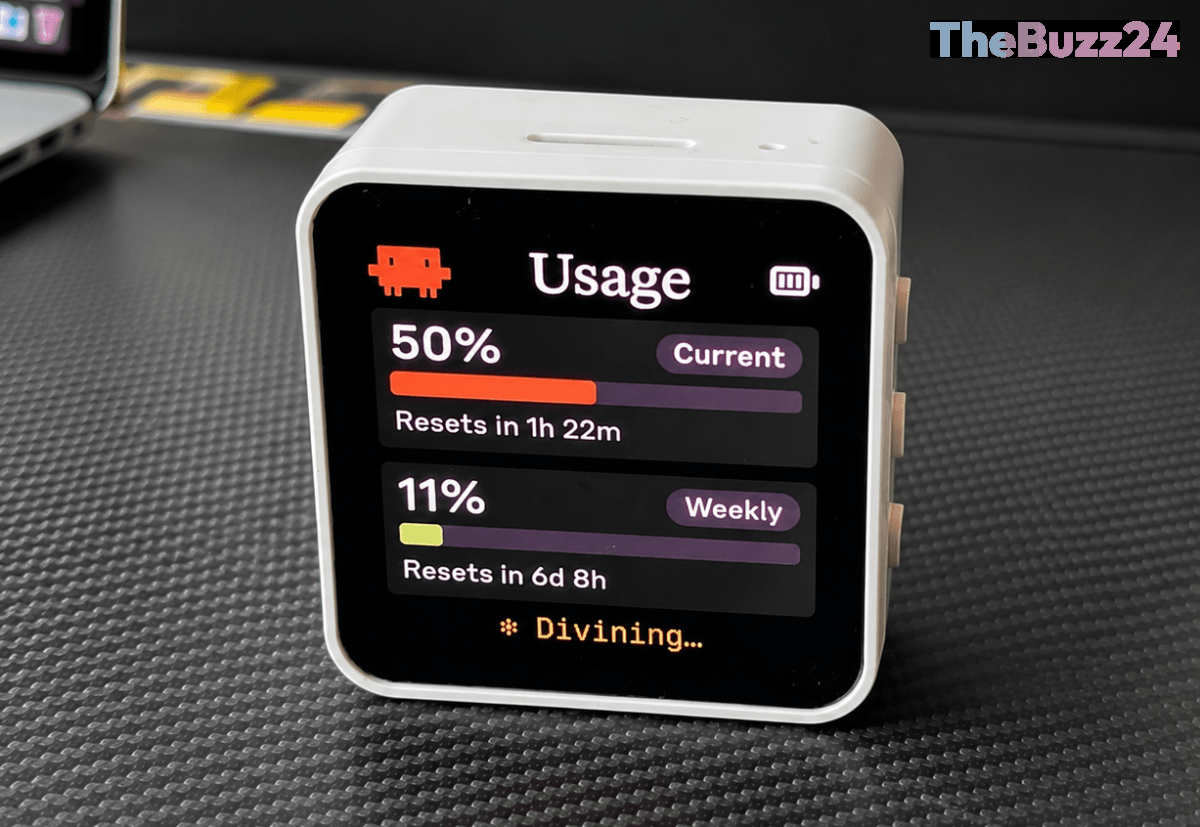
Designed as both a functional tool and a nostalgic desk accessory, the Clawdmeter utilizes a Waveshare ESP32-S3-Touch-AMOLED-2.16 display powered by a lithium-ion battery. It connects wirelessly to a user’s computer via Bluetooth to retrieve real-time data. Once active, the screen displays a pixel-art character named “Clawd” that becomes increasingly animated as the user’s token consumption rises. Users can interact with the device using a central button to cycle through different animations or view detailed charts of their weekly and session-based Claude utilization. Additionally, two side buttons act as physical shortcuts to toggle modes and trigger Claude Code’s voice mode.
The innovative gadget is the creation of Hermann Haraldsson, a software developer based in Reykjavik, Iceland. Seeking to experiment with embedded hardware for the first time, Haraldsson turned to Claude AI itself to guide him through the development process. With the AI’s assistance, he was able to program and assemble the prototype in just a few days, demonstrating how modern AI tools are democratizing hardware engineering. Haraldsson spent a significant portion of his development time polishing the device’s retro aesthetic, carefully selecting fonts, color palettes, and animations to capture a vintage feel.
Since its public release on May 10, the Clawdmeter has quickly gained traction in the open-source community, earning hundreds of stars and forks on GitHub. Haraldsson attributes the device’s popularity to its nostalgic charm, comparing it to classic dedicated electronics like the Walkman or iPod. While it is not intended to replace robust software-based monitoring dashboards, the Clawdmeter serves as a delightful, physical companion for AI developers—often described by fans as a “hardware Tamagotchi” for tracking context windows.
Key Takeaways
- The Clawdmeter is an open-source, Bluetooth-enabled desktop device designed to track Claude AI token usage with a retro, pixel-art aesthetic.
- Created by developer Hermann Haraldsson, the hardware was built in just a few days with the assistance of Claude AI itself, demonstrating the democratization of hardware programming.
- The project has quickly gained traction on GitHub, appealing to developers who enjoy nostalgic, dedicated physical gadgets reminiscent of a 'Tamagotchi' for AI.
Editor’s Analysis & Impact
The Clawdmeter represents a fascinating intersection of modern artificial intelligence and retro hardware design. As AI tools become deeply integrated into daily developer workflows, we are seeing a shift from purely software-based interfaces to physical, ambient computing devices. This ‘hardware Tamagotchi’ trend highlights a growing desire among tech enthusiasts for tactile, dedicated gadgets that break the monotony of standard screen layouts. Furthermore, the fact that Haraldsson utilized Claude AI to write the code for a Claude-monitoring device underscores a powerful feedback loop: AI is lowering the barrier to entry for hardware engineering. In the future, we can expect a surge in niche, community-driven physical accessories tailored to specific AI models and developer ecosystems, transforming how we interact with invisible digital resources.
Frequently Asked Questions
Q: What is the Clawdmeter and what does it do?
A: The Clawdmeter is an open-source desktop hardware device that connects to a computer via Bluetooth to track and display Claude AI token consumption using retro pixel-art animations and data charts.
Q: What hardware is required to build a Clawdmeter?
A: The device is built using a Waveshare ESP32-S3-Touch-AMOLED-2.16 display powered by a lithium-ion battery, along with custom open-source code available on GitHub.
Q: How does the device help with Claude AI workflows?
A: Beyond tracking token usage, the Clawdmeter features physical buttons that serve as quick shortcuts, allowing users to toggle modes and activate Claude Code's voice mode seamlessly.
AI Disclosure: This article is based on verified data and official reports. Our Team and AI have cross-referenced every financial detail with primary sources to ensure total accuracy.
More from this Category