Cosmic Feline: Telescopes Reveal Haunting Star-Forming Region in Carina Nebula
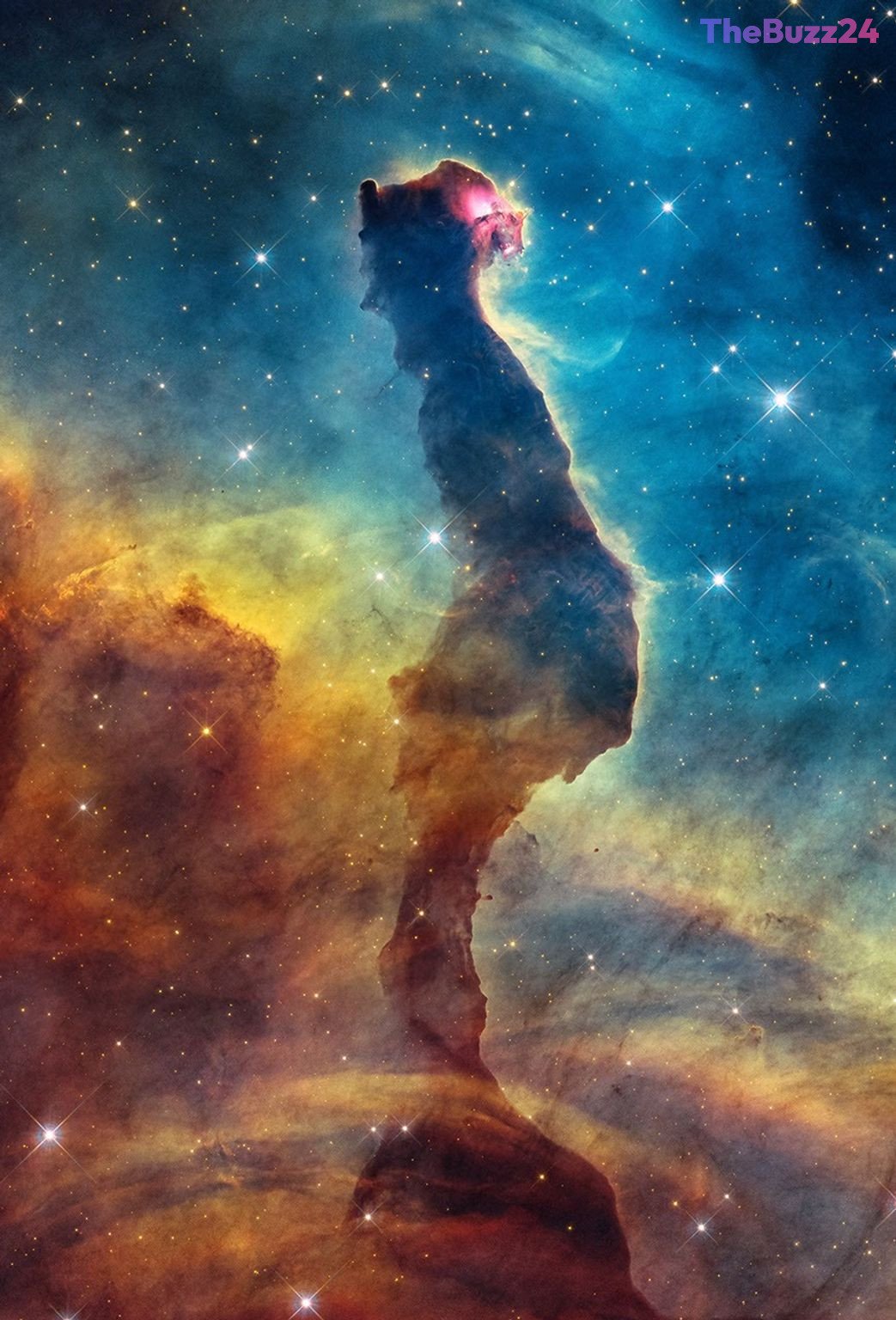
Astronomers have unveiled a striking new image of a celestial formation nicknamed the ‘Cat’s Head Nebula,’ a dynamic star-forming region located approximately 7,500 light-years away within the vast Carina Nebula. The structure, which resembles a cat sitting with its back to the observer, features a distinct glowing ‘eye’ that researchers believe is a young star still shrouded in its natal cocoon of dust and gas.
The nebula’s unique shape is the result of a violent cosmic sculpting process. Intense ultraviolet radiation and powerful stellar winds from nearby massive stars have eroded the surrounding material, leaving behind a dense, feline-shaped pillar of gas and dust. While this formation is temporary and will eventually disperse as the stars within it continue to evolve, it provides a rare, high-resolution look at the chaotic environment where new stars are born.
By combining data from the Hubble Space Telescope and the James Webb Space Telescope, scientists have gained a multi-layered perspective of the region. Hubble’s visible-light observations highlight the opaque, dark dust pillars and the ionized gas rim, while Webb’s infrared capabilities pierce through the dense clouds to reveal the intricate internal structures and hidden infant stars. This collaborative approach allows researchers to map the complex interplay between radiation, dust, and gravity that dictates the life cycle of stars in our galaxy.
Key Takeaways
- The 'Cat’s Head Nebula' is a star-forming region located 7,500 light-years away in the Carina Nebula.
- The nebula's shape is sculpted by intense radiation and stellar winds from massive neighboring stars.
- Using both Hubble and Webb telescopes allows scientists to see through dense dust to observe the birth of new stars.
Editor’s Analysis & Impact
The study of the Cat’s Head Nebula represents a significant advancement in our understanding of stellar feedback—the process by which massive stars influence their environment. By utilizing multi-wavelength observations, researchers are effectively ‘peeling back’ the layers of cosmic dust that have historically obscured the earliest stages of star formation. This research is critical for refining models of galactic evolution, as the mechanisms observed here are likely universal across the cosmos. As telescope technology continues to improve, the ability to observe these transient, high-energy environments will provide deeper insights into how gas clouds collapse to form solar systems, ultimately helping us understand the origins of our own Sun and the potential for planetary formation in similar stellar nurseries.
Frequently Asked Questions
Q: Why is the nebula called the 'Cat’s Head'?
A: It is nicknamed the Cat’s Head Nebula because its silhouette resembles a cat sitting with its back toward the viewer, with a glowing 'eye' visible on the side of the head.
Q: How do Hubble and Webb work together to study this nebula?
A: Hubble captures visible light to show the outer structure and ionized gas, while Webb uses infrared light to see through the dense dust, revealing the internal stars and complex molecular structures that are otherwise invisible.
AI Disclosure: This article is based on verified data and official reports. Our Team and AI have cross-referenced every financial detail with primary sources to ensure total accuracy.
More from this Category