NASA’s WindShaper Technology Revolutionizes Autonomous Drone Testing
NASA’s Unmanned Autonomy Research Complex (NUARC) has unveiled a sophisticated testing environment designed to accelerate the development of autonomous aerial vehicles. At the heart of this facility is the WindShaper, a high-precision fan array that allows researchers to simulate complex atmospheric conditions in a controlled indoor setting. By replicating real-world wind patterns, engineers can rigorously test how drones and other autonomous systems perform under varying environmental stressors.
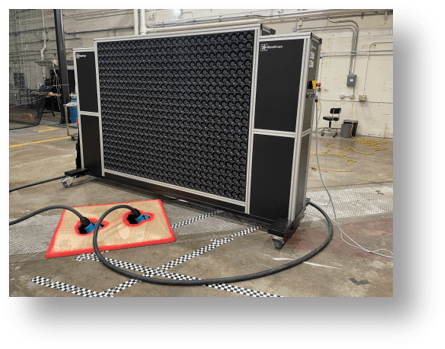
The WindShaper system is a marvel of engineering, featuring a massive 9-foot by 7-foot array composed of 1,134 individual fans. These fans are organized into 567 distinct ‘wind pixels,’ which can be programmed via a Python API to generate highly specific wind gradients and gusts. The system is capable of producing wind speeds reaching up to 16 meters per second, with rapid acceleration and deceleration capabilities that mimic the unpredictable nature of outdoor flight environments.
To ensure the accuracy of these simulations, the facility utilizes the WindProbe, a specialized handheld device designed for real-time data collection. When paired with the lab’s OptiTrack motion capture system, the WindProbe provides precise measurements of airflow, position, and orientation. This integration allows researchers to validate their simulations against actual physical data, creating a robust feedback loop that is essential for refining the navigation and stability algorithms of next-generation autonomous aircraft.
Key Takeaways
- The WindShaper facility uses 1,134 individual fans to create highly customizable, real-world wind conditions for drone testing.
- Researchers can program specific wind gradients and gusts using a Python API, simulating speeds up to 36 mph.
- The WindProbe tool integrates with motion capture technology to provide high-fidelity data on airflow and vehicle orientation during testing.
Editor’s Analysis & Impact
The deployment of the WindShaper at NUARC represents a significant leap forward in the maturation of autonomous flight technology. By moving complex atmospheric testing from unpredictable outdoor environments into a controlled, repeatable indoor setting, NASA is effectively lowering the barrier to entry for testing advanced flight algorithms. This shift is likely to accelerate the development cycle for commercial and industrial drone applications, particularly in logistics, search and rescue, and infrastructure inspection. As autonomous systems become more integrated into urban and industrial landscapes, the ability to simulate ‘edge case’ weather scenarios will be critical for safety certification. This technology not only enhances current research capabilities but also sets a new standard for how autonomous hardware and software are validated before they are deployed in the real world.
Frequently Asked Questions
Q: What is the primary purpose of the WindShaper array?
A: The WindShaper is designed to simulate complex, real-world atmospheric conditions indoors, allowing researchers to test the stability and navigation of autonomous aerial vehicles in a controlled environment.
Q: How do researchers control the wind conditions in the facility?
A: Researchers use a Python API to program the 567 'wind pixels' of the array, which allows them to create precise wind gradients, gusts, and speeds up to 16 meters per second.
AI Disclosure: This article is based on verified data and official reports. Our Team and AI have cross-referenced every financial detail with primary sources to ensure total accuracy.
More from this Category