Israel’s Proposed Permanent Security Zone in Southern Lebanon Sparks International Outcry
Israel is advancing plans to establish a permanent security buffer zone deep within southern Lebanon, asserting ongoing security control over the territory even after the cessation of hostilities with Hezbollah. Defense Minister Israel Katz detailed the scope of this proposed zone, indicating it would extend approximately 30 kilometers (18.6 miles) from the Israeli border, reaching the Litani River. This move signals a significant shift in Israel’s post-conflict strategy for the region, aiming to create a lasting defensive barrier.
Under the proposed framework, Israeli forces would maintain a defensive line against anti-tank missiles within this security zone. Katz also outlined severe measures, including the demolition of all houses in Lebanese villages adjacent to the Israeli border, drawing parallels to actions previously taken in Rafah and Beit Hanoun in Gaza. Furthermore, the return of over 600,000 displaced residents of southern Lebanon, who evacuated northward, would be prohibited south of the Litani River until the safety and security of northern Israeli communities are definitively ensured. Israeli officials state the primary objective of these actions is to safeguard its northern populace from Hezbollah’s attacks, which have persisted despite a 2024 ceasefire.
The announcement has triggered widespread condemnation from the international community and Lebanese officials. Lebanon’s Defense Minister, Major General Michel Menassa, described Katz’s remarks as “no longer mere threats,” but rather a “clear intention to impose a novel occupation of Lebanese territory,” forcibly displacing hundreds of thousands and systematically destroying villages. The United Nations, European nations, and Canada have also sharply criticized Israel’s stance. Canadian Prime Minister Mark Carney labeled Israel’s deployment of ground troops in Lebanon an “illegal invasion” violating the country’s sovereignty. A joint statement from ten European foreign ministers, alongside the EU foreign policy chief, urged Israel to avoid expanding its military operations and to respect Lebanon’s territorial integrity, while also calling on Hezbollah to cease its attacks. UN aid chief Tom Fletcher, addressing the Security Council, questioned how the international community should prepare for “a new addition to the list of occupied territories.”
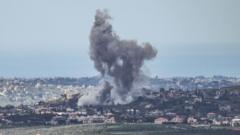
The current escalation began after Israel sent ground troops into southern Lebanon on March 2, following Hezbollah’s rocket attacks into northern Israel. These rocket attacks were reportedly in retaliation for Israel’s assassination of Iran’s supreme leader in late February. The conflict has had a devastating humanitarian toll, with at least 1,238 people killed in Lebanon since early March, including 124 children and 52 health workers. In the same period, Hezbollah attacks have claimed the lives of 10 Israeli soldiers and two Israeli civilians. The conflict has also seen the deaths of three Indonesian peacekeepers and three Lebanese journalists, with the Israel Defense Forces (IDF) confirming they killed two journalists, describing them as “terrorists.” Over a million Lebanese citizens have been displaced, exacerbating an existing humanitarian crisis, and numerous healthcare facilities have been damaged or forced to close. Lebanon’s President Joseph Aoun has decried the Israeli plans as “collective punishment against civilians,” fearing they could be part of “suspicious schemes” to expand Israel’s presence in Lebanese territory.
Key Takeaways
- Israel plans to establish a permanent security buffer zone up to the Litani River in southern Lebanon, extending 30 km from its border.
- The plan includes demolishing border villages and prohibiting the return of over 600,000 displaced Lebanese residents to the zone.
- The proposal has drawn widespread international condemnation from Lebanon, the UN, EU nations, and Canada, who view it as a violation of sovereignty and a potential new occupation.
Editor’s Analysis & Impact
Israel’s proposed permanent security zone in southern Lebanon carries significant geopolitical implications, threatening to further destabilize an already volatile region. This move could escalate tensions with Hezbollah and potentially draw in other regional actors, complicating any future peace efforts. The international community’s strong condemnation highlights concerns over territorial sovereignty and the potential for a prolonged occupation, which could set a dangerous precedent. Economically, the destruction of villages and mass displacement will exacerbate Lebanon’s severe humanitarian and financial crises. The long-term outlook suggests increased instability, making a diplomatic resolution more challenging and potentially leading to a protracted conflict with devastating human costs. This plan underscores the urgent need for international mediation to prevent a wider regional conflagration.
Frequently Asked Questions
Q: What is Israel's proposed security buffer zone in southern Lebanon?
A: Israel plans to establish a permanent security buffer zone extending approximately 30 kilometers (18.6 miles) into southern Lebanon, reaching the Litani River. This zone is intended to create a defensive line against anti-tank missiles and protect northern Israeli communities from Hezbollah attacks.
Q: Why is the international community condemning this plan?
A: International bodies and nations, including the UN, EU, and Canada, are condemning the plan due to concerns over Lebanon's territorial sovereignty, the forced displacement of hundreds of thousands of civilians, and the potential for a new occupation of Lebanese territory. They view it as an expansion of military operations that could further destabilize the region.
Q: What are the humanitarian consequences of the ongoing conflict in the region?
A: The conflict has resulted in a devastating humanitarian toll, with over 1,200 people killed in Lebanon, including many children and health workers. Over a million Lebanese citizens have been displaced, and numerous healthcare facilities have been damaged or forced to close, exacerbating an existing humanitarian crisis.
AI Disclosure: This article is based on verified data and official reports. Our Team and AI have cross-referenced every financial detail with primary sources to ensure total accuracy.
More from this Category