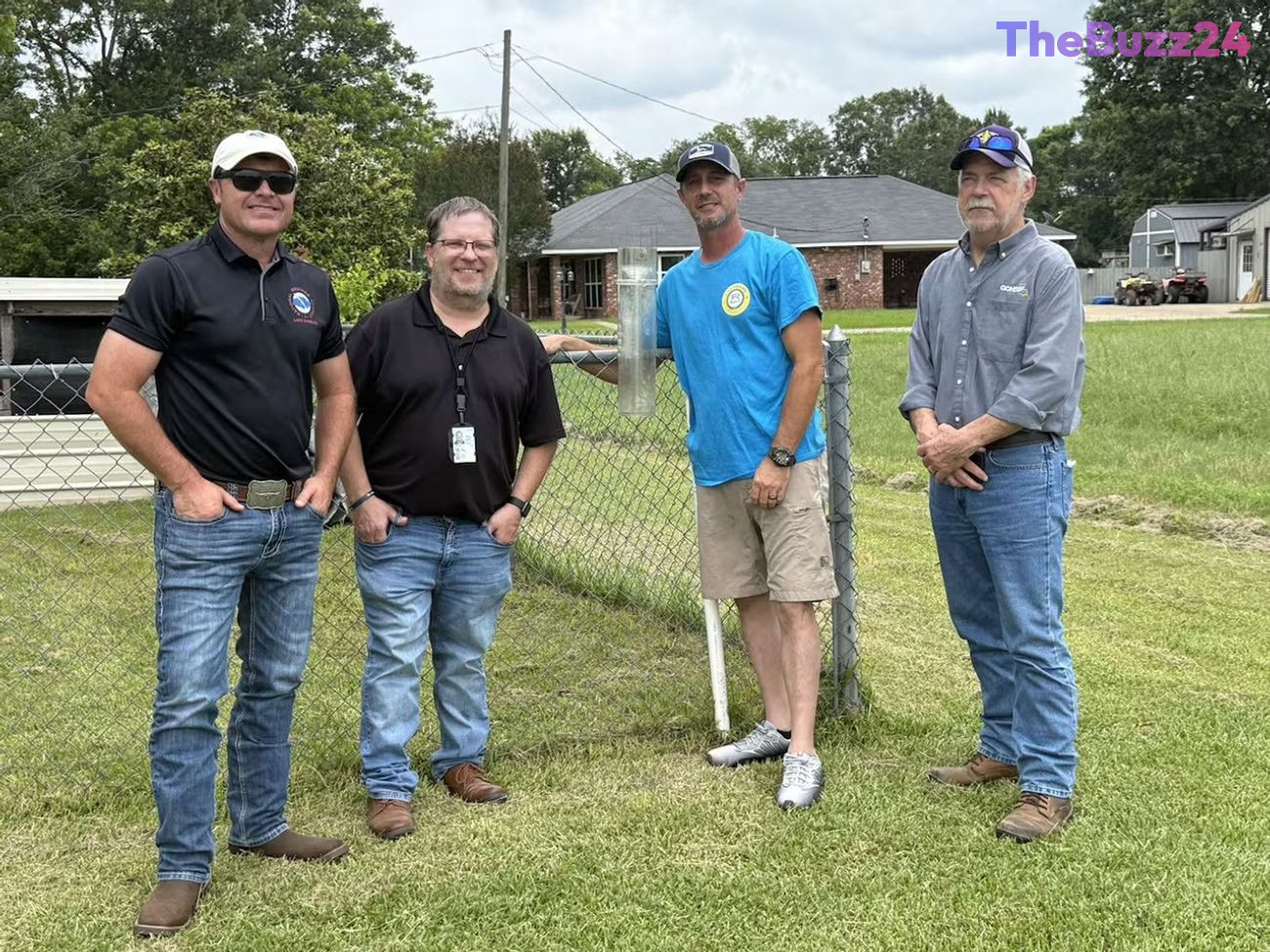
Louisiana Volunteer Shatters State 24-Hour Rainfall Record
A volunteer weather observer in Louisiana has officially rewritten the state’s meteorological history after recording an unprecedented amount of rainfall in a single day. Matt Carnicle, a participant in the Community Collaborative Rain, Hail, and Snow Network (CoCoRaHS), measured 29.06 inches of rain on June 18, 2026. This staggering total surpasses the previous state record of 22.00 inches, which had stood since 1962.
What makes the achievement even more significant is the timeframe in which the precipitation occurred. Carnicle reported that the entire 29.06 inches fell in less than 12 hours. The measurement has since been validated by the Louisiana State Climatologist and representatives from the National Weather Service. Experts have characterized the intensity of this weather event as a ‘thousand-year storm,’ meaning the statistical probability of such an occurrence in this specific region is extremely low.
The CoCoRaHS project, which is supported by NASA, relies on a vast network of citizen scientists to provide precise, ground-level data on precipitation. By using standardized manual gauges, volunteers help improve atmospheric models, enhance weather forecasting accuracy, and assist in critical water management decisions. Carnicle, who initially joined the network through a storm-spotter training program, emphasizes that his participation is driven by a simple interest in tracking local weather patterns.
As the data undergoes final review by a committee from the National Oceanic and Atmospheric Administration (NOAA) to formally document the new record, the event highlights the vital role of community-led science. The project continues to seek volunteers across the country to assist in gathering data, particularly regarding hail research in the Southeastern United States, where scientists are studying the melt rates of ice as it descends from clouds to the surface.
Key Takeaways
- Volunteer Matt Carnicle recorded 29.06 inches of rain in under 12 hours, breaking Louisiana's 1962 record of 22 inches.
- The extreme weather event has been classified by climatologists as a 'thousand-year storm' due to its rarity and intensity.
- The CoCoRaHS network utilizes citizen scientists to provide high-precision precipitation data that aids in national weather forecasting and research.
Editor’s Analysis & Impact
This event underscores the growing importance of citizen science in an era of increasingly volatile climate patterns. As traditional weather stations are often spaced far apart, the granular data provided by networks like CoCoRaHS is becoming indispensable for meteorologists and climate researchers. The validation of this record by state and federal authorities signals a shift toward greater institutional reliance on crowdsourced data to fill gaps in observational infrastructure. From an industry perspective, this highlights a future where hyper-local weather data will drive more sophisticated risk assessment models for insurance, agriculture, and urban planning. As extreme weather events become more frequent, the ability to capture precise, localized data will be a critical component in building resilient infrastructure and improving early warning systems for flash floods and severe storms.
Frequently Asked Questions
Q: What is the CoCoRaHS network?
A: CoCoRaHS (Community Collaborative Rain, Hail, and Snow Network) is a grassroots project where volunteers use standardized equipment to measure and report daily precipitation, providing valuable data for scientific research and weather forecasting.
Q: Can anyone participate in reporting rainfall data?
A: Yes, anyone can join, provided they use an approved, standardized manual rain gauge. Automated gauges are not accepted for official reporting because they do not meet the strict precision requirements needed for scientific data collection.
AI Disclosure: This article is based on verified data and official reports. Our Team and AI have cross-referenced every financial detail with primary sources to ensure total accuracy.
More from this Category