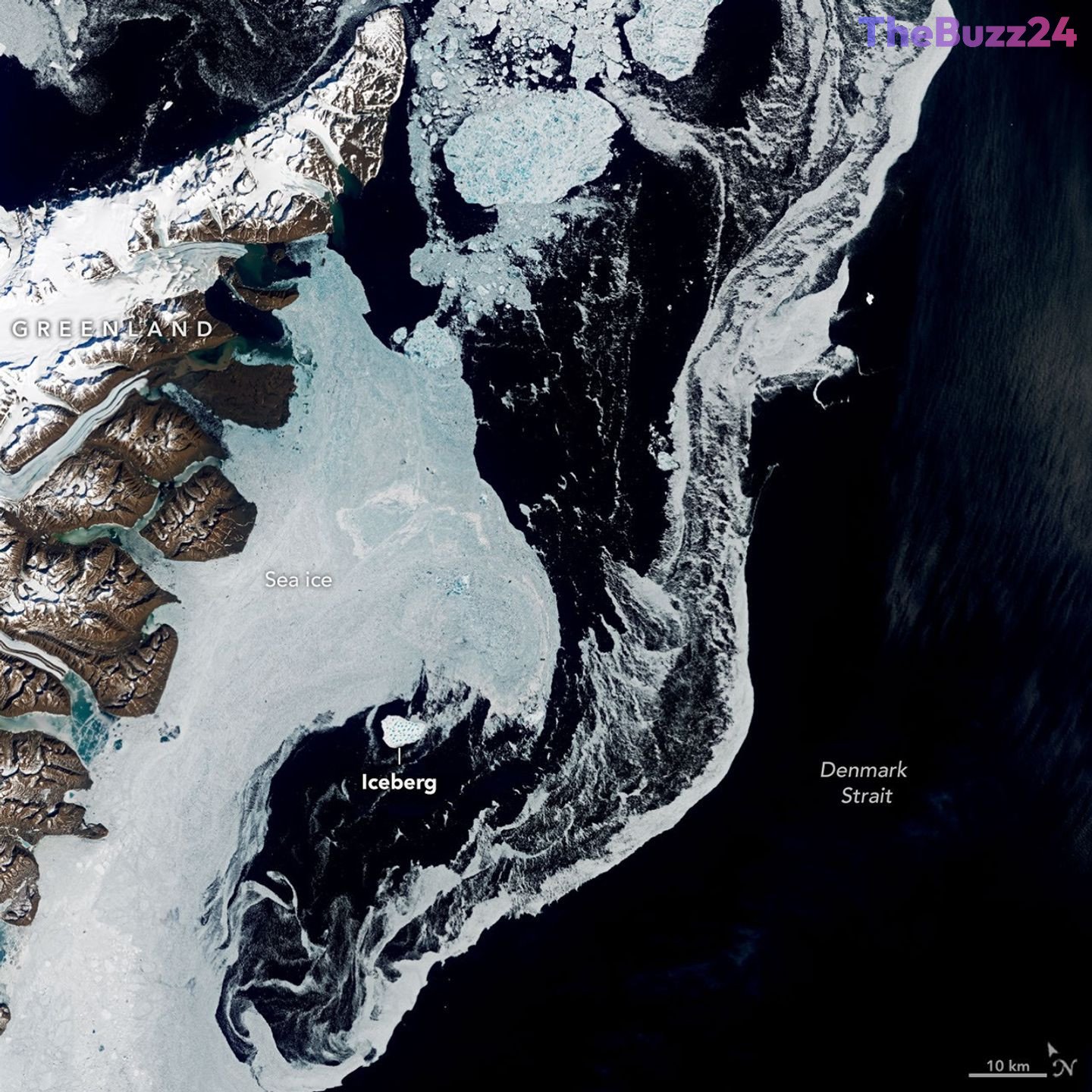
Massive Greenland Iceberg Drifts Southward into the Denmark Strait
A colossal iceberg measuring approximately 17 square kilometers has been tracked drifting through the Denmark Strait, located between Greenland and Iceland. Captured by satellite imagery in June 2026, the frozen mass journeyed more than a thousand kilometers south from its suspected birthplace in northeastern Greenland, providing researchers with a rare window into the dynamic nature of Arctic ice sheets.
Experts analyzing the formation identified it as an iceberg rather than multi-year sea ice due to its distinct brilliant white coloration, proximity to the coastline, and sheer scale—roughly five times the surface area of New York City’s Central Park. Glaciologists and ice advisors trace the berg’s origins back to Jøkelbugten, specifically pointing to a remnant ice shelf associated with the Zachariæ Isstrøm glacier that underwent rapid retreat in the early 2000s. The surface of the iceberg features a unique network of light blue meltwater ponds, resembling Swiss cheese, which heavily supports the theory that it sheared off from the aging shelf ice rather than the main glacier body.
As the summer progressed, the massive chunk of ice was carried further south along the Greenland Coastal Current into the North Atlantic, slowly disintegrating as it encountered warmer waters. Because of its trajectory and eventual breakup in the Denmark Strait, maritime authorities noted that it posed little to no threat to commercial shipping lanes operating around the southern tip of Greenland. Scientists emphasize that tracking such unique drifters highlights the complex interplay of winds, ocean currents, and seasonal variability shaping the changing Arctic landscape.
Key Takeaways
- A 17-square-kilometer iceberg was captured drifting through the Denmark Strait between Greenland and Iceland.
- Experts believe the berg originated from a remnant ice shelf in northeastern Greenland's Jøkelbugten rather than a direct glacial calving event.
- The iceberg traveled roughly 1,500 kilometers south along the Greenland Coastal Current before gradually disintegrating in the North Atlantic.
Editor’s Analysis & Impact
The unexpected journey of this Greenland iceberg underscores the increasing volatility and structural shifts occurring within Arctic ice systems. As warming global temperatures continue to weaken remnant ice shelves, phenomena such as large-scale calving and long-distance drift events are becoming increasingly important to monitor. Beyond the immediate scientific curiosity, tracking these massive ice structures provides vital data on ocean currents, sea-level dynamics, and freshwater inputs into the North Atlantic. While this particular berg fragmented safely away from major shipping lanes, the broader implications point to a persistently transforming polar environment that demands continuous satellite surveillance and advanced climate modeling.
Frequently Asked Questions
Q: Where did the iceberg originate?
A: Experts trace the iceberg's origin to Jøkelbugten, a bay in northeastern Greenland, likely breaking off from a remnant ice shelf associated with the Zachariæ Isstrøm glacier.
Q: How large was the iceberg?
A: The iceberg measured approximately 17 square kilometers (about 7 square miles), making it roughly five times the area of New York City's Central Park.
Q: Did the iceberg pose a threat to shipping lanes?
A: No, because the iceberg began breaking up in the Denmark Strait, it was unlikely to drift into the busier shipping lanes past the southern tip of Greenland.
AI Disclosure: This article is based on verified data and official reports. Our Team and AI have cross-referenced every financial detail with primary sources to ensure total accuracy.
More from this Category