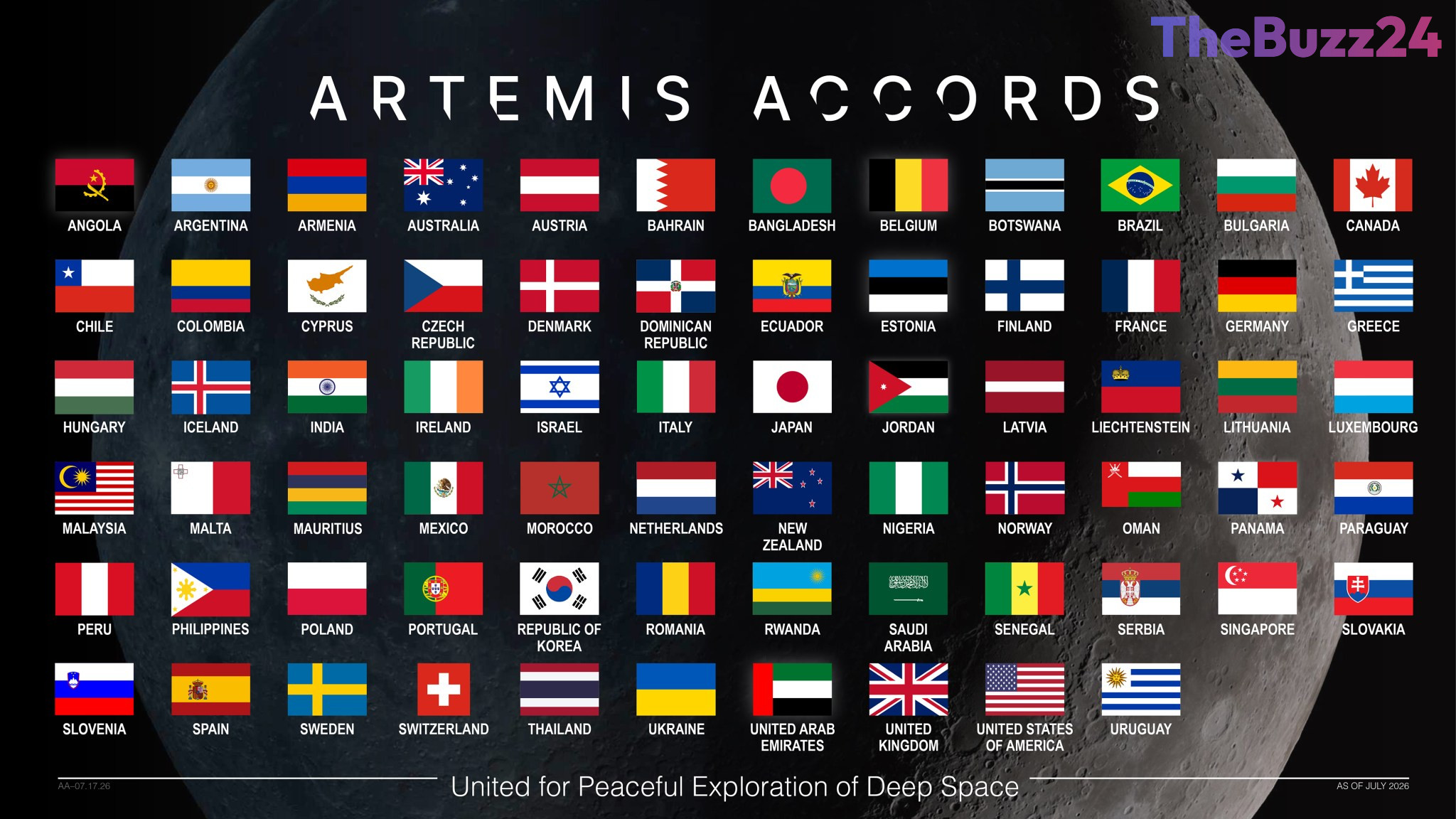
Mauritius Joins Global Coalition for Responsible Space Exploration
The Republic of Mauritius has officially solidified its commitment to international space cooperation by becoming the 70th signatory of the Artemis Accords. This milestone makes Mauritius the seventh African nation to join the growing coalition, which is dedicated to establishing a framework for safe, transparent, and peaceful lunar and deep-space exploration.
The signing ceremony, held in the city of Ébène, was attended by high-ranking officials, including Navindsing Jugmohunsing, Permanent Secretary at the Ministry of Tertiary Education, Science and Research, alongside representatives from the United States. The agreement underscores a shared vision for space governance, emphasizing the importance of scientific data sharing, the preservation of historical lunar sites, and the coordination of activities to prevent interference between nations.
For Mauritius, this partnership represents a significant step in its ‘New Space’ journey. As a Small Island Developing State, the nation aims to leverage space technology to monitor its oceans and coastlines while ensuring that the benefits of space exploration are accessible to all nations. The move also builds upon a historical relationship between the two parties, dating back to the 1960s when Mauritius hosted satellite tracking stations that provided critical geodetic data for early lunar missions.
As the Artemis Accords continue to expand, the inclusion of Mauritius highlights the global nature of the current push toward a sustainable lunar presence. By aligning with these principles, Mauritius joins a diverse group of countries committed to the peaceful use of outer space, setting the stage for future collaborative efforts in lunar and Martian exploration.
Key Takeaways
- Mauritius has become the 70th nation and the seventh African country to sign the Artemis Accords.
- The agreement establishes a set of practical principles for peaceful, transparent, and cooperative space exploration.
- Mauritius plans to utilize its new partnership to advance space governance and leverage satellite data for environmental protection.
Editor’s Analysis & Impact
The expansion of the Artemis Accords to include Mauritius reflects a broader geopolitical trend where space exploration is increasingly viewed as a multilateral endeavor rather than a competition between superpowers. By incorporating smaller, strategically located nations, the coalition strengthens the legitimacy of its governance framework, which is essential for managing the rising number of government and private lunar missions. This move not only provides Mauritius with a seat at the table for future space policy discussions but also ensures that the ‘Golden Age’ of exploration remains inclusive. As more nations join, the Accords are effectively becoming the de facto international standard for lunar operations, creating a stable environment for long-term investment and scientific discovery. The future outlook suggests that space diplomacy will play an increasingly vital role in international relations, with the Accords serving as a blueprint for sustainable development beyond Earth.
Frequently Asked Questions
Q: What are the Artemis Accords?
A: The Artemis Accords are a set of non-binding principles designed to guide civil space exploration and use in the 21st century, focusing on transparency, safety, and the peaceful use of space.
Q: Why is Mauritius joining the Artemis Accords significant?
A: Joining the Accords allows Mauritius to participate in global space governance, access scientific data, and collaborate on future lunar missions, while also highlighting the growing role of African nations in the global space economy.
AI Disclosure: This article is based on verified data and official reports. Our Team and AI have cross-referenced every financial detail with primary sources to ensure total accuracy.
More from this Category