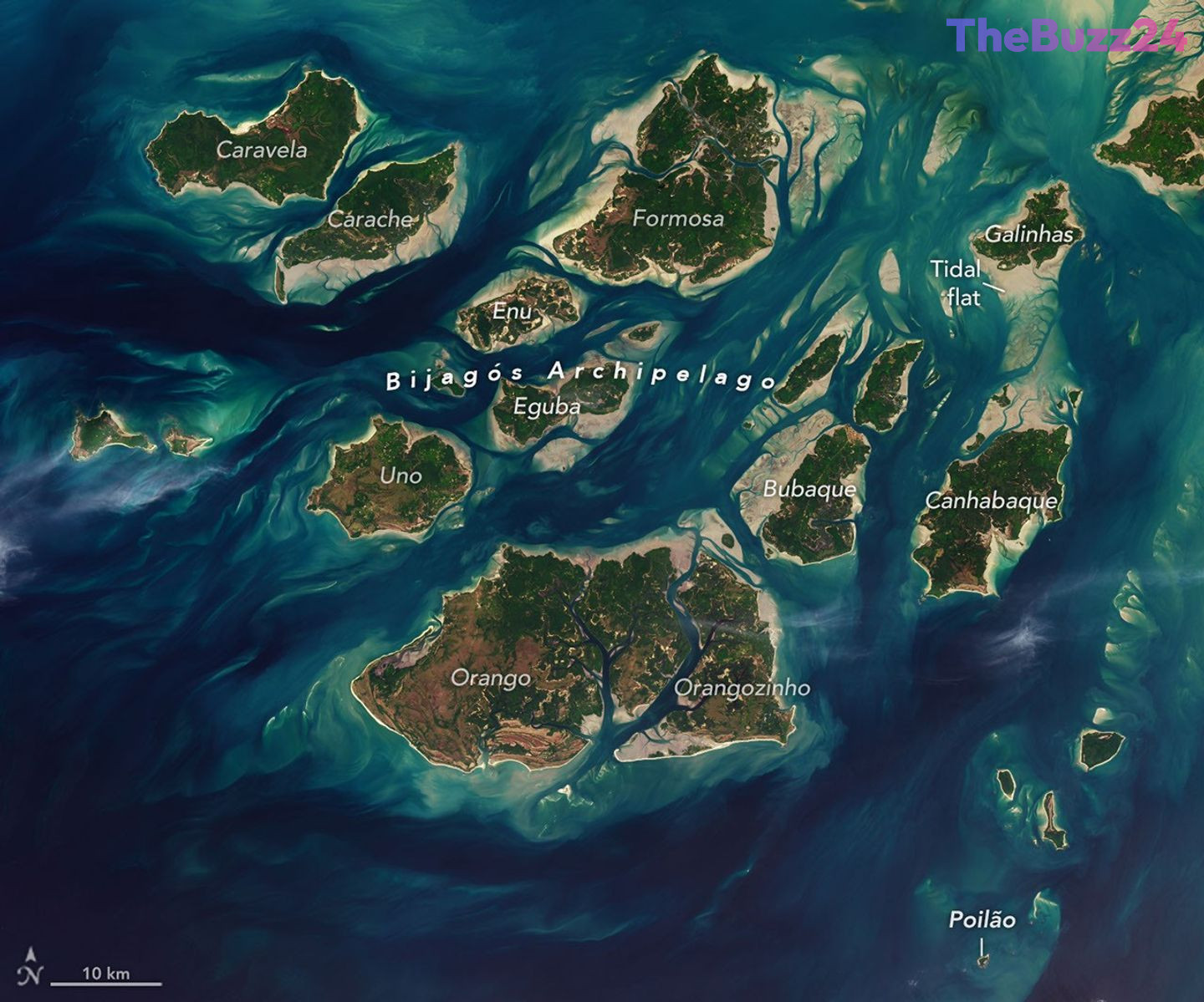
The Bijagós Archipelago: A Tidal Powerhouse of Biodiversity
The Bijagós Archipelago, located off the coast of Guinea-Bissau, stands as one of the most ecologically significant regions in West Africa. Comprising 88 islands and islets, this UNESCO World Heritage site is defined by a unique, dynamic landscape shaped by extreme tidal shifts. Twice daily, the receding waters reveal vast expanses of mudflats and sandflats, effectively expanding the islands’ surface area and creating a nutrient-rich environment that supports a diverse array of marine and avian life.
This archipelago serves as a critical hub for the East Atlantic Flyway, providing a vital feeding ground for approximately 870,000 migratory shorebirds. These birds rely on the abundant marine worms, crustaceans, and mollusks exposed during low tide. As the tide rises, the ecosystem transforms, allowing marine megafauna such as manatees, dolphins, and various fish species to navigate deeper into the protective mangrove forests that fringe the islands.
Beyond its role as a bird sanctuary, the region is a sanctuary for endangered sea turtles. The island of Poilão, part of the João Vieira and Poilão Marine National Park, is a primary nesting site for green sea turtles. The survival of these hatchlings remains a precarious struggle against natural predators, with estimates suggesting that fewer than 1 percent reach adulthood. The archipelago’s unique productivity is attributed to its geography; a wide, shallow shelf and specific estuarine geometry create tidal ranges of up to 7 meters, significantly higher than the regional average of 1 meter.
Key Takeaways
- The Bijagós Archipelago is a UNESCO World Heritage site that serves as a vital stopover for nearly 900,000 migratory shorebirds.
- The region experiences extreme tidal ranges of up to 7 meters, which drive the high productivity of the local marine ecosystem.
- The area is a critical nesting ground for green sea turtles, though hatchling survival rates remain extremely low due to natural predation.
Editor’s Analysis & Impact
The Bijagós Archipelago represents a masterclass in how geological and hydrological features dictate biological success. The 7-meter tidal range is not merely a physical curiosity; it is the engine of the local economy and ecology, facilitating nutrient cycling that sustains massive populations of migratory species. From an environmental management perspective, the region’s status as a UNESCO site is essential, yet it faces the dual challenge of preserving fragile nesting grounds while managing potential interest in eco-tourism. As climate change alters sea levels and coastal currents, the stability of these deltaic ecosystems will become a focal point for conservationists. Future research will likely focus on how these specific tidal dynamics can be modeled to predict the resilience of similar coastal ecosystems globally against rising sea levels.
Frequently Asked Questions
Q: Why is the Bijagós Archipelago so important for migratory birds?
A: It serves as a major feeding station along the East Atlantic Flyway, where the extreme tidal range exposes vast mudflats rich in food sources like crustaceans and marine worms.
Q: What makes the tides in the Bijagós Archipelago unique?
A: Due to the region's wide, shallow shelf and specific estuarine geometry, the archipelago experiences tidal ranges of up to 7 meters, which is significantly higher than the 1-meter average found along much of the West African coast.
AI Disclosure: This article is based on verified data and official reports. Our Team and AI have cross-referenced every financial detail with primary sources to ensure total accuracy.
More from this Category