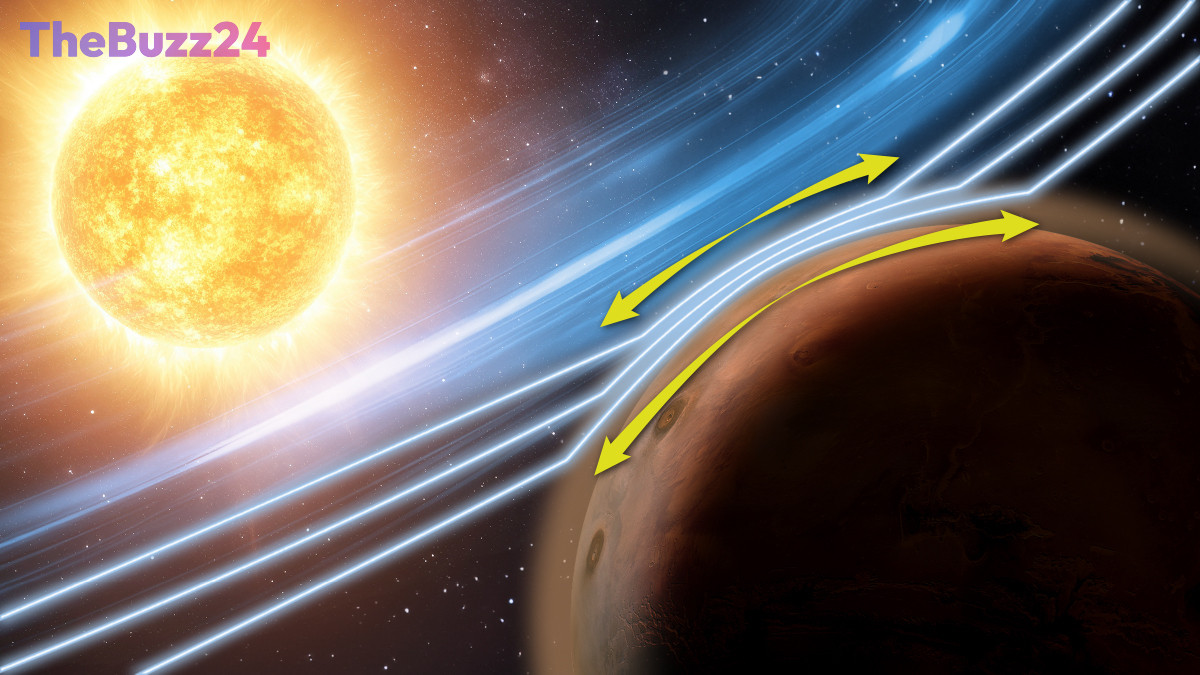
Mars’s Atmosphere Reveals ‘Zwan-Wolf’ Phenomenon for First Time
Scientists operating NASA’s MAVEN spacecraft have identified a novel atmospheric phenomenon on Mars, dubbed the ‘Zwan-Wolf’ effect. This phenomenon, previously observed only within Earth’s magnetosphere since its initial detection in 1976, is characterized by the compression of charged particles along magnetic flux tubes. The findings, detailed in a recent study, provide the first definitive evidence of this effect occurring within the Martian ionosphere.
The discovery was made by a research team led by Christopher Fowler, who observed unusual variations in MAVEN’s magnetic field readings during its orbital passes. Through rigorous analysis and correlation with data from instruments monitoring ionospheric charged particles, the team was able to eliminate other potential causes and confirm the signature of the Zwan-Wolf effect.
While Mars lacks a global magnetic field like Earth’s, its ionosphere can generate an induced magnetosphere that responds to solar wind pressure. Researchers found that a significant solar storm recently amplified this effect, making it detectable by MAVEN’s sensitive instruments at altitudes below 200 kilometers. This amplification allowed for the observation of the characteristic squeezing of charged particles. The team hypothesizes that the Zwan-Wolf effect may be a persistent, yet previously unobserved, feature of Mars’s upper atmosphere, only becoming apparent during periods of intense space weather.
“This marks the inaugural observation of the Zwan-Wolf effect within a planetary atmosphere,” stated Fowler. “It paves the way for enhanced understanding of how solar activity influences the dynamics of Mars’s upper atmosphere and may hold relevance for other celestial bodies lacking a global magnetic field, such as Venus and Titan.” The discovery emphasizes the critical need for continuous monitoring of space weather impacts on Mars, particularly as plans for future surface and orbital missions progress. The MAVEN mission, active since 2014, continues to yield vital data on atmospheric loss processes that have shaped the planet’s climatic past.
Key Takeaways
- The MAVEN spacecraft has detected the 'Zwan-Wolf' effect, a phenomenon involving the compression of charged particles, on Mars for the first time.
- This effect, previously only seen on Earth, was made visible on Mars due to amplification by a recent solar storm interacting with the planet's induced magnetosphere.
- The discovery enhances understanding of solar activity's impact on planetary atmospheres and could have implications for other unmagnetized bodies in the solar system.
Editor’s Analysis & Impact
The detection of the Zwan-Wolf effect on Mars represents a significant advancement in our understanding of planetary atmospheric dynamics and space weather interactions. This finding not only sheds light on the complex processes occurring in Mars’s upper atmosphere but also suggests that similar phenomena might be present on other atmosphered bodies lacking global magnetic fields, such as Venus and Titan. As humanity increasingly focuses on exploring and potentially colonizing Mars, comprehending these atmospheric behaviors is crucial for mission planning, astronaut safety, and the long-term viability of surface operations. The MAVEN mission’s continued success underscores the value of sustained, high-precision observation in unraveling the mysteries of our solar system.
Frequently Asked Questions
Q: What is the Zwan-Wolf effect?
A: The Zwan-Wolf effect is a phenomenon observed in planetary magnetospheres where charged particles are squeezed or compressed along magnetic flux tubes. It was first identified in Earth's magnetosphere in 1976.
Q: Why was the Zwan-Wolf effect difficult to detect on Mars?
A: Mars lacks a global magnetic field, and the Zwan-Wolf effect is typically subtle. It was only detected on Mars when a recent solar storm amplified the planet's induced magnetosphere, making the phenomenon visible to the MAVEN spacecraft's instruments.
Q: What are the implications of this discovery for future Mars missions?
A: Understanding atmospheric phenomena like the Zwan-Wolf effect is crucial for planning future missions. It helps scientists better predict how solar activity might impact spacecraft and astronauts, and provides insights into the evolution of Mars's atmosphere and climate.
AI Disclosure: This article is based on verified data and official reports. Our Team and AI have cross-referenced every financial detail with primary sources to ensure total accuracy.
More from this Category