Shivelyuch Volcano’s Persistent Heat Continues to Transform Kamchatka’s Terrain
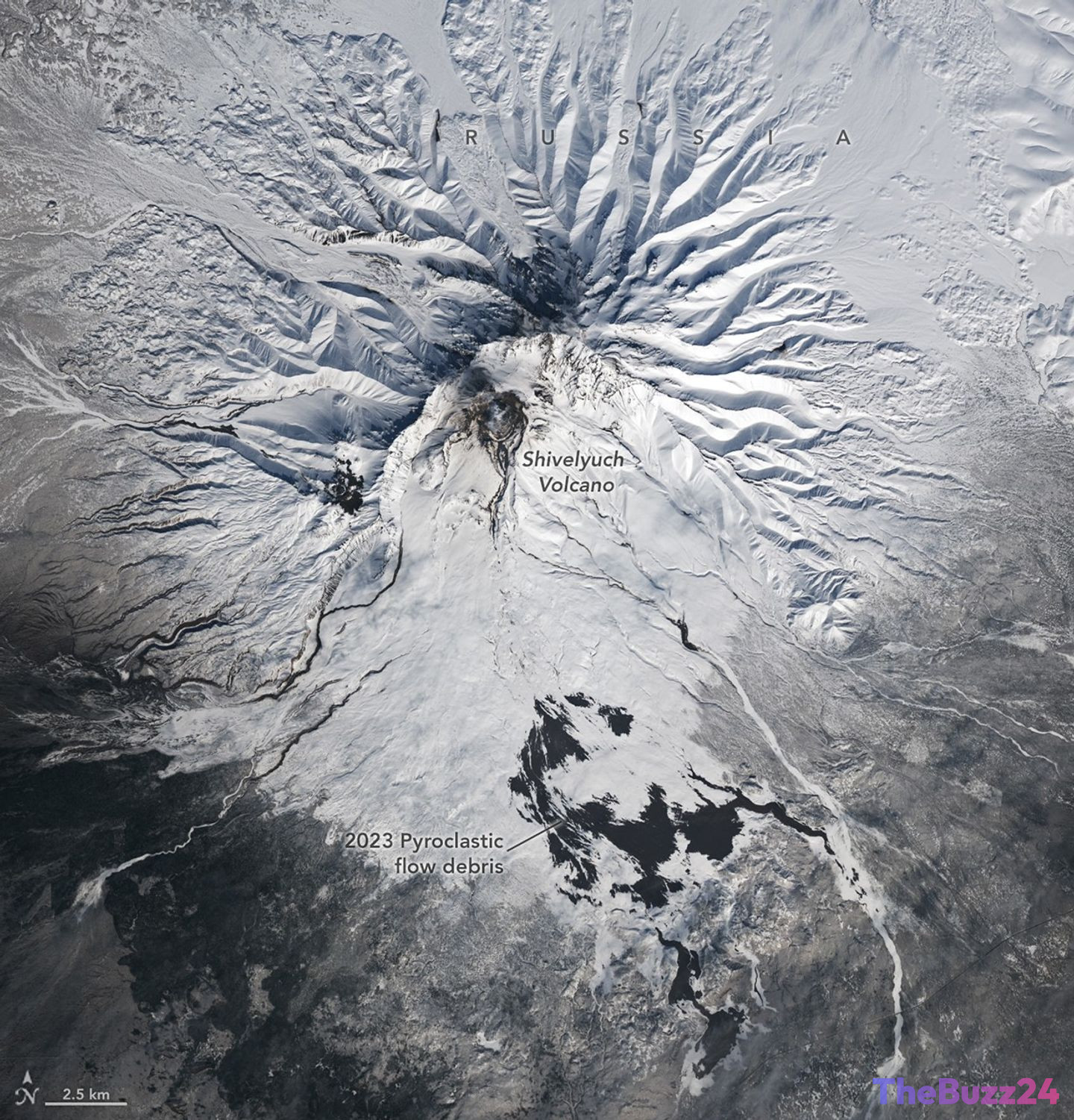
The Shivelyuch volcano, situated on the northern edge of Russia’s Kamchatka Peninsula, remains a primary subject of geological observation as it continues to demonstrate significant thermal output. Recent satellite imagery from late April 2026 illustrates a striking visual disparity between the volcano’s dark, ash-laden slopes and the surrounding snow-covered landscape. This ongoing thermal activity effectively prevents snow from settling, creating a stark, barren environment that highlights the mountain’s continuous geological evolution.
Central to this activity is the development of a lava dome within the volcano’s horseshoe-shaped caldera. This structure undergoes frequent cycles of growth and collapse, which trigger block-and-ash flows—avalanches of superheated debris that descend the mountainside. These deposits serve as powerful thermal insulators, trapping intense heat that can persist for years. Consequently, these ‘hot zones’ remain devoid of snow long after the initial volcanic events have concluded, fundamentally altering the local topography.
This pattern of growth and collapse is characteristic of Shivelyuch, which is still undergoing a long-term recovery process following a major flank collapse in April 2023. That event resulted in extensive environmental disruption, leaving behind vast fields of debris that continue to radiate heat. Scientific analysis confirms that these volcanic deposits possess remarkable thermal resilience, with some materials remaining hot to the touch for as long as five years. As one of the world’s most active volcanic systems, Shivelyuch provides a critical look at the enduring environmental consequences of persistent volcanic eruptions.
Key Takeaways
- Satellite data shows Shivelyuch's thermal radiation is actively preventing snow accumulation on its slopes.
- The volcano's lava dome periodically collapses, creating debris flows that act as long-term heat insulators.
- Volcanic deposits from Shivelyuch can retain significant heat for up to five years, delaying ecological recovery.
Editor’s Analysis & Impact
The ongoing thermal activity at Shivelyuch offers a unique window into the long-term environmental legacy of explosive volcanism. By retaining heat within debris deposits for years, the volcano creates localized climate anomalies that inhibit ecological succession. From a geological standpoint, these ‘hot zones’ are essential for understanding how volcanic systems redistribute mass and energy across a landscape. As Shivelyuch remains one of the most active volcanoes globally, it functions as a natural laboratory for monitoring the lifecycle of lava domes and the aftermath of flank collapses. Future research into these thermal deposits will likely refine predictive models for volcanic hazards and enhance our understanding of cooling rates in sub-arctic environments, providing broader implications for disaster mitigation and geological monitoring in similar regions worldwide.
Frequently Asked Questions
Q: Why does snow fail to accumulate on certain parts of Shivelyuch?
A: Snow cannot accumulate in these areas because the volcanic debris flows generated by the mountain retain intense heat for several years, causing any snow that falls to melt upon contact.
Q: What is a block-and-ash flow?
A: A block-and-ash flow is an avalanche of superheated volcanic material triggered by the structural collapse of a growing lava dome within the volcano's caldera.
AI Disclosure: This article is based on verified data and official reports. Our Team and AI have cross-referenced every financial detail with primary sources to ensure total accuracy.
More from this Category