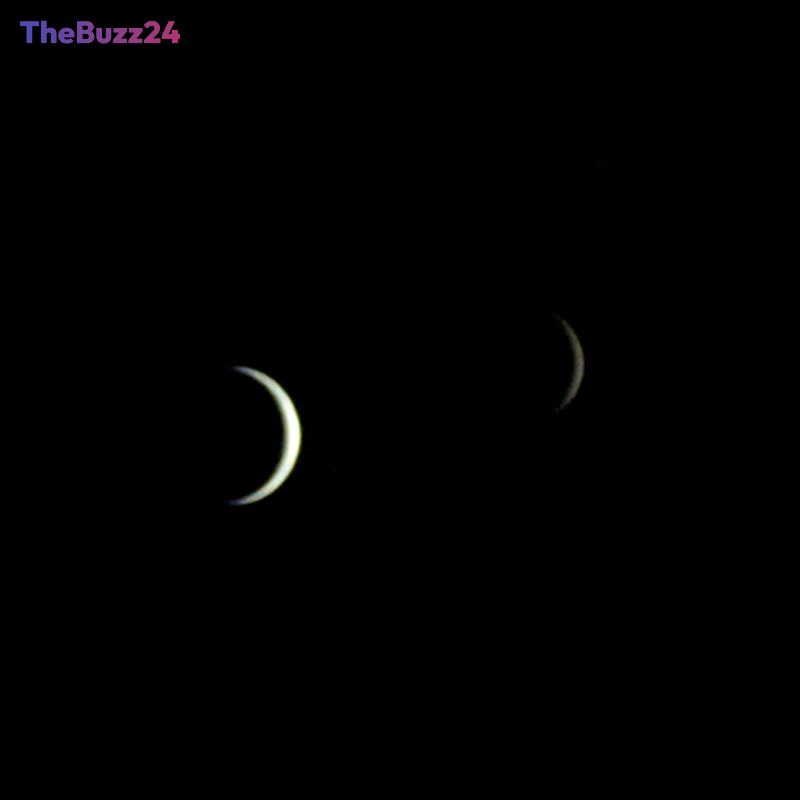
NASA’s ESCAPADE Captures Stunning ‘Family Portrait’ of Earth and Moon
NASA’s ESCAPADE mission, designed to explore the Martian environment, has provided a unique perspective of our home planet and its moon. On July 3, one of the two ESCAPADE spacecraft, currently en route to Mars, captured a striking “family portrait” of Earth and the Moon. The images were taken when the spacecraft was approximately 363,250 miles (584,600 kilometers) from Earth and 115,600 miles (186,100 kilometers) from the Moon, a distance that made our lunar companion appear notably large in the frame.
The captured images offer a dual view: one in visible light and another in thermal infrared. The visible light photograph reveals both celestial bodies as crescents, with only about 8% of their surfaces illuminated by the Sun. In contrast, the thermal infrared image showcases Earth’s shadowed hemisphere glowing with its own emitted heat, ranging from 250 to 280 kelvins (-10 to 44 degrees Fahrenheit). The Moon’s far side, lacking the insulating effects of oceans and atmosphere, appears significantly cooler at 100 kelvins (-280 degrees Fahrenheit).
These images, acquired using the Visible and Infrared Observation System cameras, serve a crucial purpose beyond aesthetic appeal. They act as an essential calibration check for ESCAPADE’s instruments, which are intended to study Martian aurora and the thermal properties of the Red Planet’s surface and atmosphere. “We are thrilled that ESCAPADE was able to accommodate these excellent space-qualified cameras which will search for visible Martian aurora and investigate thermal properties of the Martian surface and atmosphere,” stated Rob Lillis, the mission’s principal investigator at the University of California, Berkeley. “Since Earth and the Moon are well-known targets, imaging them provides an important calibration check for ESCAPADE’s cameras.”
The ESCAPADE spacecraft, constructed by Rocket Lab, are currently positioned in a loiter orbit around the second Lagrange point (L2), roughly a million miles from Earth. Their journey to Mars is scheduled to include a gravity-assist flyby of Earth in November 2026, with arrival anticipated in September 2027. Once in orbit around Mars, the mission will investigate the interaction between the solar wind and the Martian atmosphere, a key factor in understanding atmospheric loss on the Red Planet.
Key Takeaways
- NASA's ESCAPADE spacecraft captured a unique 'family portrait' of Earth and the Moon from deep space.
- The images were taken in both visible and thermal infrared light, providing different insights into the celestial bodies' temperatures and illumination.
- These observations serve as a critical calibration step for ESCAPADE's scientific instruments before their arrival at Mars.
Editor’s Analysis & Impact
The ESCAPADE mission’s capture of Earth and Moon images highlights the dual-purpose nature of deep space exploration. While primarily focused on Mars, these early observations provide invaluable data for instrument calibration, ensuring the accuracy of future Martian studies. This practice underscores the scientific rigor behind space missions, where even seemingly incidental imaging contributes to the overall success and reliability of the primary objectives. The thermal infrared data, in particular, offers a novel way to study planetary bodies, potentially informing future research on exoplanets and the thermal dynamics of planetary atmospheres. The mission’s progress also reflects advancements in small satellite technology and collaborative efforts within NASA’s Heliophysics Division.
Frequently Asked Questions
Q: What is the ESCAPADE mission?
A: ESCAPADE (Escape and Plasma Acceleration and Dynamics Explorers) is a NASA mission consisting of two spacecraft designed to study how the solar wind interacts with the Martian environment and contributes to atmospheric loss on Mars.
Q: Why did ESCAPADE take pictures of Earth and the Moon?
A: The images were taken as a crucial calibration step for ESCAPADE's scientific instruments. By imaging well-known targets like Earth and the Moon, scientists can verify that the cameras are functioning correctly and providing accurate data before the spacecraft reaches Mars.
Q: Where are the ESCAPADE spacecraft currently located?
A: The ESCAPADE spacecraft are currently in a loiter orbit around the second Lagrange point (L2), approximately one million miles from Earth, on their way to Mars.
AI Disclosure: This article is based on verified data and official reports. Our Team and AI have cross-referenced every financial detail with primary sources to ensure total accuracy.
More from this Category