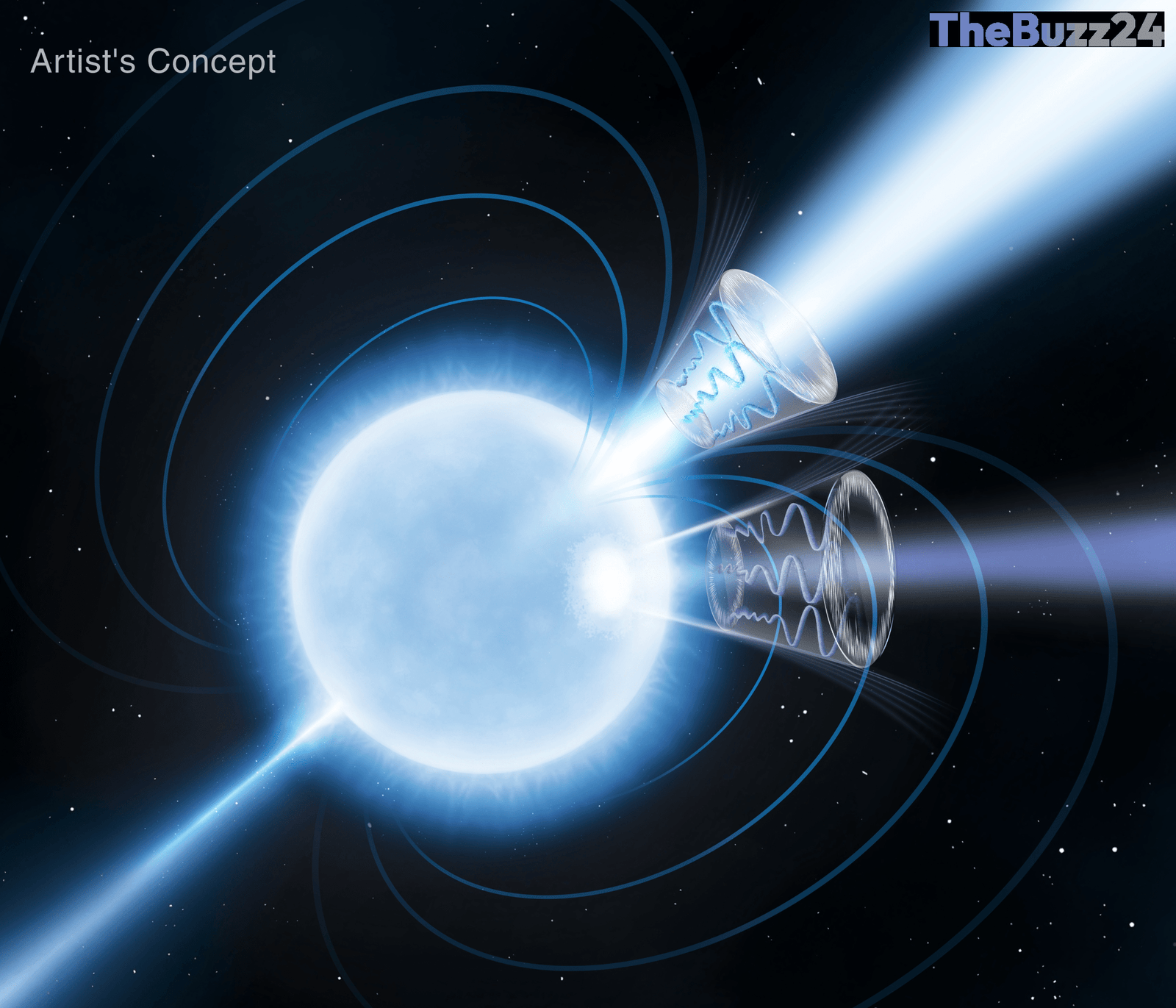
NASA’s IXPE Telescope Uncovers Potential Evidence of Quantum Vacuum Birefringence
Researchers utilizing the Imaging X-ray Polarimetry Explorer (IXPE) have potentially observed a phenomenon that has remained theoretical for nearly a century. By conducting over 140 hours of intensive observations on the magnetar 1E 1547-5408 between March and April 2025, the team gathered data that suggests empty space may be behaving in accordance with long-standing quantum electrodynamic predictions.
Magnetars represent a unique and extreme class of neutron stars characterized by magnetic fields of unparalleled intensity. These fields are estimated to be roughly a trillion times more powerful than the strongest permanent magnets ever engineered on Earth, creating an environment where the laws of physics are pushed to their absolute limits. This extreme setting provides a natural laboratory for testing theories that are impossible to replicate in terrestrial conditions.
The observations focus on the concept of vacuum birefringence, a prediction that suggests the vacuum of space can act like a crystal, altering the polarization of light as it passes through intense magnetic fields. While physicists have theorized this interaction for 90 years, the data captured by IXPE offers a significant step toward direct observational confirmation of this elusive quantum effect.
Key Takeaways
- NASA's IXPE telescope spent 140 hours observing the magnetar 1E 1547-5408 to study extreme magnetic environments.
- The data provides potential evidence for vacuum birefringence, a 90-year-old theory regarding how light interacts with empty space.
- Magnetars possess the strongest magnetic fields in the known universe, making them ideal subjects for testing quantum electrodynamics.
Editor’s Analysis & Impact
The potential confirmation of vacuum birefringence marks a significant milestone in high-energy astrophysics. By validating a 90-year-old prediction, this discovery reinforces the accuracy of quantum electrodynamics (QED) in extreme environments. From an industry perspective, this underscores the immense value of specialized X-ray polarimetry missions in expanding our fundamental understanding of the universe. As we continue to refine our ability to observe these ‘natural laboratories,’ the implications for theoretical physics are profound, potentially bridging gaps between quantum mechanics and general relativity. Future missions will likely build upon these IXPE findings to further map the behavior of light in the presence of intense gravitational and magnetic fields, ultimately refining our models of how the cosmos functions at its most granular level.
Frequently Asked Questions
Q: What is a magnetar?
A: A magnetar is a type of neutron star that possesses an ultra-strong magnetic field, which is significantly more powerful than any magnetic field created by humans.
Q: What is vacuum birefringence?
A: Vacuum birefringence is a theoretical phenomenon where the vacuum of space behaves like a crystal, causing the polarization of light to change as it travels through an extremely strong magnetic field.
AI Disclosure: This article is based on verified data and official reports. Our Team and AI have cross-referenced every financial detail with primary sources to ensure total accuracy.
More from this Category