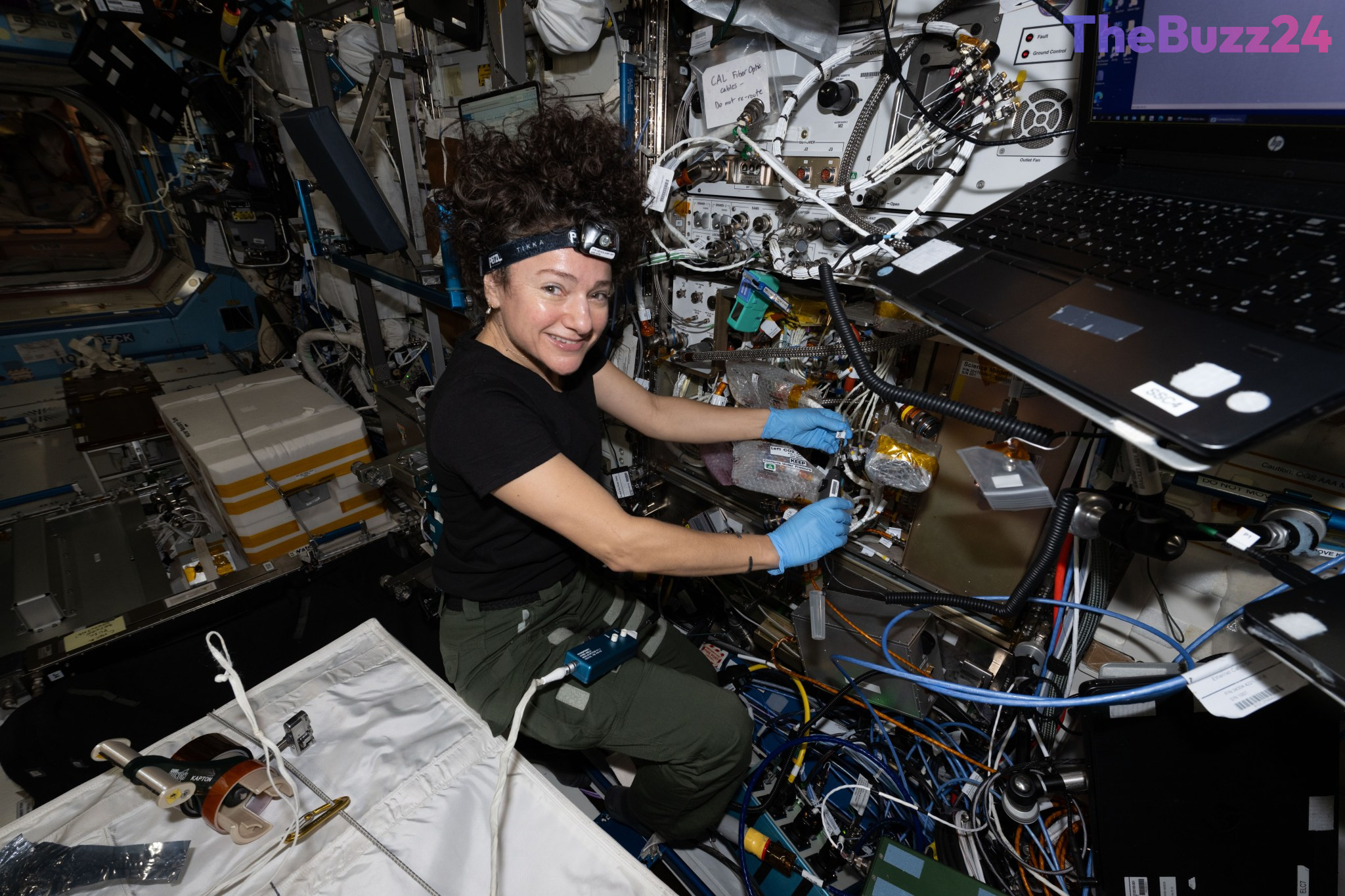
NASA’s Orbital Quantum Lab Receives Major Performance Upgrade
Astronauts aboard the International Space Station have successfully activated a significant hardware upgrade for the Cold Atom Lab (CAL), a specialized facility designed to push the boundaries of quantum physics. Roughly the size of a minifridge, the laboratory allows researchers to investigate the behavior of matter at temperatures near absolute zero, a feat that is significantly more effective in the microgravity environment of low Earth orbit than on the ground.
By chilling atoms to temperatures below minus 459 degrees Fahrenheit, the facility creates Bose-Einstein condensates—a unique state of matter where atoms behave as a single quantum object. This state allows scientists to observe wave-like properties of matter that are otherwise impossible to study in standard terrestrial conditions. The latest improvements, which include a redesigned magnetic trap and new gas-source metal strips, enable researchers to manipulate these quantum states with unprecedented precision.
This mission represents a critical step in what experts are calling ‘quantum 2.0,’ the direct manipulation of large quantum states. Beyond fundamental physics research, the project serves as a testbed for space-ready quantum technologies. These advancements could eventually revolutionize fields such as navigation, timekeeping, and gravity sensing, providing essential tools for future deep-space exploration and enhanced Earth-based scientific monitoring.
Key Takeaways
- The Cold Atom Lab has received its fourth major hardware upgrade, enhancing its ability to study quantum matter in microgravity.
- The facility creates Bose-Einstein condensates, a fifth state of matter that allows for the study of quantum mechanics on a larger, more observable scale.
- The research aims to develop 'quantum 2.0' technologies, which could lead to breakthroughs in navigation, timing, and gravity sensing for future space missions.
Editor’s Analysis & Impact
The ongoing development of the Cold Atom Lab signifies a shift from theoretical quantum physics to practical, space-based quantum engineering. By successfully maintaining and upgrading complex quantum hardware in orbit, the project demonstrates that the space environment is a viable laboratory for high-precision instrumentation. The implications for the future are profound; as these technologies mature, they will likely lead to a new generation of sensors that are far more accurate than current GPS or inertial navigation systems. Furthermore, the ability to conduct ‘quantum 2.0’ experiments in space provides a unique competitive advantage in the global race to master quantum technologies, potentially influencing everything from deep-space communication to the fundamental understanding of gravity and time.
Frequently Asked Questions
Q: Why is it better to study quantum physics in space?
A: Microgravity allows scientists to study quantum gases for longer periods and at lower temperatures than on Earth, resulting in larger, more stable quantum waves that are easier to measure.
Q: What is a Bose-Einstein condensate?
A: It is a state of matter formed at temperatures just above absolute zero, where a collection of atoms begins to behave as a single quantum object, allowing researchers to observe quantum mechanical rules on a macroscopic scale.
AI Disclosure: This article is based on verified data and official reports. Our Team and AI have cross-referenced every financial detail with primary sources to ensure total accuracy.
More from this Category