NASA’s Roman Space Telescope to Carry Over One Million Names into Deep Space
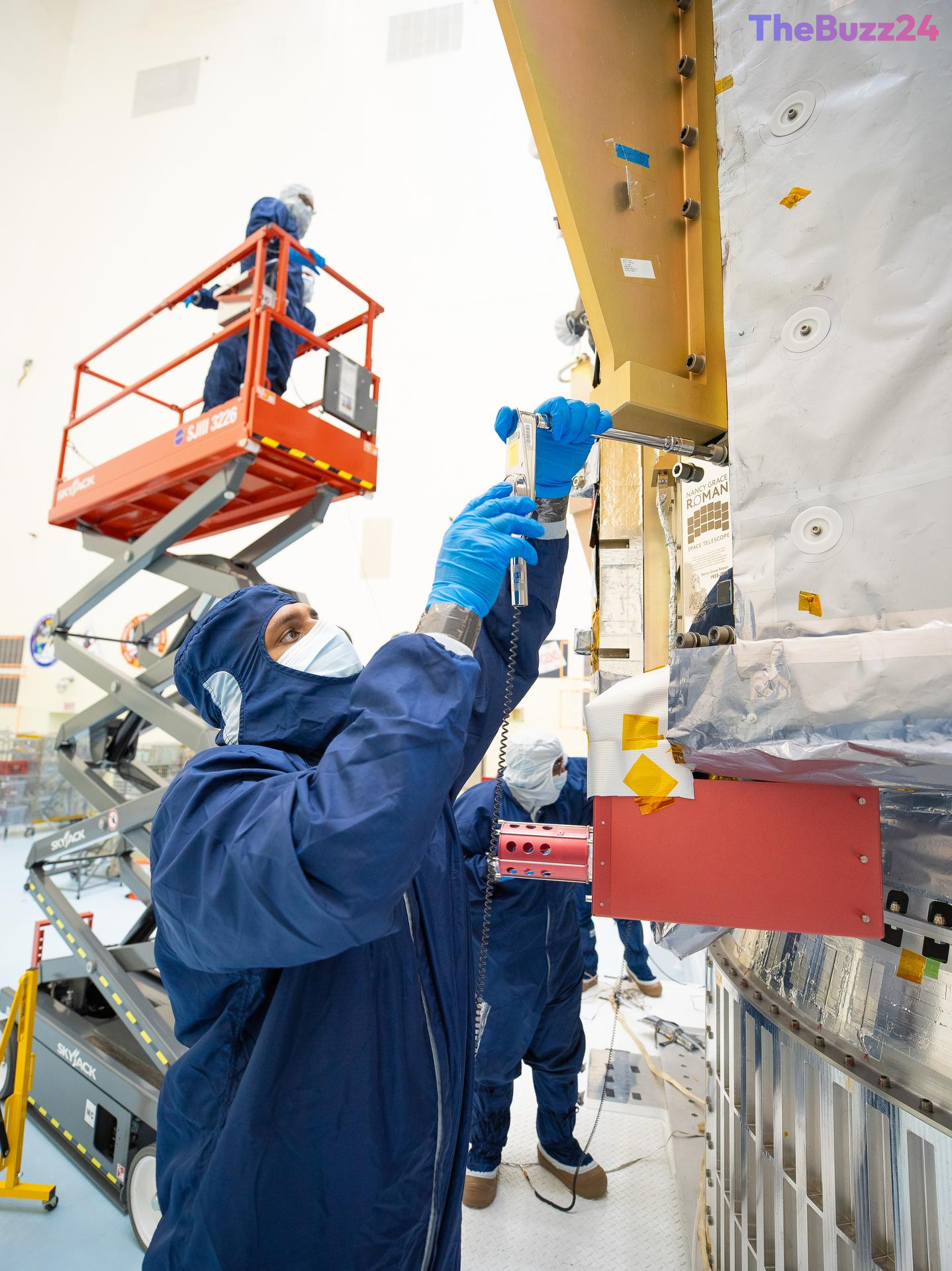
In a symbolic gesture connecting the public to the frontiers of exploration, NASA has officially installed a memory card containing the names of 1,350,144 individuals onto the Nancy Grace Roman Space Telescope. The commemorative plaque, which was secured by technicians at the Kennedy Space Center in Florida, includes submissions from people across the globe, as well as the crews of the upcoming Artemis II and Artemis III lunar missions.
The telescope is destined for the Sun-Earth Lagrange point 2 (L2), a stable gravitational location situated approximately one million miles from Earth. By positioning the observatory at this remote vantage point, scientists aim to bypass the interference of Earth’s atmosphere, allowing for unprecedented clarity in deep-space observations. The mission is scheduled to launch aboard a SpaceX Falcon Heavy rocket from Launch Complex 39A.
Named in honor of Dr. Nancy Grace Roman, the agency’s first chief astronomer, the observatory serves as a tribute to her legacy. Dr. Roman was instrumental in shaping modern space science, famously advocating for space-based telescopes that could provide the global scientific community with unobstructed views of the cosmos. This mission continues her vision by expanding humanity’s ability to study the universe’s most complex phenomena.
Key Takeaways
- NASA has finalized the installation of a memory card containing over 1.35 million public names onto the Nancy Grace Roman Space Telescope.
- The telescope will be deployed to the Sun-Earth Lagrange point 2, located one million miles from our planet.
- The mission honors Dr. Nancy Grace Roman, a pioneer who championed the development of space-based observatories.
Editor’s Analysis & Impact
The Nancy Grace Roman Space Telescope represents a significant leap in our observational capabilities, designed to address fundamental questions in cosmology, including the nature of dark energy and the search for exoplanets. By involving the public through the ‘Message in a Bottle’ style name collection, NASA is effectively fostering long-term public engagement with high-cost scientific endeavors. From an industry perspective, the reliance on the SpaceX Falcon Heavy highlights the continued integration of commercial launch providers into critical government research missions. As the telescope reaches its L2 destination, the data it produces is expected to revolutionize our understanding of the universe’s expansion, potentially shifting paradigms in theoretical physics and astronomy over the next decade.
Frequently Asked Questions
Q: What is the purpose of the Nancy Grace Roman Space Telescope?
A: The telescope is designed to study the universe from above Earth's atmosphere, focusing on dark energy, exoplanets, and infrared astrophysics to provide a clearer understanding of cosmic evolution.
Q: Where is the Sun-Earth Lagrange point 2 (L2)?
A: L2 is a point in space about one million miles from Earth where the gravitational forces of the Sun and Earth balance out, providing a stable environment for space observatories to operate.
AI Disclosure: This article is based on verified data and official reports. Our Team and AI have cross-referenced every financial detail with primary sources to ensure total accuracy.
More from this Category