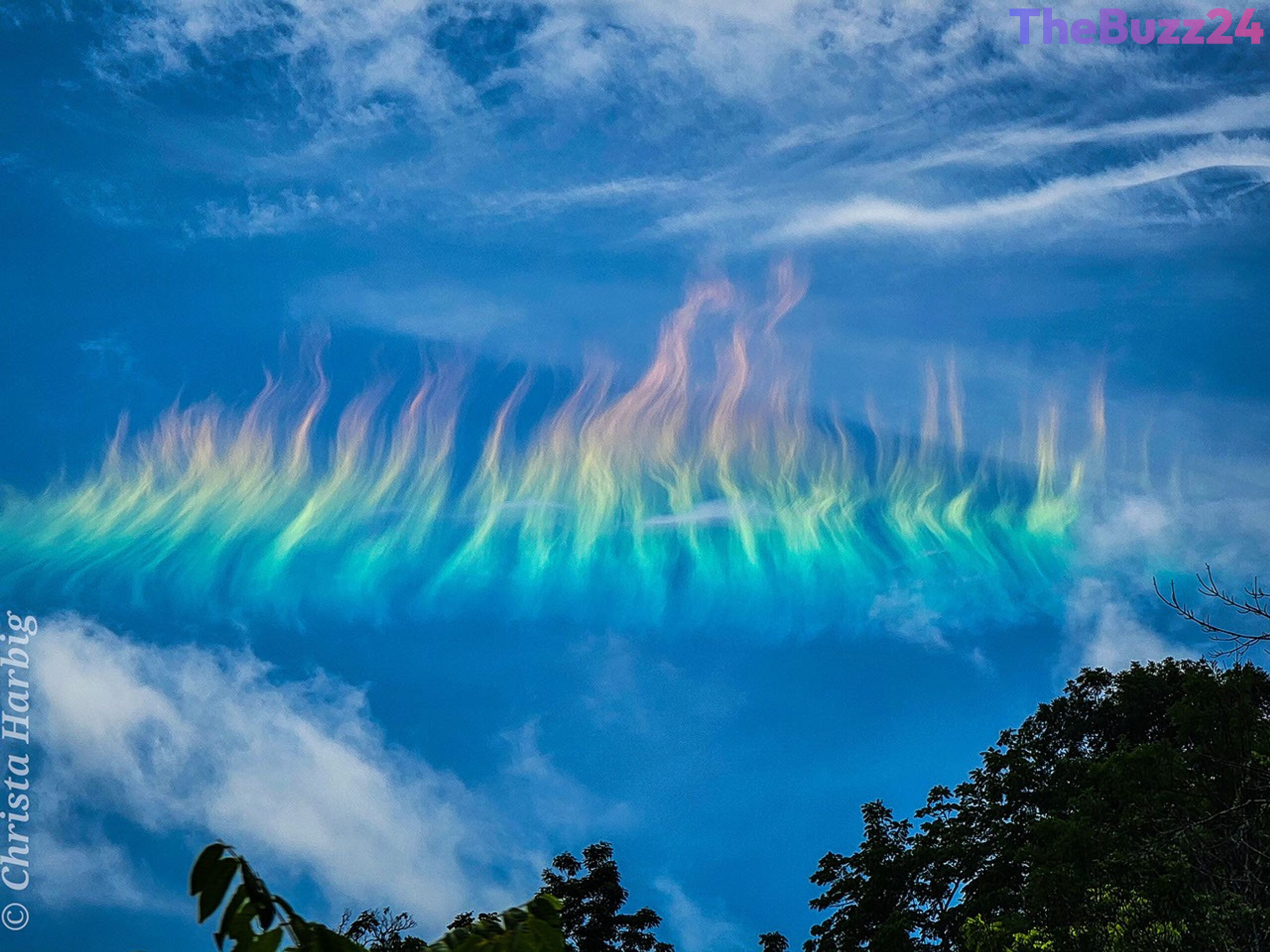
Rare ‘Fire Rainbow’ Illuminates West Virginia Skies in Stunning Atmospheric Display
A breathtaking atmospheric phenomenon, informally known as a “fire rainbow,” captivated observers near North Fork Mountain in West Virginia in 2021. This vibrant display, scientifically termed a circumhorizon arc, presented a stunning spectrum of colors, appearing to float parallel to the horizon and resembling flames across the sky.
The occurrence of a circumhorizon arc is a testament to specific and somewhat unusual atmospheric conditions. It forms when sunlight passes through hexagonal ice crystals suspended within high-altitude cirrus clouds, particularly the cirrus fibratus type. These tiny ice crystals act as miniature prisms, refracting the sunlight and splitting it into its constituent colors, much like a conventional rainbow.
However, unlike a typical rainbow, a circumhorizon arc requires a precise alignment. For the phenomenon to be visible, the sun must be positioned at least 58 degrees above the horizon. Crucially, the numerous, flat, hexagonal ice crystals within the cirrus cloud must be oriented horizontally. This specific alignment ensures that the sunlight is refracted in a collectively similar manner, creating the distinct, vivid arc. Due to these stringent requirements, witnessing a circumhorizon arc is considered a relatively rare and special event.
Key Takeaways
- A "fire rainbow" is a circumhorizon arc, a rare atmospheric optical phenomenon characterized by its flame-like appearance.
- It forms when sunlight refracts through horizontally aligned hexagonal ice crystals within high-altitude cirrus clouds.
- Specific conditions, including the sun being at least 58 degrees above the horizon, are essential for its visibility.
Editor’s Analysis & Impact
The observation of phenomena like the “fire rainbow” underscores the intricate beauty and complexity of Earth’s atmosphere. While it doesn’t directly impact financial markets or specific industries, such events contribute significantly to public engagement with science and meteorology. Increased awareness, often amplified by social media, can inspire a greater appreciation for natural wonders and potentially foster interest in atmospheric science, photography, and citizen science initiatives. From a broader perspective, these occurrences serve as a reminder of the dynamic processes constantly at play in our environment, encouraging continued research into atmospheric optics and climate patterns.
Frequently Asked Questions
Q: What is a "fire rainbow"?
A: A "fire rainbow" is the informal name for a circumhorizon arc, which is an optical phenomenon appearing as a colorful, flame-like band parallel to the horizon. It's not a true rainbow but rather a halo phenomenon.
Q: What causes a circumhorizon arc to form?
A: It is caused by sunlight refracting through horizontally aligned, plate-shaped hexagonal ice crystals found in high-altitude cirrus clouds. The sun must also be at a high angle, at least 58 degrees above the horizon.
Q: Are "fire rainbows" common?
A: No, circumhorizon arcs are relatively rare because they require a very specific combination of conditions: the presence of cirrus clouds with horizontally oriented ice crystals and the sun being at a high angle in the sky.
AI Disclosure: This article is based on verified data and official reports. Our Team and AI have cross-referenced every financial detail with primary sources to ensure total accuracy.
More from this Category