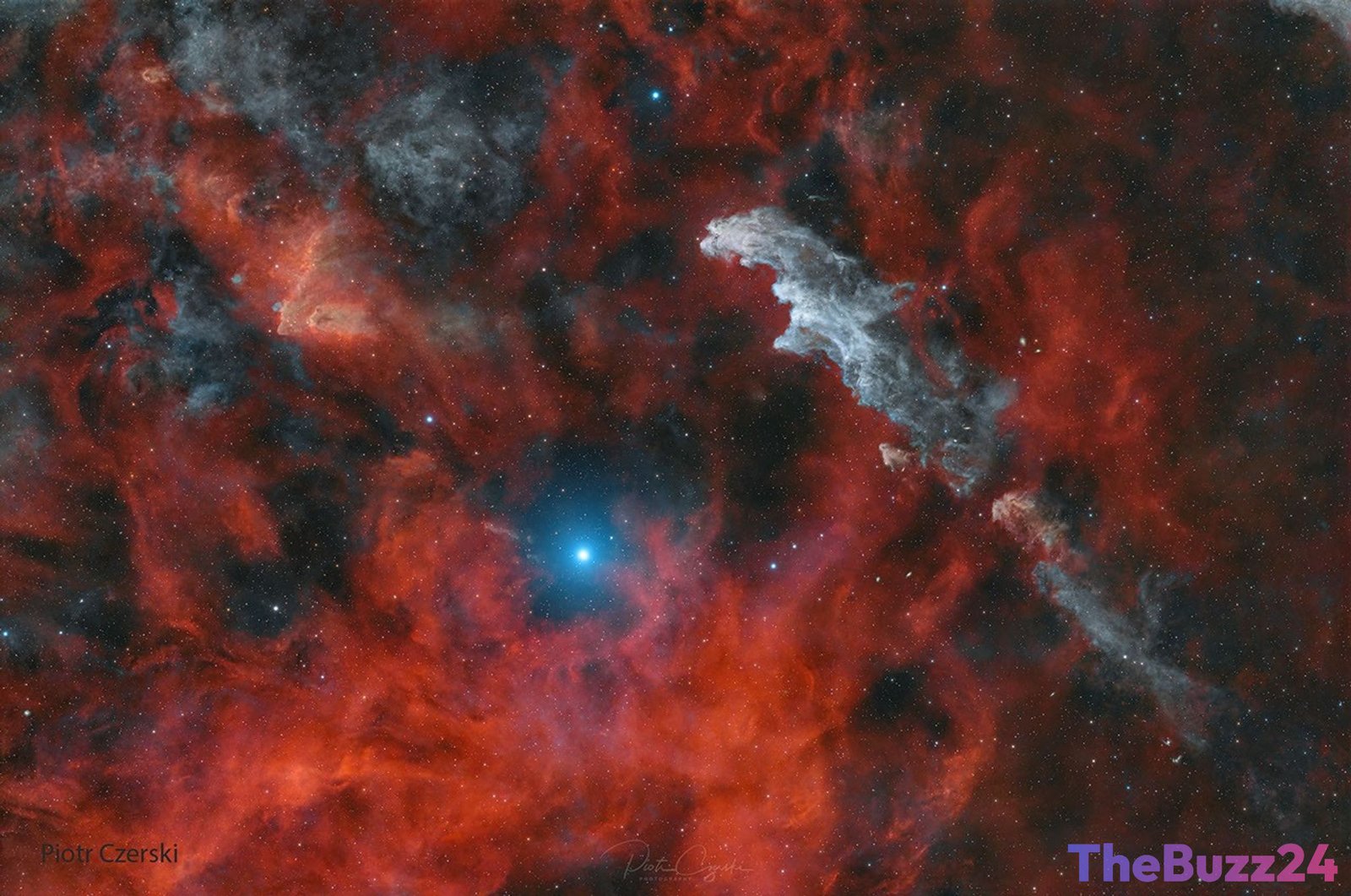
Stunning Cosmic Portrait Captures Rigel and the Eerie Witch Head Nebula
A breathtaking celestial image has brought into sharp focus the striking interplay between a brilliant blue supergiant star and a haunting interstellar dust cloud known as the Witch Head Nebula. Spanning approximately 50 light-years across, the expansive nebula gets its iconic moniker from imaginative stargazers who see a resemblance to a classic Halloween caricature of a witch’s profile.
The cosmic spectacle, officially designated as IC 2118, owes much of its form to the energetic influence of the nearby star Rigel. Located just below the frame’s center in the constellation Orion, Rigel has actively sculpted and eroded the surrounding gas and dust over vast expanses of time through its intense stellar winds and radiation.
The distinctive azure hue illuminating the nebula is primarily the result of two physical mechanisms. First, Rigel radiates an intense blue starlight. Second, the microscopic dust grains within IC 2118 scatter blue light wavelengths far more efficiently than red wavelengths. This exact same optical scattering phenomenon is responsible for giving Earth its familiar blue daytime skies, though terrestrial scattering relies on nitrogen and oxygen molecules rather than interstellar dust.
Key Takeaways
- The Witch Head Nebula (IC 2118) spans an impressive 50 light-years and is composed of interstellar gas and dust.
- The nebula's distinctive shape has been partly eroded and sculpted by the intense energy of the nearby bright star Rigel.
- The brilliant blue coloration of the nebula is caused by Rigel's starlight combined with the efficient scattering of blue light by dust grains.
Editor’s Analysis & Impact
Astrophotography and daily public outreach initiatives continue to play a pivotal role in maintaining public engagement with space exploration and astronomical sciences. By capturing phenomena like the Witch Head Nebula, researchers and astrophotographers bridge the gap between complex astrophysical concepts—such as Rayleigh and Mie scattering—and accessible visual storytelling. As imaging technologies advance, the clarity and frequency of such deep-space discoveries will likely increase, driving further interest in astronomy education and inspiring future generations of scientists and space enthusiasts worldwide.
Frequently Asked Questions
Q: What is the Witch Head Nebula?
A: The Witch Head Nebula, cataloged as IC 2118, is a massive reflection nebula composed of gas and dust that spans about 50 light-years and is famously shaped like a witch's profile.
Q: Why is the Witch Head Nebula blue?
A: The nebula appears blue because of the intense blue light emitted by the nearby star Rigel, combined with the microscopic dust grains in the nebula scattering blue light more efficiently than red light.
Q: Which constellation contains Rigel and the Witch Head Nebula?
A: Both Rigel and the Witch Head Nebula are located within the prominent constellation Orion.
AI Disclosure: This article is based on verified data and official reports. Our Team and AI have cross-referenced every financial detail with primary sources to ensure total accuracy.
More from this Category