The Price of Progress: Dutch Village Faces Erasure for Green Energy Infrastructure
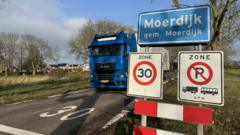
The small fishing community of Moerdijk, situated on the Hollands Diep estuary in the southern Netherlands, is currently grappling with the potential dissolution of its entire village. As the Dutch government accelerates its transition toward renewable energy, the 1,100-resident town has been earmarked as a strategic location for high-voltage substations. These facilities are intended to serve as critical connection points for the nation’s rapidly expanding offshore wind farms, which are essential to meeting the country’s climate goals.
For the residents of Moerdijk, the news has been devastating. Families with multi-generational ties to the area, including local business owners who have operated in the village for over a century, are now facing the prospect of losing their homes, livelihoods, and ancestral burial grounds. While the community recognizes the necessity of sustainable energy, many are calling for the government to explore alternative locations, such as offshore converter stations, that would not require the displacement of an entire population.
The situation highlights a growing tension in the Netherlands, where limited land availability forces the government to choose between housing, agriculture, and the infrastructure required for a green future. With the national electricity grid already under significant strain, officials argue that the 450-hectare site in Moerdijk is vital for housing power facilities, hydrogen production, and transport pipelines. Under current Dutch law, the central government maintains the authority to override local opposition for projects deemed to be of national interest.
As the village remains in a state of uncertainty, local leadership is attempting to negotiate the terms of a potential relocation. While the municipality has conditionally agreed to the move to avoid more widespread disruption across other regions, the final decision remains pending. The outcome for Moerdijk is expected to set a significant precedent for how the nation manages the ethical and social costs of its ambitious energy transition.
Key Takeaways
- The Dutch government plans to demolish the village of Moerdijk to build essential high-voltage substations for offshore wind energy.
- Residents are facing the loss of homes and businesses that have existed for generations, sparking a debate over the social cost of green infrastructure.
- The case serves as a critical test for the Netherlands as it attempts to balance urgent national energy security needs with the preservation of local communities.
Editor’s Analysis & Impact
The Moerdijk situation is a microcosm of the ‘Not In My Backyard’ (NIMBY) phenomenon scaled to a national level. As European nations push toward aggressive net-zero targets, the physical footprint of renewable energy infrastructure is increasingly clashing with established land use. This case illustrates the growing friction between centralized state planning and local autonomy. From a market perspective, the delay of such projects due to social opposition poses a significant risk to the timeline of energy transition goals. Future infrastructure projects will likely need to incorporate more sophisticated community engagement strategies or invest in more expensive, less intrusive technologies—such as offshore platforms—to avoid the political and social fallout associated with displacing entire populations. The precedent set here will likely influence how future land-use disputes are handled across the European Union.
Frequently Asked Questions
Q: Why is the village of Moerdijk being targeted for demolition?
A: The village is located in a strategic position required for the construction of high-voltage substations and hydrogen production plants needed to connect offshore wind farms to the national power grid.
Q: Can the local government stop the demolition?
A: Under Dutch law, the central government has the authority to implement projects of 'vital national interest,' which can override local objections, making it difficult for the municipality to block the project entirely.
AI Disclosure: This article is based on verified data and official reports. Our Team and AI have cross-referenced every financial detail with primary sources to ensure total accuracy.
More from this Category