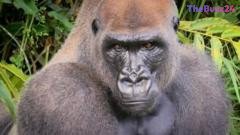
The Quest to Heal Jojo: Can a Lifelong Solitary Gorilla Finally Find a Companion?
For more than a decade, an eleven-year-old great ape named Jojo has lived a life of profound isolation, highlighting the tragic consequences of the illegal wildlife trade. Captured as an infant after poachers killed his family in the wild, Jojo spent his formative years confined to a tiny cage at a private zoo, stripped of the social structures crucial to his development. Today, he resides in a dedicated sanctuary in Gabon, yet he remains entirely alone, having never experienced the comfort of gorilla companionship.
Experts studying Jojo’s psychological state describe his case as an extreme instance of trauma and isolation. Researchers utilizing thermal imaging have discovered physiological markers of chronic stress, observing that Jojo’s stress response remains constantly triggered, manifesting as a persistently cold nose. Despite these challenges, his keepers note that he actively craves interaction, often attempting to engage human caretakers through clever gestures. While adult male gorillas in the wild do occasionally spend periods of their lives as solitary figures, Jojo’s forced isolation from infancy has left unique emotional scars that distinguish his situation from natural solitude.
Wildlife conservationists and researchers are now striving to find a compatible companion for Jojo, whether a rescued individual or a zoo-bred ape, to help him process his long-standing grief. However, facilitating such an introduction is a delicate and complex endeavor. Current international frameworks governing the transfer of captive great apes are predominantly tailored for formal breeding programs rather than rehabilitation or companionship initiatives. Despite these bureaucratic and logistical hurdles, advocates remain determined to bridge the gap, hoping to provide Jojo with the social connection that is so deeply ingrained in his species’ nature.
Key Takeaways
- Jojo the gorilla has spent nearly his entire life in isolation after poachers killed his family and captured him as an infant.
- Advanced thermal imaging reveals that Jojo suffers from physiological signs of chronic stress and trauma due to his upbringing.
- Researchers and sanctuary keepers are seeking a compatible companion for Jojo, though international transfer regulations complicate the process.
Editor’s Analysis & Impact
The plight of Jojo underscores the severe, long-term impacts of the illegal wildlife trade on captive primates, pushing conservation science to explore new frontiers in animal mental health. Utilizing advanced tools like thermal imaging to measure physiological stress responses bridges human psychology and veterinary science, offering unprecedented insights into trauma recovery for great apes. However, this case exposes a significant operational bottleneck: international wildlife regulations and zoo transfer protocols are rigidly structured around breeding rather than psychological rehabilitation or social integration. For conservation sanctuaries, navigating these bureaucratic hurdles to relocate and bond traumatized animals remains a formidable challenge. As the scientific community learns more about the detrimental effects of forced isolation on apes, industry stakeholders will likely face increasing pressure to modernize policies, creating more flexible pathways for animal welfare, translocations, and rehabilitation programs globally.
Frequently Asked Questions
Q: Who is Jojo and where does he currently live?
A: Jojo is an 11-year-old gorilla who was captured from the wild as an infant and now resides at the Lekedi Foundation sanctuary in Gabon.
Q: Why is it difficult to find a companion for Jojo?
A: Finding a companion is challenging due to Jojo's extreme trauma, the complexities of introducing mature great apes, and international regulations that are designed for breeding programs rather than social rehabilitation.
Q: How do researchers measure Jojo's stress levels?
A: Researchers use thermal imaging cameras to monitor blood flow in Jojo's face, specifically tracking his 'nasal dip'—a phenomenon where stress causes a temporarily colder nose that fails to recover normally in chronic cases.
AI Disclosure: This article is based on verified data and official reports. Our Team and AI have cross-referenced every financial detail with primary sources to ensure total accuracy.
More from this Category