Royal Navy Intercepts Russian Submarine Operation Targeting Critical UK Infrastructure
The United Kingdom has successfully identified and tracked a covert operation involving three Russian submarines operating in close proximity to vital undersea cables and energy pipelines. Defence Secretary John Healey confirmed that the Royal Navy deployed warships and aerial assets to monitor the vessels, characterizing the maneuver as a deliberate act of aggression against British national security. While no physical damage to the infrastructure was reported, the incident has prompted a stern warning from the UK government regarding the protection of its maritime assets.
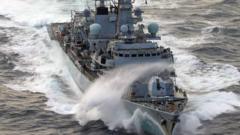
Undersea networks are essential to the United Kingdom’s economic stability and daily operations, carrying over 90% of the nation’s internet traffic and facilitating significant gas imports from the North Sea. The Russian deployment reportedly utilized an Akula-class submarine as a diversion, while two specialized vessels from the Main Directorate for Deep Sea Research (GUGI) conducted surveillance on communication and energy arteries. The Royal Navy, supported by Norwegian monitoring efforts, utilized the frigate HMS St Albans and Merlin anti-submarine helicopters to maintain constant surveillance of the Russian fleet.
Although the Russian embassy in London has dismissed the allegations, the incident highlights growing concerns over GUGI, a secretive unit known for deep-sea reconnaissance and potential sabotage capabilities. These operations are increasingly viewed as a form of hybrid warfare, designed to test the vulnerabilities of Western infrastructure without triggering a direct military conflict. Prime Minister Keir Starmer has reaffirmed the government’s commitment to safeguarding these critical assets, emphasizing that the UK will continue to expose and deter such destabilizing activities in the future.
Key Takeaways
- The Royal Navy successfully tracked three Russian submarines, including specialized GUGI spy vessels, near critical UK undersea infrastructure.
- Undersea cables and pipelines are vital to the UK, carrying the vast majority of the nation's internet traffic and energy imports.
- The UK government has labeled the incident as 'hybrid warfare' and warned that any future attempts to sabotage these assets will face severe consequences.
Editor’s Analysis & Impact
The discovery of Russian GUGI vessels near critical undersea infrastructure signals a shift toward ‘gray zone’ or hybrid warfare, where adversaries target the digital and energy backbone of a nation to exert pressure without engaging in open conflict. This incident underscores the extreme vulnerability of the global subsea network, which remains largely unprotected despite its role as the foundation of the modern internet and energy markets. For the UK and its allies, this necessitates a significant increase in maritime surveillance budgets and the development of advanced subsea monitoring technologies. The broader implication is a heightened state of tension in the North Atlantic, where the ‘silent’ battle for control over critical infrastructure is likely to intensify as geopolitical relations remain strained. Future security strategies will likely prioritize the hardening of these assets and increased international intelligence sharing to deter covert sabotage.
Frequently Asked Questions
Q: What is the GUGI unit?
A: GUGI stands for the Main Directorate for Deep Sea Research, a secretive Russian naval unit that reports directly to the Kremlin and specializes in deep-sea surveillance, reconnaissance, and potential sabotage of undersea infrastructure.
Q: Why are undersea cables and pipelines considered critical infrastructure?
A: These assets are essential for modern society; undersea cables carry over 90% of global internet traffic, while pipelines are critical for the transport of natural gas and energy resources, making them prime targets for strategic disruption.
AI Disclosure: This article is based on verified data and official reports. Our Team and AI have cross-referenced every financial detail with primary sources to ensure total accuracy.
More from this Category