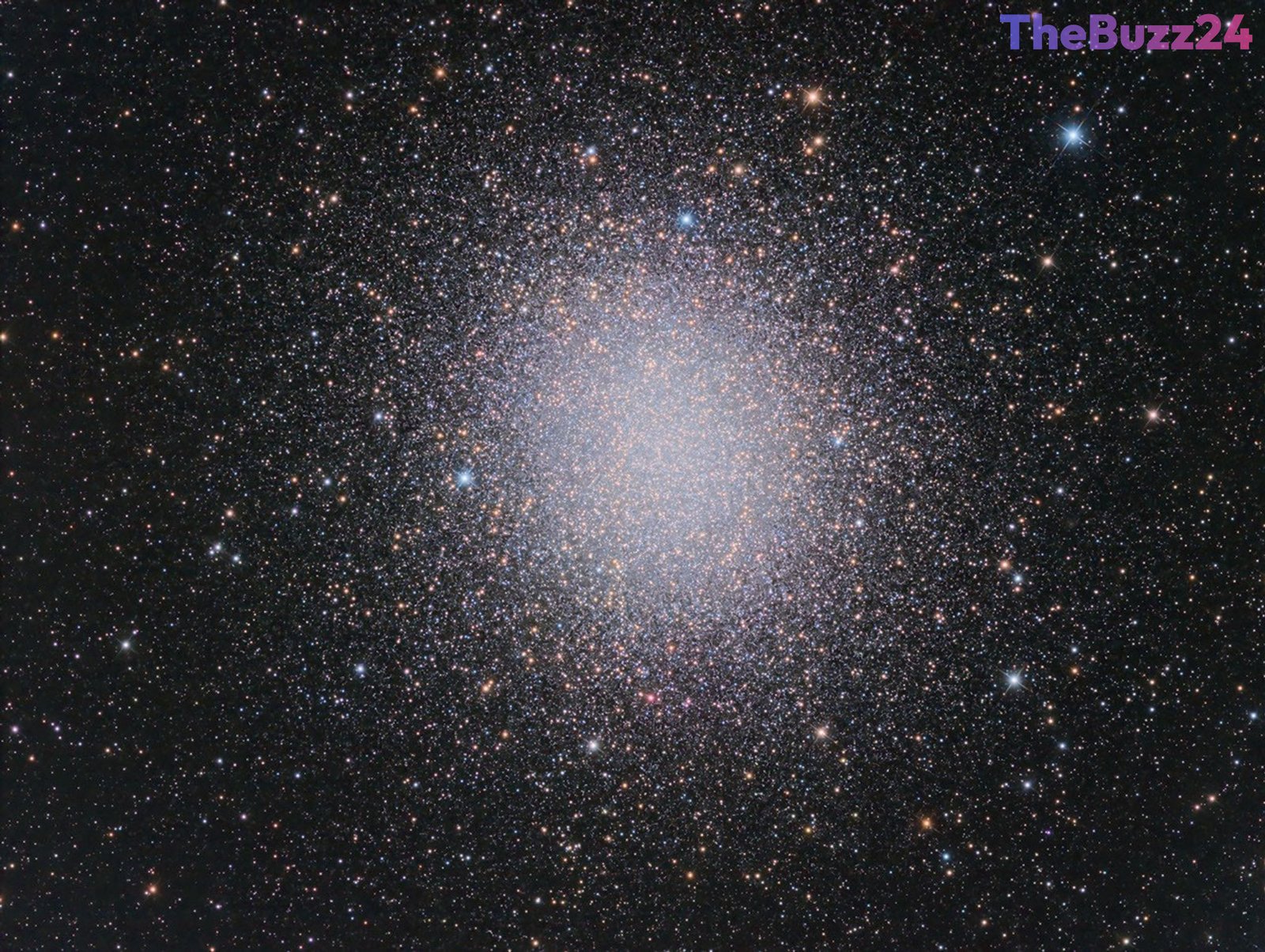
Unlocking the Secrets of Omega Centauri: The Milky Way’s Mysterious Stellar Giant
Omega Centauri, cataloged as NGC 5139, stands as the most prominent and massive globular cluster within the Milky Way’s halo. Spanning approximately 150 light-years in diameter, this dense stellar collection houses roughly 10 million stars, many of which are significantly older than our own Sun. Located 15,000 light-years from Earth, it serves as a primary subject for astronomers seeking to understand the complex evolution of star systems.
Unlike typical globular clusters, which generally feature stars of uniform age and chemical makeup, Omega Centauri displays a diverse range of stellar populations. This anomaly has led researchers to hypothesize that the cluster is not a standard star group, but rather the surviving core of a dwarf galaxy that was long ago absorbed by the Milky Way. The cluster is visually distinguished by its yellowish hue, largely contributed by a high concentration of red giant stars.
Recent advancements in deep-space observation have further deepened the mystery surrounding this celestial body. Data collected over two decades by the Hubble Space Telescope has provided compelling evidence for the existence of a massive black hole residing at the heart of the cluster. This discovery reinforces the theory that Omega Centauri possesses a unique evolutionary history that sets it apart from the hundreds of other globular clusters orbiting our galaxy.
Key Takeaways
- Omega Centauri contains roughly 10 million stars and is the largest globular cluster associated with the Milky Way.
- The cluster's diverse stellar ages and chemical compositions suggest it may be the remnant core of a captured dwarf galaxy.
- Long-term observations from the Hubble Space Telescope indicate the presence of a massive black hole at the center of the cluster.
Editor’s Analysis & Impact
The study of Omega Centauri represents a critical frontier in galactic archaeology. By analyzing the chemical and age variations within such dense clusters, astronomers can reconstruct the history of the Milky Way’s formation and its history of galactic cannibalism. The confirmation of a central black hole in a globular cluster of this size challenges previous models regarding how these clusters form and interact with their host galaxies. As observational technology improves, Omega Centauri will likely remain a focal point for understanding the transition between dwarf galaxies and globular clusters, providing essential data for broader cosmological models regarding dark matter distribution and galactic evolution.
Frequently Asked Questions
Q: What makes Omega Centauri different from other globular clusters?
A: Most globular clusters consist of stars with the same age and chemical composition. Omega Centauri is unique because it contains multiple stellar populations with varying ages and chemical abundances, suggesting it was once the core of a separate galaxy.
Q: How far away is Omega Centauri from Earth?
A: Omega Centauri is located approximately 15,000 light-years away from Earth.
AI Disclosure: This article is based on verified data and official reports. Our Team and AI have cross-referenced every financial detail with primary sources to ensure total accuracy.
More from this Category