SpaceX Dragon Set for Mid-May Launch to Deliver Critical Science and Supplies to ISS
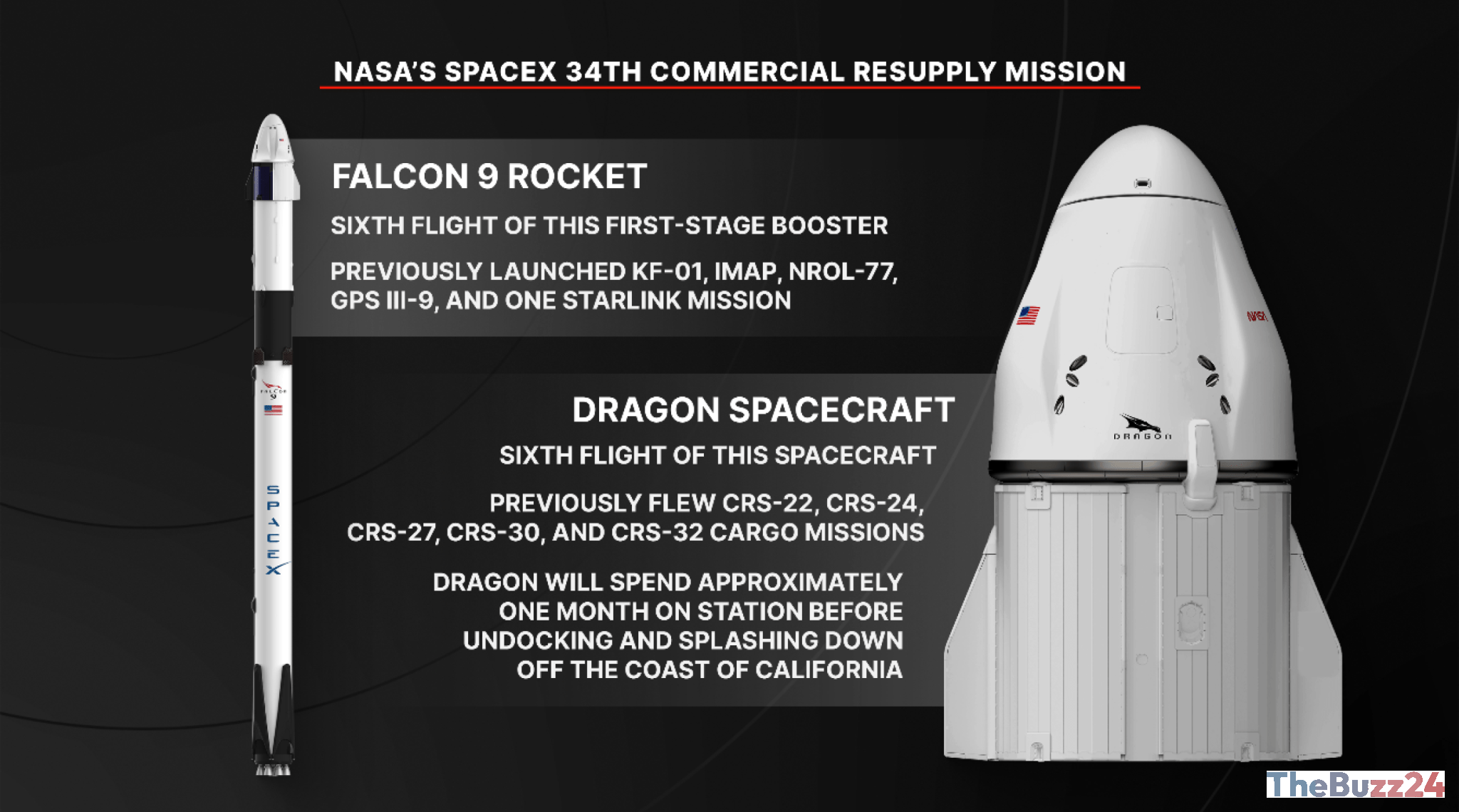
NASA and SpaceX are preparing for a mid-May launch of the 34th commercial resupply services mission to the International Space Station (ISS). Utilizing a SpaceX Falcon 9 rocket, the Dragon spacecraft will lift off from Launch Complex 40 at Cape Canaveral Space Force Station in Florida. Carrying approximately 6,500 pounds of cargo, the autonomous spacecraft will dock at the forward port of the station’s Harmony module, delivering essential supplies, technical hardware, and cutting-edge scientific experiments to the orbiting laboratory.
Among the scientific payloads are several pioneering studies designed to advance deep-space exploration and improve life on Earth. The ODYSSEY experiment will evaluate the accuracy of Earth-based microgravity simulators by comparing bacterial behavior in space to simulated environments. Meanwhile, the STORIE instrument will monitor charged particles in Earth’s orbit to better predict space weather impacts on satellites and power grids. Additionally, the Laplace project will study dust particle collisions in microgravity to unlock secrets of planetary formation, while the Green Bone study will investigate bone cell development on wood-derived scaffolds, potentially offering new treatments for osteoporosis.
The mission also prioritizes astronaut health and station maintenance. The SPARK experiment will analyze how spaceflight affects red blood cells and the spleen to safeguard future crews on long-duration missions to the Moon and Mars. Onboard hardware includes a replacement power cable for the European Enhanced Exploration Exercise Device, a vital catalytic reactor for the station’s water recovery system, and universal pretreat concentrate tanks. Astronauts Jack Hathaway and Sophie Adenot will monitor the Dragon’s arrival. After a month-long stay, the spacecraft will return to Earth with critical research samples and decommissioned hardware, including an ocular imaging device and the Advanced Plant Habitat.
Key Takeaways
- SpaceX's 34th resupply mission will deliver 6,500 pounds of cargo, including scientific experiments and critical hardware, to the ISS in mid-May.
- Key scientific payloads include studies on space weather (STORIE), planetary formation (Laplace), bone growth on wood scaffolds (Green Bone), and astronaut health (SPARK).
- The Dragon spacecraft will remain docked for approximately one month before returning to Earth with scientific samples and equipment for analysis and museum display.
Editor’s Analysis & Impact
The 34th commercial resupply mission highlights the mature, highly reliable partnership between NASA and SpaceX, which remains the backbone of low-Earth orbit logistics. By consistently delivering thousands of pounds of cargo, these missions sustain the ISS as a vital testbed for the upcoming Artemis lunar missions and eventual crewed journeys to Mars. The diverse scientific payload—ranging from materials science to biomedical research—underscores the commercialization of space research, where terrestrial industries like pharmaceuticals and materials engineering leverage microgravity to innovate. Furthermore, the return of hardware like the Advanced Plant Habitat for museum display marks a transition phase as the ISS enters its final decade of operations, paving the way for future commercial space stations.
Frequently Asked Questions
Q: What is the primary goal of the SpaceX 34th commercial resupply mission?
A: The mission aims to deliver approximately 6,500 pounds of scientific research, crew supplies, and critical hardware to the International Space Station to support ongoing operations and future deep-space exploration preparation.
Q: What kind of scientific experiments are being sent to the ISS on this flight?
A: Key experiments include ODYSSEY (testing microgravity simulators), STORIE (monitoring space weather), Laplace (studying dust particle collisions), Green Bone (investigating bone growth on wood scaffolds), and SPARK (analyzing astronaut blood and spleen health).
Q: How long will the Dragon spacecraft remain at the space station?
A: The spacecraft is scheduled to remain docked to the Harmony module for about one month before returning to Earth with scientific samples and hardware.
AI Disclosure: This article is based on verified data and official reports. Our Team and AI have cross-referenced every financial detail with primary sources to ensure total accuracy.
More from this Category