Texas Driver Arrested After Attempting to Test Cybertruck ‘Wade Mode’ in Public Lake
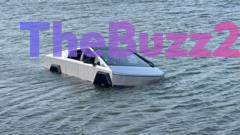
A Texas man is facing criminal charges after intentionally driving his Tesla Cybertruck into Grapevine Lake in an unauthorized attempt to test the vehicle’s ‘wade mode’ feature. Local authorities were dispatched to the scene on Monday, where they found the electric truck partially submerged near the southern shoreline. The driver and his passengers had managed to evacuate the vehicle safely before it became fully disabled, requiring a specialized recovery operation by the Grapevine Fire Department’s Water Rescue Team.
During the subsequent investigation, the driver admitted that the excursion was a deliberate experiment to see how the truck’s specialized water-navigation settings would perform in a real-world environment. While the Cybertruck is engineered with a ‘wade mode’—which pressurizes the battery pack and adjusts the suspension to navigate shallow water—the driver’s decision to utilize a public lake violated local environmental and safety regulations, leading to his immediate arrest.
Tesla’s official documentation clearly outlines the limitations of the vehicle, noting that while it can traverse water up to 81.5 cm deep, owners are strictly advised to assess conditions carefully. The manufacturer warns that fast-moving currents or excessive depth can cause catastrophic mechanical failure. Furthermore, the company has clarified that any damage resulting from water immersion is explicitly excluded from the vehicle’s warranty, leaving the owner responsible for the full cost of repairs.
This incident serves as a cautionary tale regarding the intersection of advanced automotive technology and public safety. While the Cybertruck is marketed for its rugged, stainless-steel construction and off-road prowess, officials are reminding the public that engineering capabilities do not grant immunity from local laws. The case highlights the risks associated with testing high-tech features in uncontrolled environments, which can result in both legal consequences and significant financial loss.
Key Takeaways
- A driver was arrested for driving a Cybertruck into a public lake to test its water-navigation capabilities.
- Tesla’s warranty does not cover water damage, even when the vehicle's 'wade mode' is engaged.
- Authorities are emphasizing that vehicle engineering limits do not supersede local public safety and environmental laws.
Editor’s Analysis & Impact
The incident at Grapevine Lake highlights a growing trend where consumers push the limits of advanced vehicle features, often blurring the line between marketing-driven capability and real-world safety. As manufacturers like Tesla continue to introduce specialized modes—such as ‘wade mode’ or ‘off-road assist’—the potential for misuse in public spaces increases. From an industry perspective, this creates a liability challenge for automakers who must balance the promotion of rugged, high-performance features with the need to educate consumers on legal and safety boundaries. Moving forward, we expect to see more explicit digital warnings within vehicle software interfaces to prevent users from attempting dangerous maneuvers. The broader implication is a shift toward stricter enforcement of environmental and public safety laws as high-tech, off-road-capable vehicles become more accessible to the general public.
Frequently Asked Questions
Q: Does Tesla's warranty cover water damage if the vehicle is in 'wade mode'?
A: No, Tesla explicitly states that any damage caused by water immersion is not covered under the vehicle's warranty.
Q: What is the purpose of the Cybertruck's 'wade mode'?
A: Wade mode is designed to help the vehicle navigate through shallow water by pressurizing the battery pack and adjusting the air suspension to keep the vehicle stable.
AI Disclosure: This article is based on verified data and official reports. Our Team and AI have cross-referenced every financial detail with primary sources to ensure total accuracy.
More from this Category