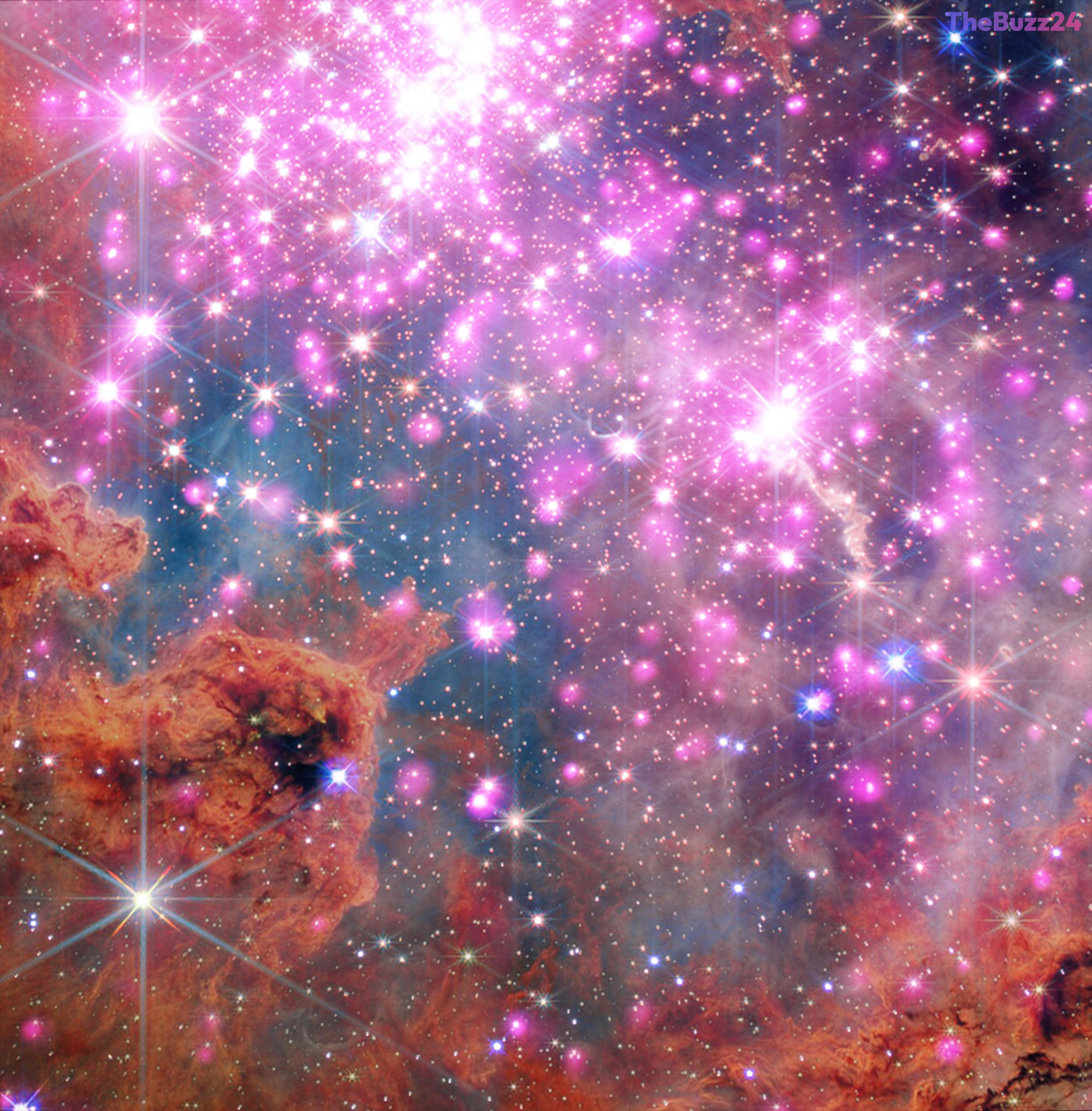
Cosmic Nursery Revealed: New Imagery of Westerlund 2 Combines X-Ray and Infrared Data
A stunning new composite image of the star cluster Westerlund 2 has been unveiled, offering a vivid look at one of the most active stellar breeding grounds in our galaxy. By merging data from the Chandra X-ray Observatory with infrared observations from the James Webb Space Telescope, astronomers have captured the complex interplay of light and matter within this vibrant region.
The imagery highlights a dense collection of stars, estimated to be between one and three million years old, surrounded by a striking neon-pink glow. This pink hue represents high-energy X-ray emissions, while the surrounding infrared data reveals a spectrum of red, orange, green, cyan, and blue, providing a multi-layered view of the cluster’s internal dynamics. Along the bottom of the frame, dense, brick-orange dust clouds serve as a reminder of the raw materials currently fueling the birth of new stars.
Westerlund 2 is situated within the Gum 29 nebula, a massive stellar nursery located approximately 20,000 light-years from Earth in the constellation Carina. This region remains a primary focus for researchers studying the life cycles of stars, as the extreme conditions within the cluster provide a unique laboratory for observing how massive stars form and influence their surrounding environments.
Key Takeaways
- A new composite image of Westerlund 2 combines Chandra X-ray and James Webb infrared data to visualize stellar formation.
- The cluster, located 20,000 light-years away in the Gum 29 nebula, contains stars aged between one and three million years.
- The imagery effectively maps high-energy X-ray emissions against the raw dust and gas clouds that serve as the building blocks for new stars.
Editor’s Analysis & Impact
The release of this composite imagery underscores the growing importance of multi-wavelength astronomy in modern astrophysics. By layering X-ray data—which captures high-energy phenomena like stellar winds and supernova remnants—with the infrared capabilities of the James Webb Space Telescope, which can peer through dense dust clouds, scientists are gaining an unprecedented understanding of star formation. This collaborative approach to data processing is essential for mapping the ‘life cycle’ of galaxies. As we continue to refine these imaging techniques, the ability to observe stellar nurseries in such high fidelity will likely lead to breakthroughs in our understanding of how massive star clusters shape the chemical and structural evolution of the interstellar medium. This is a significant step forward in mapping the history of our galaxy.
Frequently Asked Questions
Q: What is Westerlund 2?
A: Westerlund 2 is a young, massive star cluster located about 20,000 light-years from Earth within the Gum 29 nebula.
Q: Why are two different telescopes used to create this image?
A: Using both X-ray and infrared data allows scientists to see different physical processes; X-rays reveal high-energy activity, while infrared light penetrates thick dust clouds to show the stars and gas structures that would otherwise be hidden.
AI Disclosure: This article is based on verified data and official reports. Our Team and AI have cross-referenced every financial detail with primary sources to ensure total accuracy.
More from this Category