Mexico City Aims for World Record with Massive Crowd Wave
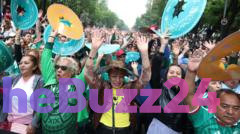
Thousands of spectators in Mexico City have attempted to set a new Guinness World Record for the largest crowd wave. The ambitious event took place along the iconic Paseo de la Reforma, a wide urban avenue chosen for its potential to facilitate a widespread and visible wave.
Participants, many clad in the vibrant green jerseys of the Mexican national football team, enthusiastically participated in the attempt, shouting “Mexico, Mexico!” as they raised their arms in unison. This effort aims to surpass the current record of 157,574 people, set at a NASCAR event in Tennessee in 2008. Guinness World Records officials are currently reviewing the data to verify if a new record has been established.
The choice of Mexico City holds historical significance, as it was here, 40 years ago, that the crowd wave phenomenon first gained international recognition. While the “Mexican wave” is now a global staple at sporting events, its origins are debated. American George Henderson, known as “Krazy George,” claims to have initiated and directed the first wave at a baseball game in California in 1981. However, it was the 1986 FIFA World Cup in Mexico that truly propelled the wave into a worldwide spectacle, broadcast to an immense audience.
Beyond its entertainment value, the crowd wave has also been a subject of scientific study. Researchers have modeled the wave’s propagation, comparing it to phenomena like forest fires and electrical signals in heart tissue. Studies suggest that a typical wave travels clockwise at approximately 12 meters per second and requires as few as 25 to 35 people to initiate in large venues. While often seen as a symbol of collective excitement, the wave can also signal spectator boredom or a desire for action during lulls in a game.
Key Takeaways
- Mexico City hosted an event attempting to break the Guinness World Record for the largest crowd wave.
- The origins of the 'Mexican wave' are debated, with claims dating back to a 1981 US baseball game, but its global popularization is linked to the 1986 World Cup in Mexico.
- Scientific studies have analyzed the crowd wave, determining its speed and the minimum number of participants needed to start it.
Editor’s Analysis & Impact
This event highlights the enduring global appeal of the crowd wave, a phenomenon deeply intertwined with the cultural fabric of major sporting events, particularly in Mexico. The attempt to reclaim a world record underscores the nation’s passion for collective participation and its historical connection to this unique form of spectator engagement. Beyond the spectacle, the scientific interest in the wave’s dynamics reveals fascinating insights into crowd behavior and emergent patterns. As sports continue to evolve, such displays of unity and energy remain a powerful, albeit sometimes debated, element of the fan experience, influencing how audiences interact with and express their enthusiasm during games.
Frequently Asked Questions
Q: What is the current Guinness World Record for the largest crowd wave?
A: The current Guinness World Record for the largest crowd wave was set in 2008 at a NASCAR racing event in Tennessee, with 157,574 participants.
Q: Who is credited with inventing the crowd wave?
A: The invention of the crowd wave is often attributed to George Henderson, also known as 'Krazy George,' who claims to have started it at a baseball game in California in 1981. However, its widespread global recognition is strongly associated with the 1986 FIFA World Cup held in Mexico.
Q: How fast does a crowd wave travel?
A: Scientific studies suggest that a typical crowd wave travels at a speed of about 12 meters per second, or roughly 20 seats per second, and usually moves in a clockwise direction.
AI Disclosure: This article is based on verified data and official reports. Our Team and AI have cross-referenced every financial detail with primary sources to ensure total accuracy.
More from this Category