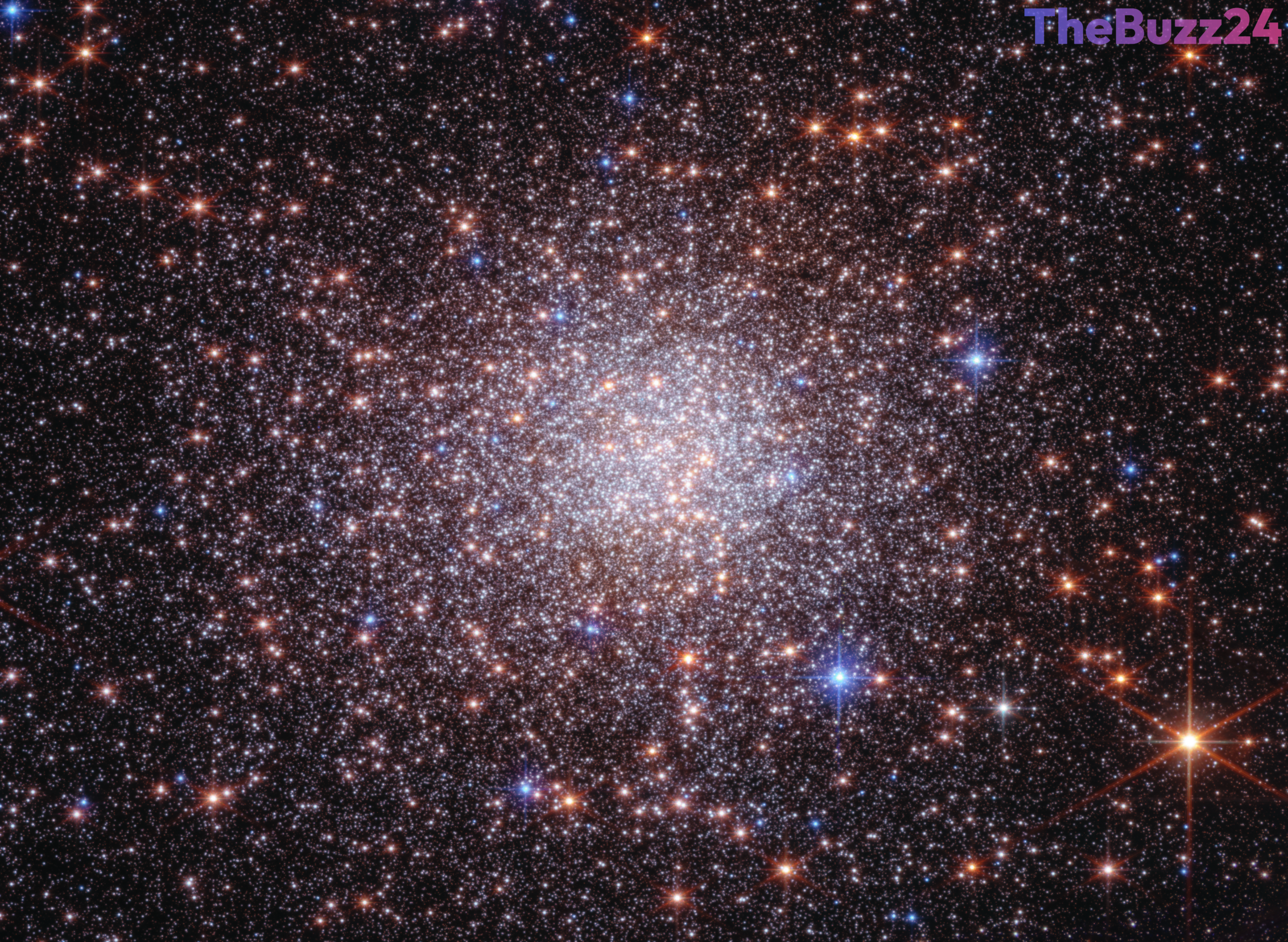
Cosmic Time Capsule: Webb and Hubble Unmask the Secret History of Terzan 5
For decades, astronomers classified Terzan 5 as a standard globular star cluster nestled deep within the crowded, dusty central bulge of the Milky Way. However, groundbreaking joint observations from the James Webb Space Telescope and the Hubble Space Telescope have shattered this classification. Researchers have confirmed that Terzan 5 is actually a “bulge fossil fragment”—a massive, self-enriching stellar system that survived the chaotic assembly of our galaxy. Unlike typical globular clusters, which host only a single generation of ancient stars, Terzan 5 contains at least four distinct generations of stars spanning billions of years.
Peering into the heart of the Milky Way is notoriously difficult due to thick cosmic dust and extreme stellar crowding. To overcome this, astronomers utilized Webb’s advanced near-infrared vision to cut through the dust and catalog faint stars with unprecedented detail. They then cross-referenced these findings with over a decade of archival Hubble data. By tracking the minute movements of individual stars over a 12-year span, the team successfully separated the stars belonging to Terzan 5 from the background noise of the Milky Way’s central bulge.
The combined data revealed a complex timeline of star formation. The oldest stellar population in Terzan 5 formed roughly 12.5 billion years ago, coinciding with the birth of the Milky Way itself. Subsequent generations emerged 4.7 billion, 3.8 billion, and 2.5 billion years ago. This multi-generational history rules out external triggers, such as a random collision with a gas cloud. Instead, it proves that Terzan 5 was originally massive enough to retain the heavy elements blasted out by supernovae, using this recycled material to forge new stars over eons.
This discovery offers a rare window into the early universe. Cosmologists believe that early galaxies featured massive, clumpy disks of gas that eventually migrated and merged to form central bulges. While most of these primordial clumps dissolved into the Milky Way’s structure, Terzan 5 somehow remained intact, acting as a pristine “fossil” of our galaxy’s evolutionary history. Researchers now plan to examine dozens of other candidate clusters in the galactic bulge to see if more of these ancient cosmic relics are hiding in plain sight.
Key Takeaways
- Terzan 5 has been reclassified from a simple globular cluster to a 'bulge fossil fragment' containing four distinct generations of stars.
- By combining Webb's infrared capabilities with 12 years of Hubble archival data, astronomers mapped stellar ages ranging from 12.5 billion to 2.5 billion years old.
- The system's ability to retain supernova debris and self-enrich over billions of years provides direct evidence of how the Milky Way's central bulge formed.
Editor’s Analysis & Impact
The reclassification of Terzan 5 represents a significant paradigm shift in observational astrophysics and galactic archaeology. By proving that some “globular clusters” are actually surviving primordial fragments of the early universe, this discovery validates long-standing theoretical models of hierarchical galaxy formation. The synergy between the James Webb Space Telescope’s infrared sensitivity and the Hubble Space Telescope’s multi-decade baseline of astrometric data showcases the power of multi-observatory science. Moving forward, this methodology will likely be applied to dozens of other ambiguous stellar clusters within the Milky Way’s dusty interior. If more fossil fragments are identified, astronomers will gain a highly detailed, chronological map of how our galaxy’s central bulge was constructed, bridging the gap between local stellar chemistry and deep-space observations of the early universe.
Frequently Asked Questions
Q: What is a bulge fossil fragment?
A: A bulge fossil fragment is a remnant of a highly massive primordial stellar system that formed during the early stages of a galaxy. Unlike typical globular clusters, these fragments are massive enough to retain supernova ejecta, allowing them to form multiple generations of stars over billions of years without merging or dissolving into the galaxy's central bulge.
Q: How did astronomers distinguish Terzan 5's stars from the rest of the Milky Way?
A: Astronomers combined the infrared imaging of the James Webb Space Telescope, which penetrated the thick cosmic dust of the galactic center, with 12 years of archival Hubble Space Telescope data. By measuring the tiny movements (proper motions) of the stars over more than a decade, they could separate the stars moving with Terzan 5 from the surrounding stars of the Milky Way's bulge.
Q: Why is the discovery of four star generations in Terzan 5 significant?
A: Finding four distinct generations of stars rules out the theory that Terzan 5's star formation was triggered by a one-time external event, like a collision with another gas cloud. Instead, it proves the system was self-enriching, possessing enough gravitational mass to hold onto its own gas and supernova debris to fuel repeated cycles of star birth.
AI Disclosure: This article is based on verified data and official reports. Our Team and AI have cross-referenced every financial detail with primary sources to ensure total accuracy.
More from this Category