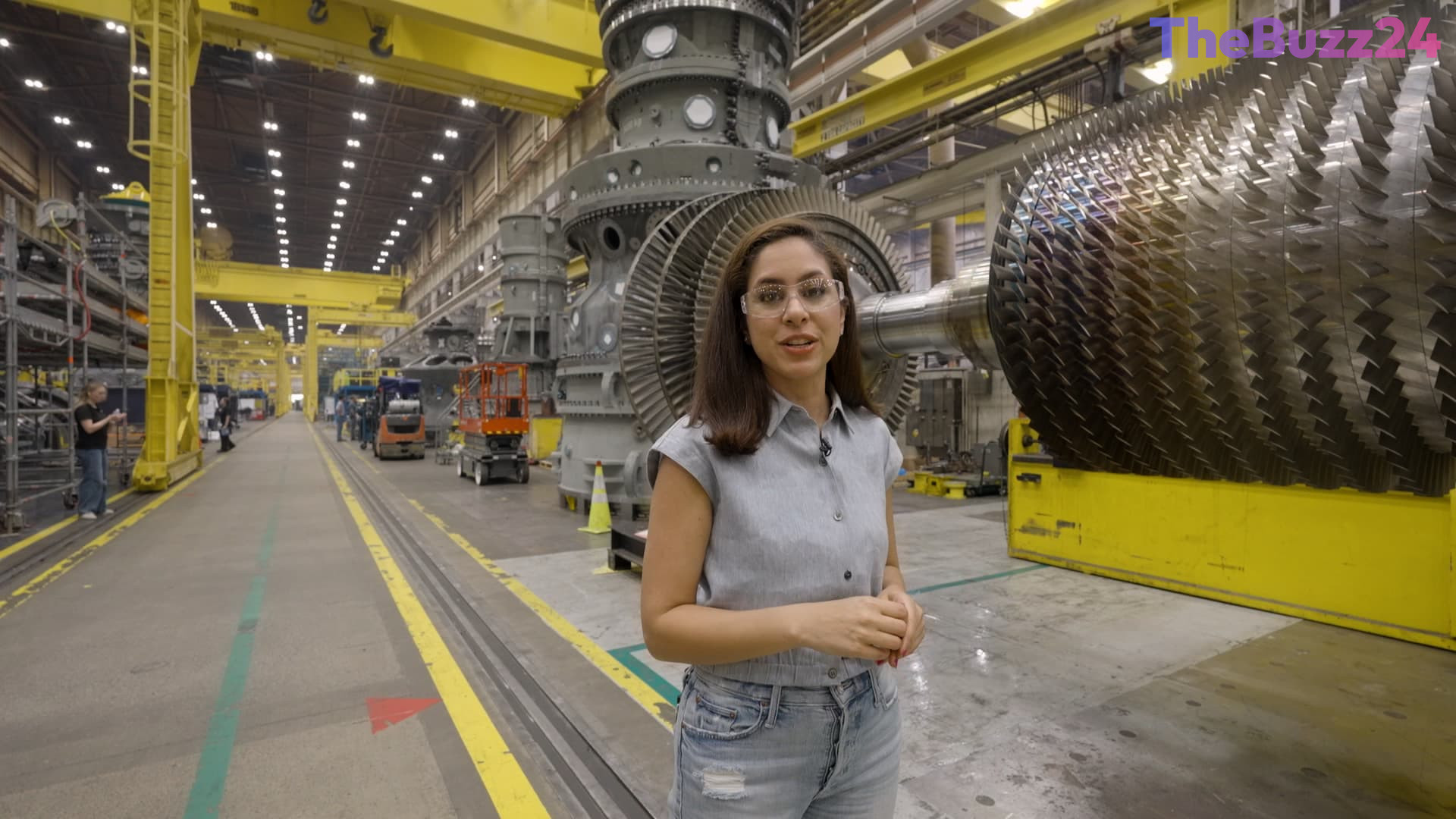
Powering the AI Revolution: Inside GE Vernova’s Sold-Out Gas Turbine Factory
The rapid expansion of artificial intelligence is driving an unprecedented demand for electricity, forcing tech giants to look beyond traditional power grids. At GE Vernova’s massive manufacturing facility in Greenville, South Carolina, production is ramping up significantly to build the colossal gas turbines required to keep AI data centers running. To meet this surging demand, the company has embarked on a hiring spree, adding hundreds of new workers to its factory floor as tech companies scramble to secure reliable energy sources.
Major hyperscalers, including Microsoft, Amazon, Google, and Oracle, are increasingly relying on standalone power solutions to bypass electrical grid bottlenecks. GE Vernova’s order book is now completely filled through 2029, with some orders extending as far out as 2031. Approximately 20% of the company’s gas power orders are now directly tied to data centers and AI applications. For instance, Microsoft recently purchased seven massive turbines—capable of generating 2.7 gigawatts of electricity—to power its Texas data center operations, while similar turbine installations are already active or planned for Elon Musk’s xAI campus in Tennessee and OpenAI’s ambitious “Stargate” project.
These industrial machines are engineering marvels, standing 31 feet tall and weighing 280 tons, with a single unit capable of powering roughly half a million homes. However, securing this level of power comes with a hefty price tag. Industry estimates place the cost of a single turbine at over $250 million, representing a staggering 300% price increase over the last three years. This soaring capital expenditure highlights the massive financial commitments tech companies are making to sustain their AI ambitions, which has in turn boosted GE Vernova’s stock by nearly 60% over the past six months.
Despite the economic windfall, the rapid buildout of gas-powered data centers has drawn scrutiny from environmental advocates concerned about carbon emissions. In response to these challenges, GE Vernova is emphasizing the sustainability of its newer models. Company officials note that modern turbines are twice as efficient as those manufactured two decades ago, offering a bridge solution as the tech industry grapples with the dual demands of massive computational power and environmental responsibility.
Key Takeaways
- AI data center demand has filled GE Vernova's gas turbine order book through 2029, with bookings extending into 2031.
- Tech giants like Microsoft, OpenAI, and xAI are bypassing grid bottlenecks by purchasing massive $250 million turbines for standalone power.
- Turbine prices have surged by 300% over the last three years, reflecting the intense capital expenditure driving the AI infrastructure boom.
Editor’s Analysis & Impact
The intersection of artificial intelligence and heavy industrial manufacturing represents a critical bottleneck in the tech sector’s growth trajectory. As hyperscalers realize that existing electrical grids cannot support the exponential power demands of next-generation AI models, they are forced to act as independent utility operators. This shift has transformed traditional industrial players like GE Vernova into essential tech-enablers, driving up their valuations and order backlogs. However, this reliance on natural gas turbines exposes a glaring contradiction in the tech industry’s carbon-neutrality pledges. While GE Vernova’s efficiency gains mitigate some impact, the sheer volume of fossil-fuel power being deployed will likely trigger intense regulatory and public backlash. Moving forward, the industry must balance immediate power needs with long-term sustainability, potentially accelerating investments in nuclear and advanced renewable energy storage.
Frequently Asked Questions
Q: Why are tech companies buying gas turbines instead of using the standard power grid?
A: AI data centers require massive, continuous amounts of electricity. Standard power grids are facing severe capacity bottlenecks and cannot deploy power quickly enough to meet the rapid expansion of AI infrastructure, forcing tech companies to secure standalone, on-site power sources.
Q: How much do these gas turbines cost, and who is buying them?
A: A single turbine can cost upwards of $250 million, with prices rising 300% over the last three years due to high demand. Major buyers include hyperscalers and AI developers such as Microsoft, Amazon, Google, Oracle, OpenAI, and xAI.
Q: What is the environmental impact of using gas turbines for AI?
A: While gas turbines emit carbon dioxide, manufacturers like GE Vernova are designing modern turbines to be twice as efficient as older models to reduce emissions. However, the massive scale of these projects remains a point of concern for environmental advocates.
AI Disclosure: This article is based on verified data and official reports. Our Team and AI have cross-referenced every financial detail with primary sources to ensure total accuracy.
More from this Category