The Secret Service Shell Game: How U.S. Presidents Are Hidden in Plain Sight
To safeguard the President of the United States in high-risk international environments, executive security teams frequently deploy tactical deception strategies designed to confuse potential adversaries. In a striking example of these covert maneuvers, Donald Trump was secretly transferred off Air Force One via a catering truck while in Turkey and moved to a military C-32A aircraft bound for the United Kingdom. Passengers remaining on the primary presidential jet had no knowledge of the chief executive’s departure, effectively serving as unwitting decoys during a mission triggered by elevated security risks.
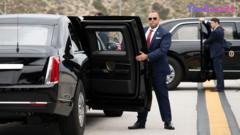
Such deceptive tactics, known internally within security details as a “shell game,” represent standard protocol when navigating heightened threat conditions. Similar strategies are routinely deployed on a smaller scale during presidential movements both on the ground and in the air. Official motorcades frequently feature twin armored limousines—colloquially known as “The Beasts”—that swap positions under highway overpasses or inside tunnels to obscure which vehicle carries the President. Likewise, Marine One helicopter formations regularly reshuffle mid-flight to prevent ground threats from identifying and targeting the leader’s specific aircraft.
Historical precedents show that secret switches and diversionary tactics have long been vital tools for executive protection during foreign travel, particularly into volatile areas. In 2000, President Bill Clinton arrived in Islamabad aboard an unmarked executive jet that landed shortly after a decoy aircraft fully outfitted in standard Air Force One livery. In 2003, President George W. Bush made a surprise Thanksgiving trip to Baghdad under cover of darkness after publicly indicating he would remain at his ranch in Texas. More recently, President Joe Biden was covertly transported into Ukraine under extreme operational secrecy with a heavily restricted media contingent.
Security experts emphasize that executing an emergency aircraft swap mid-journey indicates a significant and immediate intelligence evaluation. While the Secret Service maintains strict operational discretion and refrains from commenting on specific threat assessments or tactical maneuvers, the primary objective remains mitigating risk without compromising critical intelligence gathering. As threat vectors continue to evolve globally, security personnel remain poised to improvise and adapt protocols to guarantee presidential safety.
Key Takeaways
- Secret Service protection protocols frequently utilize tactical deception, dubbed a "shell game," to conceal presidential movements during high-threat scenarios.
- Diversionary maneuvers are routinely deployed across land and air assets, including decoy limousines, reshuffling helicopter formations, and unmarked secondary aircraft.
- Historical precedents show presidents including Bill Clinton, George W. Bush, and Joe Biden using similar covert travel tactics to enter volatile regions safely.
Editor’s Analysis & Impact
The reliance on complex presidential travel swaps underscores the growing volatility of international executive protection. In an era marked by advanced satellite surveillance, real-time digital tracking, and heightened geopolitical tensions, traditional physical security measures alone are no longer sufficient. The Secret Service’s strategic use of diversionary tactics highlights a crucial pivot toward dynamic threat mitigation, where operational ambiguity serves as a primary defensive shield. Moving forward, presidential transport logistics will likely integrate even higher levels of physical and electronic obfuscation. While these high-stakes operations ensure continuity of leadership in unpredictable foreign domains, they also require seamless coordination among intelligence agencies, military commands, and foreign diplomatic partners.
Frequently Asked Questions
Q: What is a "shell game" in executive protection tactics?
A: A "shell game" refers to a strategy where security personnel deploy multiple identical or decoy vehicles, aircraft, or routes, constantly shifting positions to obscure which asset is actually transporting the President.
Q: Has the Secret Service used decoy aircraft in the past?
A: Yes. Decoy jets and covert transfers have been used previously, such as President Bill Clinton's arrival in Pakistan aboard an unmarked plane in 2000 and President George W. Bush's secret flight to Baghdad in 2003.
Q: Why are journalists and staff on board kept unaware of plane swaps?
A: To maintain operational security and prevent real-time information leaks, non-security personnel and reporters accompanying the presidential detail are often kept unaware of tactical switches until the President reaches safety.
AI Disclosure: This article is based on verified data and official reports. Our Team and AI have cross-referenced every financial detail with primary sources to ensure total accuracy.
More from this Category