Cosmic Embrace: Twin Galaxies Merge, Sparking New Life and Discovery
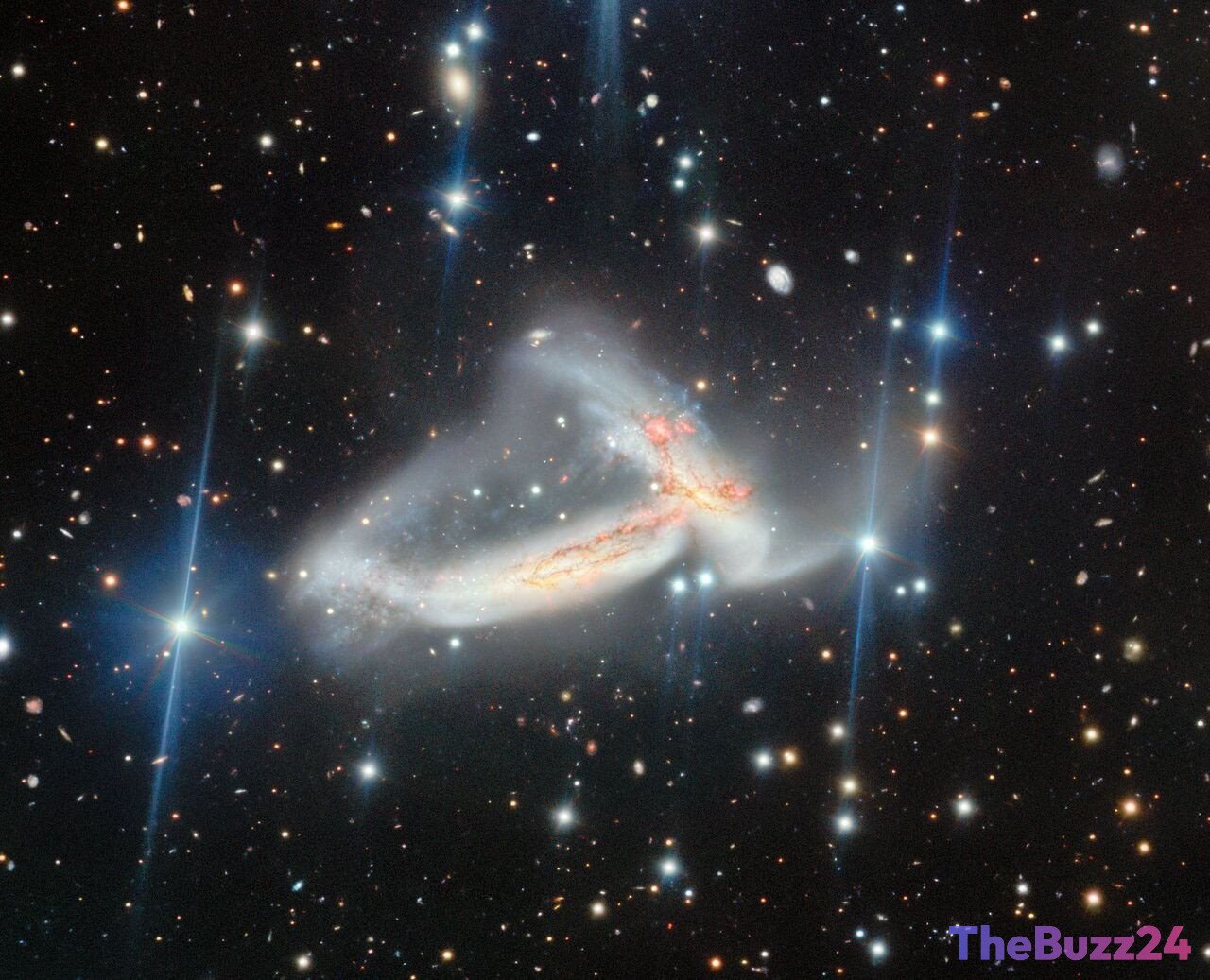
A breathtaking celestial event, captured by the 8.1-meter Gemini North telescope on Maunakea, Hawai‘i, reveals a pair of spiral galaxies locked in a mutual gravitational dance. Located approximately 200 million light-years away in the direction of the high-flying constellation Pegasus, these galaxies, known as NGC 7253 and Arp 278, are undergoing a spectacular merger that reshapes their structures and ignites a cosmic maelstrom of star formation.
This captivating image has been given the Hawaiian name Nā ʻUhane Māhoe Huki Pū i ke Ola, which translates to “The Twin Spirits Pulling Together Creating Life.” This culturally and astronomically resonant name reflects the profound implications of such galactic collisions. Far from being destructive, these mergers are vital processes in the universe, triggering intense bursts of new star birth from the vast reservoirs of gas and dust within the colliding galaxies. These stellar nurseries are where the elemental building blocks of life are forged and dispersed throughout the cosmos.
The naming and research of this galaxy pair were a collaborative effort by high school students participating in the joint Gemini Observatory and University of Hawaiʻi Project Hōkūlani internship program. Their involvement highlights a unique blend of scientific inquiry and cultural heritage, as the merging galaxies reside within a region of Pegasus recognized by Hawaiians as the navigational constellation Ka Lupe o Kawelo. This initiative not only advances astronomical understanding but also inspires the next generation of scientists by connecting them directly to cutting-edge research and their ancestral knowledge.
Key Takeaways
- A pair of spiral galaxies, NGC 7253 and Arp 278, are undergoing a spectacular merger 200 million light-years away, observed by the Gemini North telescope.
- High school students from the Project Hōkūlani program named the merging galaxies Nā ʻUhane Māhoe Huki Pū i ke Ola, meaning "The Twin Spirits Pulling Together Creating Life."
- Galaxy mergers are crucial cosmic events that trigger intense star formation, producing the elemental building blocks essential for life in the universe.
Editor’s Analysis & Impact
This observation of merging galaxies, NGC 7253 and Arp 278, underscores the dynamic and evolving nature of the cosmos. From an industry perspective, it highlights the critical role of advanced astronomical instruments like the Gemini North telescope and the importance of international scientific collaborations in pushing the boundaries of our understanding. The integration of cultural context, through the Hawaiian naming by students, also sets a precedent for more inclusive scientific engagement. Looking ahead, continued study of such mergers will provide invaluable data on galaxy evolution, the lifecycle of stars, and the distribution of heavy elements necessary for planetary formation and life. This research not only expands our knowledge of the universe’s past and future but also inspires future generations through direct involvement in cutting-edge discoveries.
Frequently Asked Questions
Q: What are NGC 7253 and Arp 278?
A: NGC 7253 and Arp 278 are a pair of spiral galaxies located approximately 200 million light-years from Earth in the constellation Pegasus. They are currently in the process of a spectacular gravitational merger.
Q: What is the significance of their Hawaiian name, Nā ʻUhane Māhoe Huki Pū i ke Ola?
A: The name, meaning "The Twin Spirits Pulling Together Creating Life," was given by high school students. It reflects both the cultural heritage of Hawai‘i and the astronomical reality that galaxy mergers trigger intense star formation, which produces the elemental building blocks necessary for life.
Q: How do galaxy mergers contribute to star formation?
A: When galaxies collide, their vast clouds of gas and dust are compressed and agitated by gravitational forces. This compression leads to the collapse of these clouds, initiating rapid and intense bursts of new star formation, enriching the merging system with new stars and heavy elements.
AI Disclosure: This article is based on verified data and official reports. Our Team and AI have cross-referenced every financial detail with primary sources to ensure total accuracy.
More from this Category