Hubble Captures Stunning Detail of Edge-On Spiral Galaxy NGC 1827
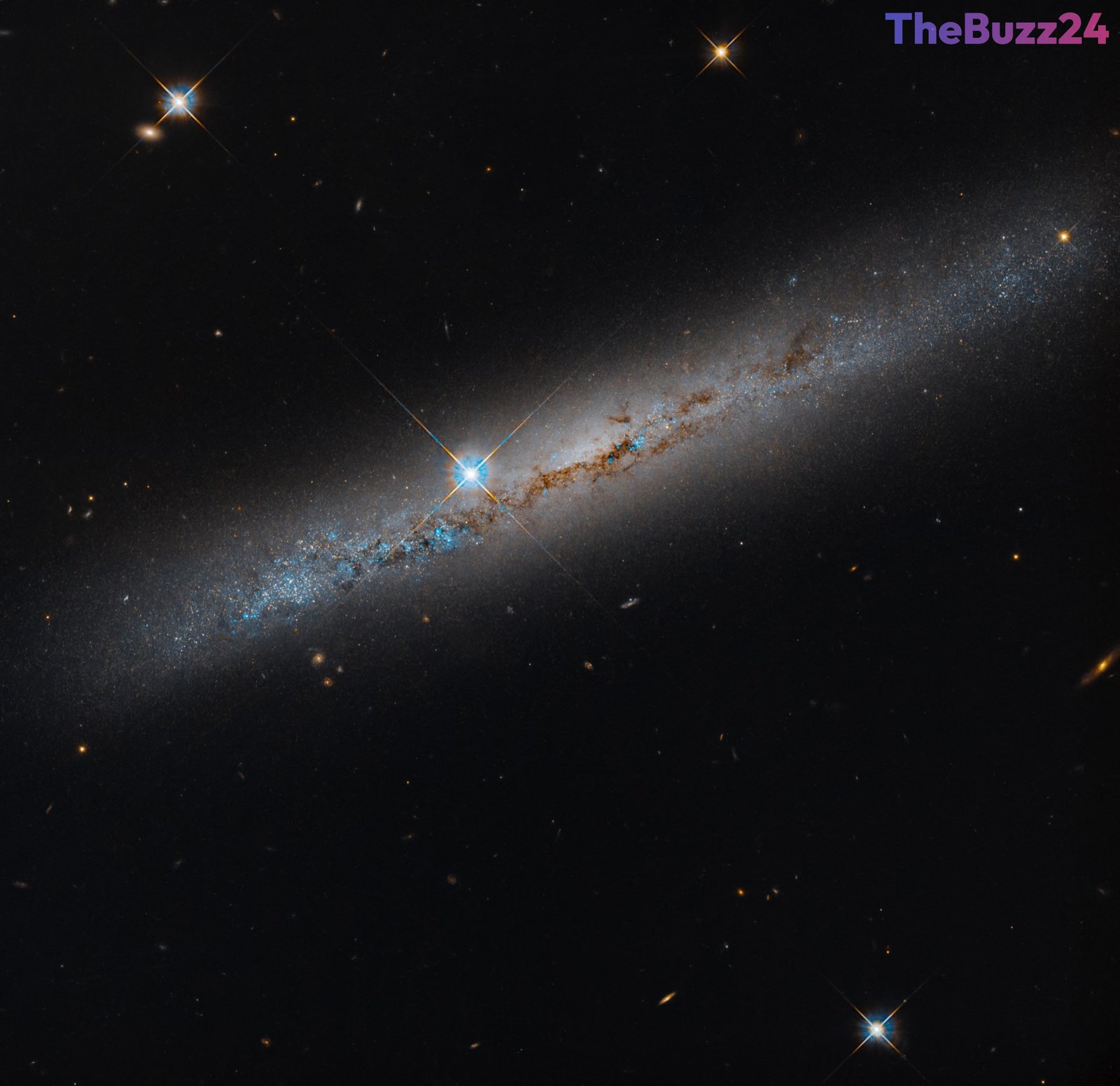
Astronomers have revealed a breathtaking new image captured by the Hubble Space Telescope showcasing the edge-on, intermediate spiral galaxy known as NGC 1827. Situated approximately 37 million light-years away within the constellation Columba, the Dove, the galaxy offers a unique perspective due to its alignment relative to Earth.
The observation is part of an extensive scientific survey aimed at examining 260 satellite galaxies distributed around 22 Milky Way-like host galaxies. This celestial neighborhood extends within a radius of roughly 32 million light-years from our own solar system, providing researchers with a robust sample size for comparative studies.
Investigating low-mass galaxies of this nature serves a crucial role in modern astrophysics. These celestial structures allow scientists to rigorously test the predictions of prevailing cosmological models on smaller scales, an area where current theoretical frameworks often struggle to align with empirical observations.
Key Takeaways
- The Hubble Space Telescope has captured a detailed image of the spiral galaxy NGC 1827.
- NGC 1827 is positioned edge-on and is located 37 million light-years away in the constellation Columba.
- The observation is part of a larger survey studying 260 satellite galaxies to test cosmological models.
Editor’s Analysis & Impact
The ongoing survey utilizing the Hubble Space Telescope to observe low-mass satellite galaxies represents a critical step forward in addressing the persistent discrepancies in modern cosmological models. While large-scale structures of the universe are mapped with increasing precision, small-scale dynamics frequently yield observational anomalies that theorists struggle to explain. By gathering high-resolution data on galaxies like NGC 1827, researchers can refine simulations of dark matter behavior and galaxy formation. Over the coming years, combining these optical observations with data from newer instruments will likely yield breakthroughs in our understanding of how dwarf galaxies evolve within the gravitational influence of larger host galaxies, ultimately bridging the gap between theoretical physics and empirical astronomy.
Frequently Asked Questions
Q: What is the galaxy NGC 1827 and where is it located?
A: NGC 1827 is an intermediate spiral galaxy viewed edge-on, located roughly 37 million light-years away from Earth in the constellation Columba, the Dove.
Q: Why are astronomers studying low-mass galaxies like NGC 1827?
A: Low-mass galaxies are studied because they help scientists test and refine cosmological models on smaller scales, where current theoretical predictions often fail to match real-world observations.
Q: Which telescope captured the new image of NGC 1827?
A: The image was captured by the Hubble Space Telescope as part of a targeted survey of satellite galaxies surrounding Milky Way-like host galaxies.
AI Disclosure: This article is based on verified data and official reports. Our Team and AI have cross-referenced every financial detail with primary sources to ensure total accuracy.
More from this Category