Around-the-Clock Trading: Analyzing the Premiums, Liquidity Gaps, and Growth of Tokenized Equities
The global market capitalization for tokenized equities has surged past the $3 billion threshold, driven by increasing investor demand for continuous, on-chain exposure to traditional stock prices. Platforms and issuers such as xStocks, Ondo Tokenized Stocks, and bStocks have expanded access, allowing international investors to track U.S. equities outside of standard trading hours. Despite reaching billions in valuation, spot trading volumes for tokenized equities remain comparatively modest against their perpetual swap counterparts on decentralized derivatives platforms, which continue to capture significantly higher daily volume.
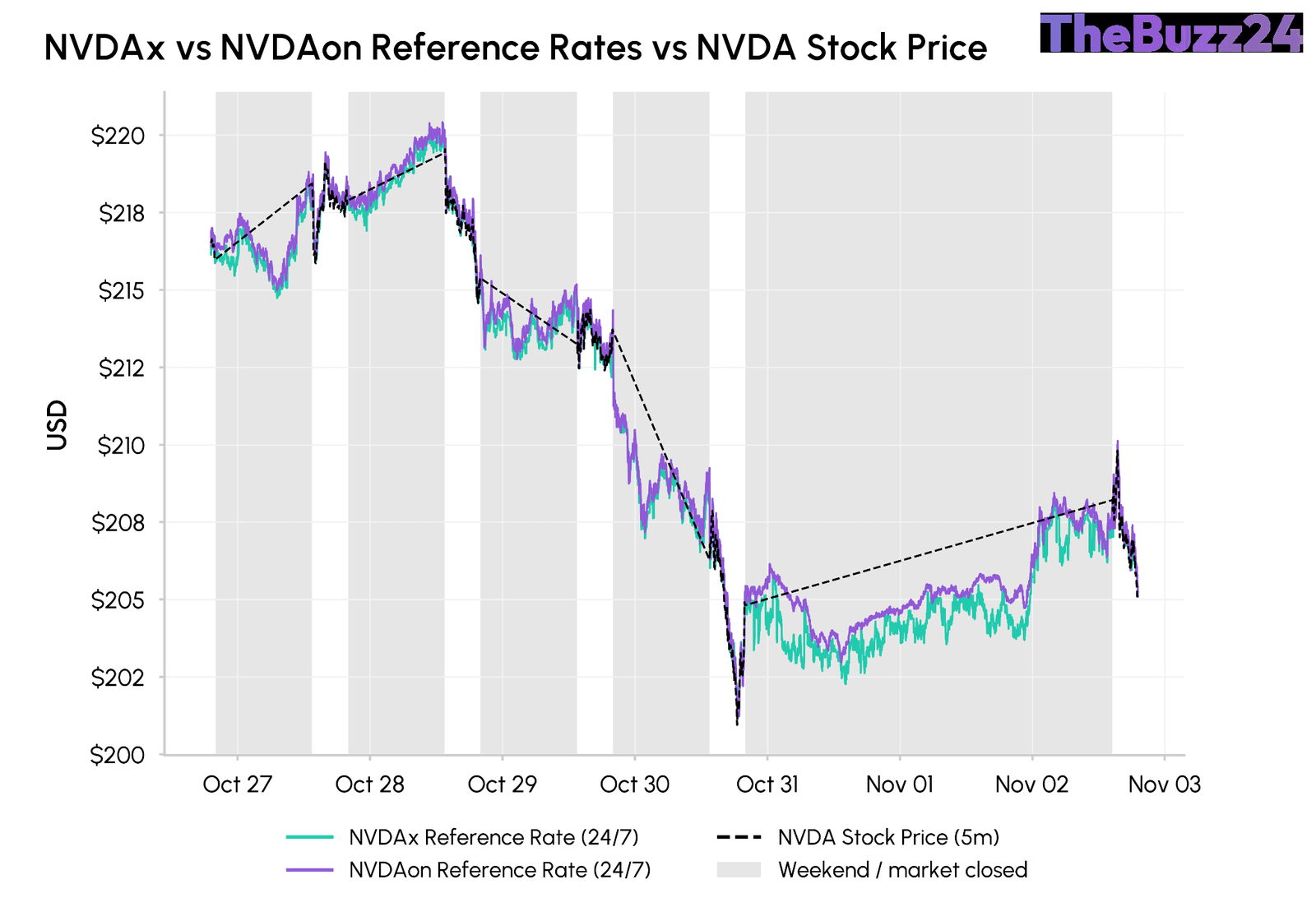
Tokenized shares operate via custodians holding the underlying traditional equities, enabling continuous 24/7 pricing. However, this structure introduces specific trading dynamics and redemption risks for non-whitelisted participants. Market data reveals that popular tokenized variants frequently trade at premiums relative to the underlying assets. For instance, specific Nvidia-linked tokens recorded consistent premiums during market-open hours, while overall liquidity experienced noticeable contractions during traditional market closures. During after-hours and overnight sessions, liquidity depth within the 1% midprice range often drops significantly across major supporting exchanges, occasionally resulting in temporary mispricing across different venues until traditional markets reopen.
Cross-venue execution analyses highlight notable fragmentation across exchanges offering these assets. Pricing and execution costs, including slippage, vary widely depending on the chosen platform and the trade size. While smaller orders find deep liquidity across a diverse array of platforms, larger block trades are typically optimized on a select few dominant exchanges. Furthermore, variations among different tokenized variants of the same underlying asset indicate that execution efficiency heavily depends on both the issuer and the venue. Although these fragmented prices can theoretically present arbitrage opportunities, prevailing spreads and slippage costs often neutralize potential gains after factoring in standard trading fees.
Key Takeaways
- The total market capitalization of tokenized equities has surpassed $3 billion, driven by international demand for continuous on-chain exposure.
- Tokenized stocks often trade at distinct premiums compared to underlying traditional shares, experiencing liquidity contractions during closed market hours.
- Cross-venue execution costs and price discrepancies vary significantly based on trade size, exchange fragmentation, and the specific token issuer.
Editor’s Analysis & Impact
The rapid expansion of tokenized equities marks a pivotal bridge between traditional financial markets and blockchain infrastructure, offering continuous price discovery and broader international access to U.S. assets. However, the current market structure reveals critical challenges, notably fragmentation across exchanges and liquidity thinning during off-hours. While the concept of a 24/7 stock market appeals to modern investors, the persistence of trading friction, slippage, and redemption risks underscores that the ecosystem is still in a nascent growth phase. As institutional adoption matures and cross-venue data standardization improves, these liquidity gaps are likely to narrow, potentially transforming how global investors interact with traditional equity assets.
Frequently Asked Questions
Q: What are tokenized equities?
A: Tokenized equities are blockchain-based digital assets that provide price exposure to traditional stocks, such as U.S. equities, allowing non-U.S. investors to trade them around the clock.
Q: Why do tokenized stock prices vary across different exchanges?
A: Exchange fragmentation causes pricing discrepancies and varying liquidity depths across platforms, meaning the same tokenized stock can trade at slightly different prices depending on where the order is executed.
Q: Do tokenized stocks trade continuously?
A: Yes, tokenized equities trade 24/7, though the majority of volume and highest liquidity typically concentrate around traditional U.S. market open and close hours.
AI Disclosure: This article is based on verified data and official reports. Our Team and AI have cross-referenced every financial detail with primary sources to ensure total accuracy.
More from this Category