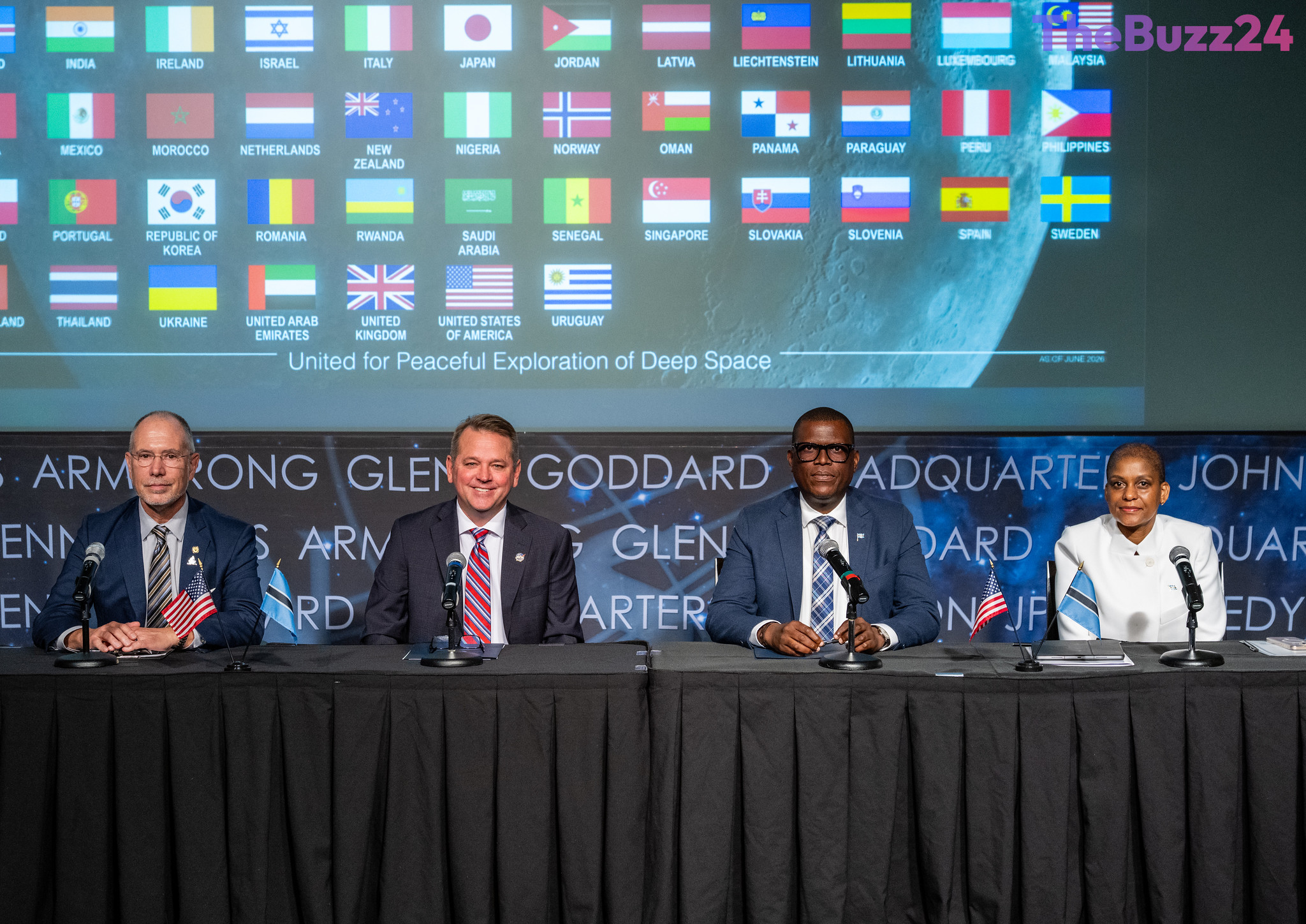
Botswana Joins Global Coalition for Sustainable Space Exploration
The Republic of Botswana has officially become the 68th nation to sign the Artemis Accords, marking a significant expansion of international cooperation in space exploration. The signing ceremony, held at the NASA headquarters in Washington, D.C., solidifies Botswana’s commitment to the peaceful, transparent, and sustainable use of outer space alongside a growing coalition of global partners.
Representing Botswana, Minister of Communications and Innovation David Tshere signed the agreement, joined by U.S. officials including NASA Deputy Administrator Matt Anderson and Senior Advisor for Space Gregory Autry. The move establishes Botswana as the sixth African nation to join the Accords, reinforcing the continent’s increasing role in the future of lunar and deep-space missions. This partnership is built upon a foundation of long-standing collaboration, dating back to Botswana’s early involvement in satellite-based Earth observation programs in the 1970s and the successful launch of its first satellite, Botswana Satellite 1, in 2025.
By signing the Accords, Botswana pledges to adhere to a set of practical principles designed to ensure safe and responsible space activities. These include commitments to transparency, the sharing of scientific data, the preservation of historical space artifacts, and the provision of emergency assistance to other nations. As NASA continues to advance its Artemis program, the inclusion of diverse international partners like Botswana is viewed as a critical step toward establishing a sustainable framework for human exploration of the Moon, Mars, and beyond.
Key Takeaways
- Botswana has become the 68th signatory to the Artemis Accords and the sixth African nation to join the initiative.
- The agreement commits the nation to principles of peaceful, transparent, and sustainable space exploration, including data sharing and emergency assistance.
- The partnership builds on Botswana's history of satellite technology, including the 2025 launch of its first Earth observation satellite.
Editor’s Analysis & Impact
The addition of Botswana to the Artemis Accords underscores the strategic importance of ‘space diplomacy’ in the current geopolitical landscape. As the race to the Moon and Mars intensifies, NASA is effectively building a coalition that prioritizes a rules-based order for space operations. For emerging space nations, these Accords provide a structured pathway to participate in global scientific advancements and gain access to international expertise. The broader implication is the normalization of space as a collaborative, rather than purely competitive, domain. As more nations join, the Accords are becoming the de facto international standard for civil space conduct, which will likely influence future commercial and governmental regulations regarding lunar resource extraction and orbital traffic management. This trend suggests a future where space exploration is defined by multilateral alliances that bridge the gap between established space powers and developing nations.
Frequently Asked Questions
Q: What are the Artemis Accords?
A: The Artemis Accords are a set of non-binding principles designed to guide civil space exploration and use in the 21st century, focusing on safety, transparency, and the sustainable use of space.
Q: Why is Botswana's participation significant?
A: Botswana's participation is significant as it represents the growing influence of African nations in the global space sector and strengthens the international framework for responsible space exploration.
AI Disclosure: This article is based on verified data and official reports. Our Team and AI have cross-referenced every financial detail with primary sources to ensure total accuracy.
More from this Category