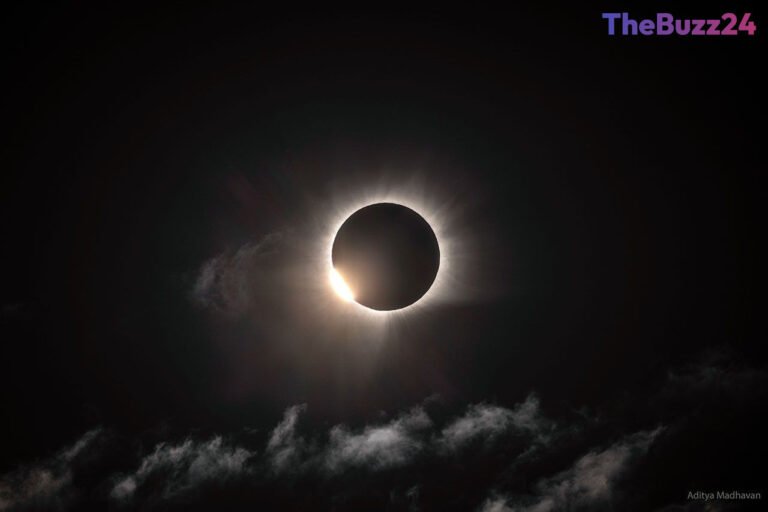
Skygazers in northern Spain were treated to a spectacular celestial event on August 12, 2026, as the Moon aligned perfectly with the Sun, casting a shadow across the Earth. This rare total solar eclipse provided a fleeting opportunity for those within the path of totality to witness the Sun’s ethereal outer atmosphere, known as the corona, for a brief but breathtaking period.
The dramatic event was captured in a composite image taken from San Millán de los Caballeros, a town situated south of León in northwestern Spain. Amidst a field of sunflowers, the progression of the eclipse was documented, highlighting the unique alignment. Northern Spain, along with select regions of Greenland and Iceland, represented some of the few landmasses fortunate enough to lie within the eclipse’s path of totality.
As sunset approached, the Moon’s darkest shadow, the umbra, traversed Spain. In León, the partial phase of the eclipse commenced in the late afternoon, culminating in totality around 8:28 p.m. local time, lasting approximately two minutes. This occurred just moments before the Sun dipped below the horizon. Further east, the Sun had already set before the eclipse concluded. During the period of totality, a striking solar prominence, a luminous loop of plasma, was visible extending from the Sun’s corona, showcasing the dynamic nature of our star.
These astronomical phenomena offer valuable scientific opportunities. NASA utilized the event to study the Sun and Earth’s atmosphere. High-altitude jets were deployed to capture images of the corona in various light spectrums, while scientific balloons were launched to measure atmospheric changes caused by the Sun’s temporary obscuration. Although the path of totality was geographically limited, a partial eclipse was observable across much of Europe, parts of Africa, Canada, and the United States, providing a wider audience with a glimpse of this cosmic dance.
Key Takeaways
- A total solar eclipse occurred on August 12, 2026, with northern Spain within the path of totality.
- The event allowed for observation of the Sun's corona and solar prominences.
- NASA conducted scientific research using high-altitude jets and balloons during the eclipse.
Editor’s Analysis & Impact
The August 12, 2026, total solar eclipse served as a significant astronomical and scientific event, particularly for regions like northern Spain. Such eclipses, while rare in specific locations, provide invaluable opportunities for researchers to study the Sun’s corona and its influence on Earth’s atmosphere. The data collected can enhance our understanding of solar activity, space weather, and atmospheric dynamics. The limited path of totality underscores the importance of precise astronomical predictions and the global interest these events generate, often spurring tourism and scientific collaboration. The next major total solar eclipse in 2027, crossing North Africa and the Middle East, will undoubtedly continue this trend of scientific inquiry and public fascination.
Frequently Asked Questions
Q: What is a total solar eclipse?
A: A total solar eclipse occurs when the Moon passes directly between the Sun and Earth, completely blocking the Sun's face for a short period. This allows the Sun's outer atmosphere, the corona, to become visible.
Q: Where was the path of totality for the August 12, 2026 eclipse?
A: The path of totality for the August 12, 2026, total solar eclipse primarily crossed parts of northern Spain, Greenland, and Iceland.
Q: What scientific research was conducted during the eclipse?
A: During the eclipse, scientists used high-altitude jets to image the Sun's corona and launched balloons to measure changes in Earth's atmosphere as the Sun was temporarily blocked.