Capturing the Cosmic Swirl: The Fascinating Dynamics of Sh2-188
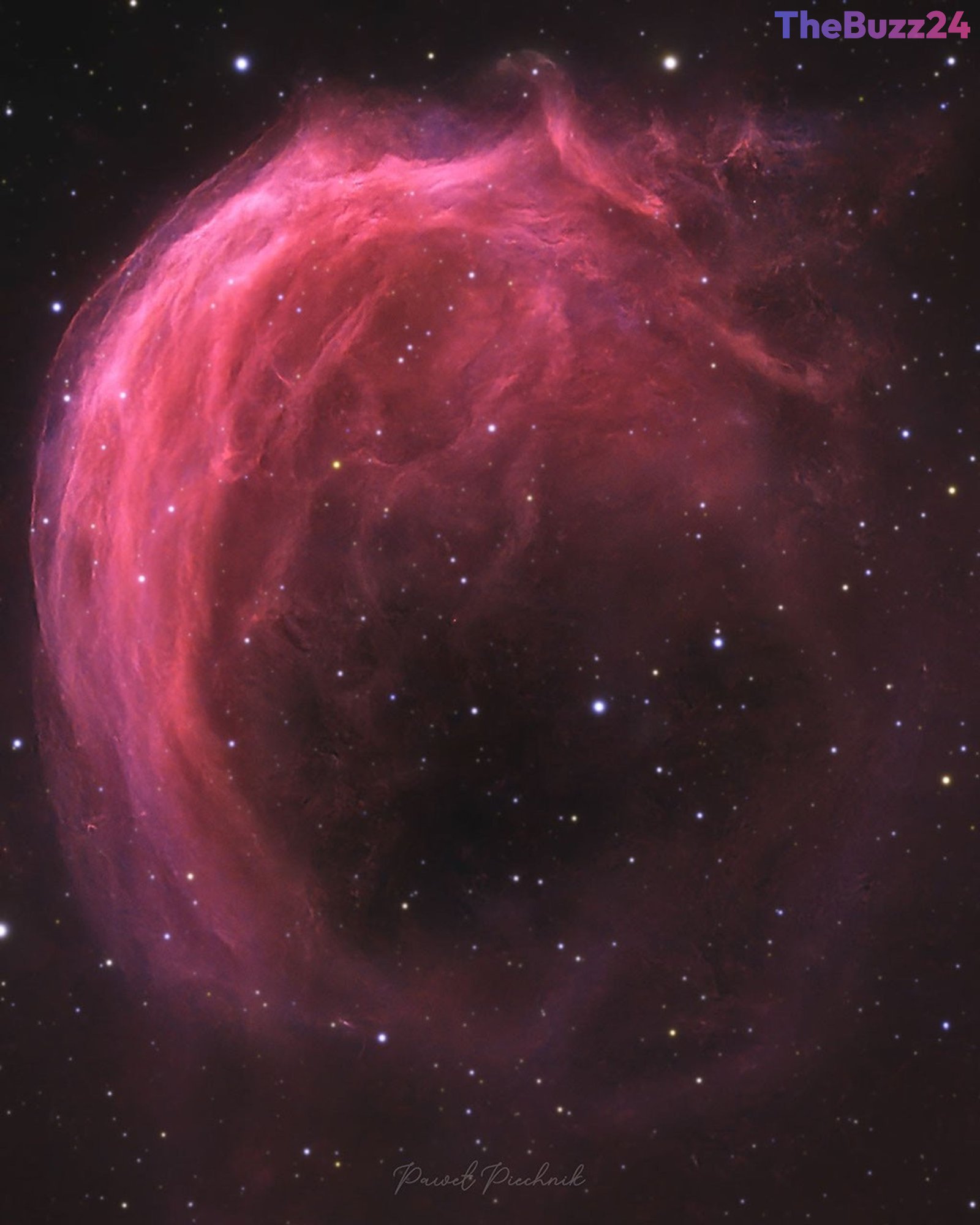
Astronomers and astrophotography enthusiasts have turned their attention to the remarkable planetary nebula known as Sh2-188, often referred to as the Shrimp Nebula. Spanning an angular size of about half the diameter of the Moon, this celestial formation stands out as one of the larger planetary nebulas visible in the night sky. The distinctive swirling structure and overall appearance of the nebula are primarily attributed to its high-speed movement through interstellar space.
at the heart of Sh2-188 lies a white-dwarf core, which is the dense remnant of a Sun-like star that previously shed its outer atmospheric layers. This stellar core is hurtling through space at an unusually fast velocity, generating a distinct bow shock that is prominently visible on its upper edge. This phenomenon closely mirrors the wake left behind a boat plowing through water, as the rapid motion compresses and brightens surrounding gas.
Recently, detailed astrophotography captured from a backyard setup in Krakow, Poland, brought out the faint yet intricate details of the Shrimp Nebula. By imaging in the specific light emissions of hydrogen, sulfur, and oxygen, and subsequently applying digital adjustments, astrophotographers were able to closely approximate the natural, true-to-life colors of this expansive cosmic marvel.
Key Takeaways
- Sh2-188, known as the Shrimp Nebula, is one of the larger planetary nebulas visible in the night sky by angular size.
- The nebula's unique bow shock is created by a white-dwarf core moving at an unusually fast velocity through interstellar space.
- Recent detailed imaging utilizing specific hydrogen, sulfur, and oxygen light filters successfully captured the true colors of the nebula.
Editor’s Analysis & Impact
The continuous advancement of amateur astrophotography equipment and digital processing techniques has bridged the gap between professional observatories and backyard astronomers. Capturing faint celestial objects like the Shrimp Nebula (Sh2-188) demonstrates how technological democratization in telescopes and narrow-band imaging allows for high-fidelity scientific observation from urban and suburban environments. As consumer-grade gear continues to improve, public engagement with astronomy and deep-space imaging is expected to surge, fostering greater appreciation and amateur contributions to astronomical documentation.
Frequently Asked Questions
Q: What is Sh2-188?
A: Sh2-188, commonly called the Shrimp Nebula, is a large planetary nebula in the night sky featuring a unique swirling structure caused by high-speed movement.
Q: What causes the bow shock in the Shrimp Nebula?
A: The bow shock is created by the nebula's central white-dwarf core—the leftover remnant of a Sun-like star—traveling unusually fast through interstellar space and compressing surrounding gas.
Q: How large does Sh2-188 appear from Earth?
A: By angular size, the Shrimp Nebula spans about half the diameter of the Moon.
AI Disclosure: This article is based on verified data and official reports. Our Team and AI have cross-referenced every financial detail with primary sources to ensure total accuracy.
More from this Category