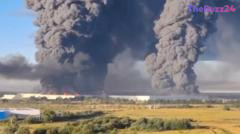
Deadly Drone Strikes Target Major Russian Logistics Hubs
A series of coordinated drone strikes has targeted two major warehouses operated by Wildberries, Russia’s largest online retailer, resulting in at least eight fatalities and dozens of injuries. The attacks, which occurred overnight, struck facilities in the Tambov region and Elektrostal, near Moscow, causing massive fires and significant structural damage to the logistics centers. Local officials reported that emergency services were deployed to manage the aftermath as workers fled the burning buildings.
Ukrainian leadership confirmed the operation, characterizing the warehouses as critical logistics nodes that have been utilized to facilitate the supply of sanctioned components, including navigation equipment and parts for drone production. The strikes are being framed by Kyiv as a strategic response to ongoing Russian military actions against Ukrainian civilian infrastructure and urban centers. In addition to the warehouse strikes, reports indicate that Ukrainian forces targeted oil facilities and maritime assets in the Black Sea and Sea of Azov regions.
Wildberries, a retail giant often compared to Amazon, has faced significant operational disruption following the incident. Company leadership described the event as a devastating blow to their workforce and operations. While Russian regional governors reported that dozens of incoming drones were intercepted by air defense systems, the successful strikes have highlighted the increasing vulnerability of Russia’s domestic logistics and energy infrastructure to long-range aerial attacks.
Analysts suggest that the targeting of such facilities serves a dual purpose: disrupting the flow of dual-use goods to the Russian military and exerting economic and psychological pressure on the Russian home front. As the conflict continues, the shift toward targeting logistics and energy supply chains marks a significant escalation in the scope of the war, with both sides increasingly focused on degrading the other’s industrial and economic capacity to sustain military operations.
Key Takeaways
- Eight people were killed and over 60 injured in drone strikes on two major Wildberries warehouses in Russia.
- Ukraine claims the targeted facilities were being used to supply military-grade components and drone parts for the Russian war effort.
- The strikes are part of an intensified campaign by Ukraine to disrupt Russian logistics and energy infrastructure, which Kyiv views as legitimate military targets.
Editor’s Analysis & Impact
The targeting of Wildberries warehouses represents a strategic evolution in the conflict, moving beyond frontline military engagements to the disruption of the Russian ‘dual-use’ supply chain. By striking a major logistics hub, Ukraine is attempting to bridge the gap between battlefield operations and the domestic economy that sustains them. The broader implication is a heightened risk for Russian commercial infrastructure, which may now be viewed as legitimate military targets if they facilitate the movement of sanctioned goods. This creates a challenging environment for Russian businesses, potentially leading to increased insurance costs, supply chain fragmentation, and a heightened sense of insecurity among the civilian workforce. As Ukraine continues to leverage long-range drone technology, the Russian government faces the difficult task of balancing the protection of its vast industrial base with the demands of its ongoing military campaign.
Frequently Asked Questions
Q: Why did Ukraine target Wildberries warehouses?
A: Ukraine stated that these facilities were being used to store and distribute sanctioned components, including navigation equipment and parts for drone production, which directly support the Russian military.
Q: What is the significance of the Wildberries strikes in the context of the war?
A: The strikes signal a shift toward targeting the logistics and supply chains that support the Russian war effort, aiming to degrade both the military's operational capacity and the economic stability of the country.
AI Disclosure: This article is based on verified data and official reports. Our Team and AI have cross-referenced every financial detail with primary sources to ensure total accuracy.
More from this Category