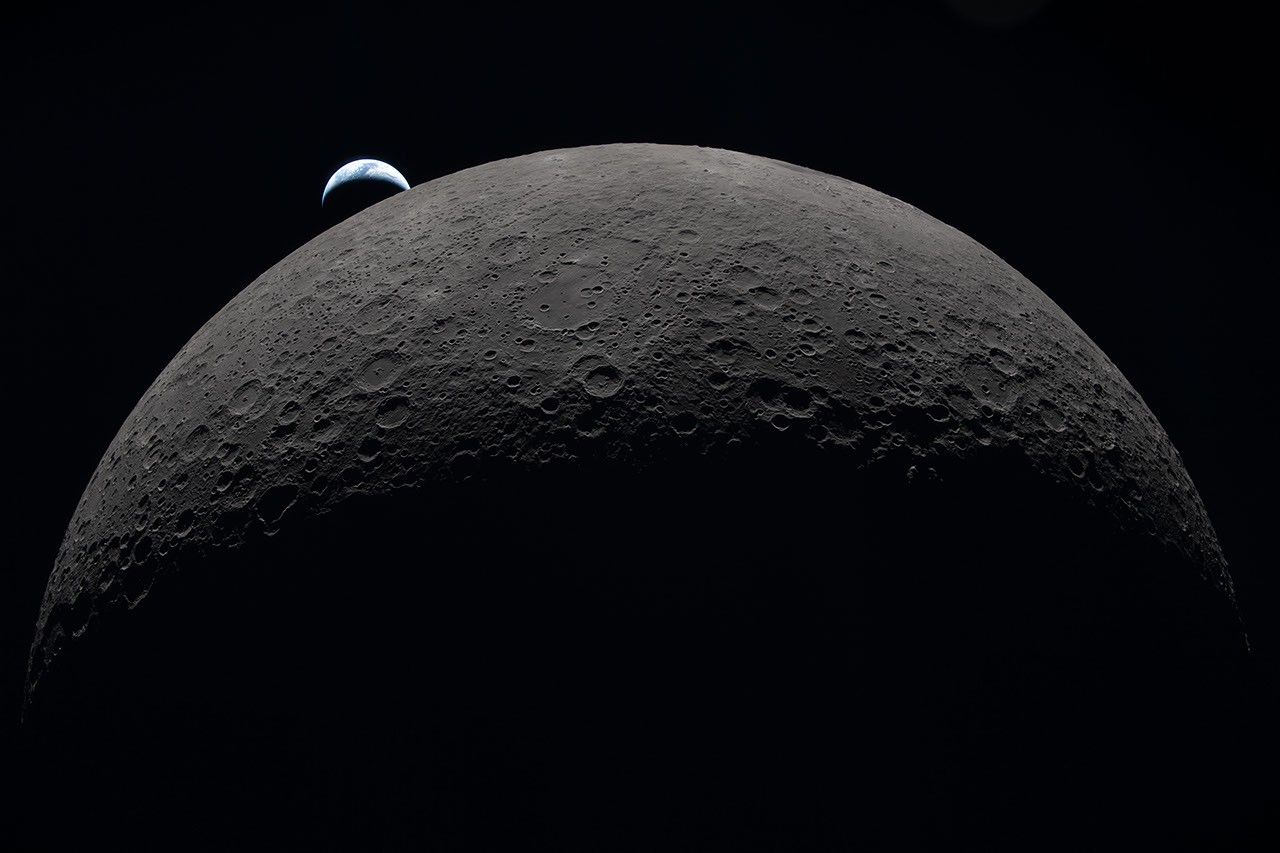
Artemis II Crew Shares Historic ‘Earthset’ View from Lunar Far Side
As the Artemis II mission approaches the final stages of its 10-day lunar expedition, the crew has transmitted a remarkable series of images that offer a rare perspective of Earth from deep space. Among the most notable captures is a stunning ‘Earthset,’ a visual phenomenon where the planet appears to descend beneath the jagged, cratered horizon of the Moon. This image serves as a modern counterpart to the iconic ‘Earthrise’ photograph captured by the Apollo 8 mission nearly 60 years ago.
The photograph, recorded on April 6, 2026, depicts a crescent Earth partially illuminated against the dark backdrop of space, with the vibrant blues of the Oceania region and distinct cloud patterns standing out against the lunar surface. The image was secured while the Orion spacecraft was positioned behind the far side of the Moon, a vantage point that allowed the crew to document the intricate geological features of the lunar landscape, including deep basins and ancient impact craters.
Beyond the Earthset, the Artemis II crew has utilized their seven-hour flyby to compile a comprehensive collection of high-resolution imagery. Their documentation includes observations of a total solar eclipse, the subtle glow of nearby planets, and the stark contrast of shadows along the lunar terminator line. The mission is currently on track to conclude its journey on April 10, 2026, with a controlled splashdown in the Pacific Ocean off the coast of California.
Key Takeaways
- The Artemis II crew successfully captured a rare 'Earthset' image while navigating the far side of the Moon.
- The mission's high-resolution photography includes documentation of a total solar eclipse and detailed lunar surface features.
- The 10-day mission is scheduled to conclude on April 10, 2026, with a splashdown near the California coast.
Editor’s Analysis & Impact
The successful capture of these images by the Artemis II crew represents more than just a public relations milestone; it underscores the significant technological advancements in deep-space imaging and communication since the Apollo era. By providing high-resolution, real-time data from the lunar far side, the mission validates the capabilities of the Orion spacecraft and the Artemis program’s infrastructure. This mission serves as a critical precursor to future crewed lunar landings and long-term habitation efforts. The ability to maintain stable high-bandwidth data transmission from behind the Moon is a vital step toward establishing a sustainable presence in cislunar space. As humanity looks toward Mars, the operational lessons learned from these flybys will be instrumental in refining navigation, life support, and scientific observation protocols for future interplanetary exploration.
Frequently Asked Questions
Q: What is an 'Earthset' in the context of space exploration?
A: An 'Earthset' occurs when the Earth appears to sink below the horizon of the Moon, a phenomenon visible only from specific vantage points behind the lunar surface.
Q: When is the Artemis II mission expected to return to Earth?
A: The mission is scheduled to conclude on April 10, 2026, with a splashdown off the coast of California.
AI Disclosure: This article is based on verified data and official reports. Our Team and AI have cross-referenced every financial detail with primary sources to ensure total accuracy.
More from this Category